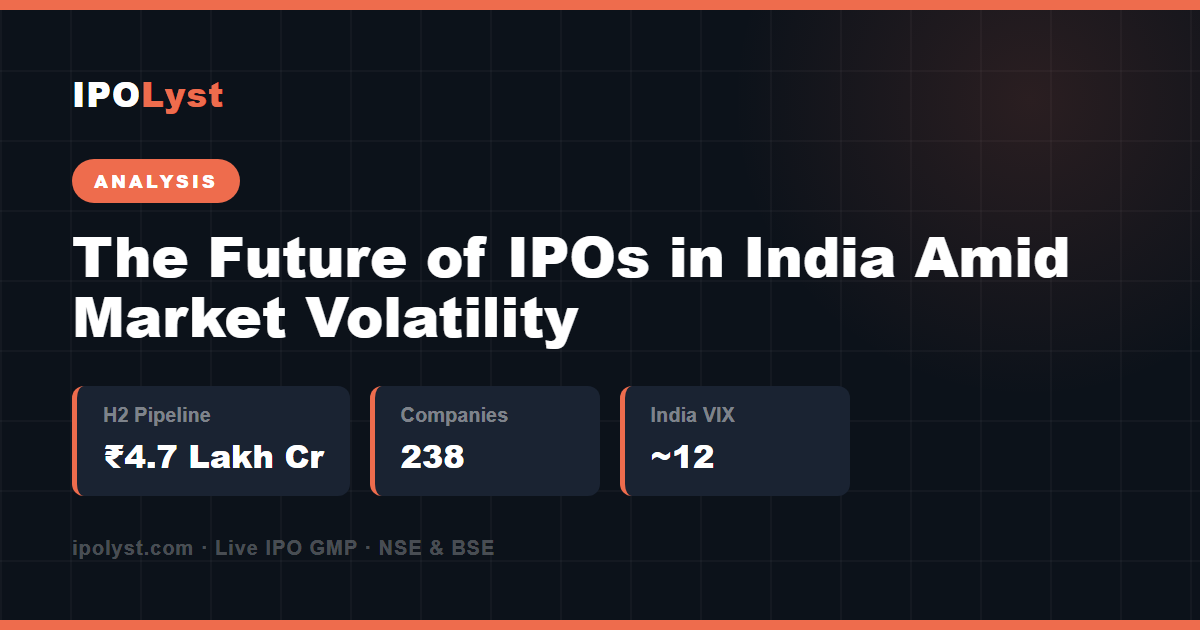
It is one of the strangest contradictions in the Indian market right now. The Sensex and Nifty have been swinging on crude oil shocks and geopolitical headlines — yet behind the scenes, a record-breaking wave of IPOs is lining up to hit the exchanges. As of early July 2026, some 238 companies are in the pipeline, aiming to raise a staggering ₹4.7 trillion in the second half of the year alone. So which signal do you trust: the nervous secondary market, or the confident primary market? Let us break down what market volatility really means for the future of IPOs in India.
The Market Backdrop: Choppy, But Not Panicked
The recent volatility has been real but orderly. The Sensex slipped to around 76,500 in one session — its sharpest single-day fall in months — as rising crude prices and Middle East tensions rattled sentiment. Yet by the week's close it had recovered to roughly 77,700, with the Nifty 50 back near 24,270. This is the pattern of 2026 so far: sharp dips followed by resilient recoveries, rather than a sustained bear market.
Crucially, the India VIX — the market's 'fear gauge' — has actually cooled to around 12, its lowest level since February. Falling volatility even amid scary headlines tells you something important: investors are not panicking, they are repricing. That distinction matters enormously for the IPO market.
The Paradox: Why the IPO Market Is Booming Anyway
Here is the headline number that captures the moment. Despite the choppiness, India's primary market is gearing up for its strongest half-year on record. Investment bankers, including Goldman Sachs and Kotak Mahindra Capital, project 2026 IPO proceeds in the range of $15–25 billion. The H2CY26 pipeline of 238 companies and ₹4.7 trillion is not a sign of a market in trouble — it is a sign of deep, structural demand for equity.
The primary market has shown surprising resilience even when the secondary market wobbled. The reason is simple, and it is the single most important force in Indian equities today: domestic money.
The Domestic Liquidity Engine
For years, Indian markets lived and died by foreign institutional investor (FII) flows. When FIIs sold, the market fell. That relationship has weakened dramatically. Today, a relentless tide of domestic money — driven by monthly SIP (Systematic Investment Plan) contributions running in the tens of thousands of crores — provides a floor under the market that simply did not exist a decade ago.
This domestic liquidity is what lets IPOs keep launching even when global headlines turn ugly. When a quality company opens its issue, mutual funds, insurers, and millions of retail investors are ready to absorb it. Volatility scares traders; it does not scare a 30-year-old investing ₹5,000 a month through an SIP. That structural shift is the real reason the IPO pipeline stays full through the turbulence.
But Volatility Does Leave Its Mark
None of this means volatility is irrelevant to IPOs. It absolutely shapes them — just in more subtle ways than a simple 'markets down, IPOs cancelled' story.
- Slower start to the year: IPO fundraising in the first five months of 2026 was softer than the previous two years, as issuers waited out valuation uncertainty and choppy conditions.
- Pricing discipline: In volatile markets, companies and bankers price issues more conservatively to ensure subscription — good news for investors hunting for value at IPO.
- Timing games: Issuers cluster their launches into windows of calm. A stretch of falling VIX, like the current one, often triggers a rush of filings and openings.
- Choppier listing gains: Grey market premiums (GMP) and listing-day pops become more erratic when the broader market is swinging. A strong GMP can evaporate if the Nifty gaps down on listing morning.
The Mega IPOs That Will Define the Next 18 Months
The pipeline is not just large — it is loaded with landmark names that could reshape India's market-cap tables:
- Reliance Jio — India's largest-ever IPO, targeting roughly ₹35,000–37,700 crore, DRHP already filed
- National Stock Exchange (NSE) — the exchange itself finally going public, one of the most awaited listings in years
- SBI Funds Management — the country's largest asset manager, opening July 14–16, 2026
- PhonePe — the UPI payments giant
- Zepto — the quick-commerce disruptor
- OYO (Oravel Stays) and Avaada Electro — travel-tech and clean-energy plays
These are not thinly-traded small caps riding a hype cycle. They are category leaders. Their arrival will test just how deep India's domestic demand really runs — and each successful mega-listing makes the next one easier.
The Risks You Should Not Ignore
A record pipeline is not a guarantee of easy money. Several headwinds could still disrupt the party:
- Global shocks: A sustained spike in crude oil or an escalation of geopolitical tension in the Middle East could trigger a genuine risk-off wave and push IPOs onto the back burner.
- Stretched valuations: When too many issues chase the same pool of money at premium pricing, listing gains compress and weak IPOs can list below their issue price.
- FII behaviour: While domestic flows dominate, a large, sudden FII exit can still knock the secondary market and sour sentiment during a subscription window.
- Earnings reality check: With Q1 FY27 results underway, disappointing corporate earnings could dent the optimism that keeps the IPO machine running.
What This Means for You as an Investor
So how should a retail investor approach IPOs in a volatile-but-resilient market like this one? A few principles cut through the noise:
1. Volatility is a filter, not a stop sign
Choppy markets separate quality issues from hype. In a raging bull market, almost every IPO pops. In a volatile one, only genuinely strong businesses hold up. That makes your due diligence more valuable, not less.
2. Watch the GMP journey, not just the number
In a swinging market, a single day's grey market premium tells you very little. What matters is the trend — is sentiment building steadily into the listing, or fading? Tracking GMP day by day (as you can on IPOLyst's GMP journey charts) is far more useful than a one-off snapshot.
3. Separate long-term bets from listing-gain punts
If you are applying for a quick listing pop, volatility is your enemy — size your risk accordingly. If you are buying a category leader for the next five years, short-term market swings are noise. Know which game you are playing before you apply.
4. Respect valuation
The single biggest predictor of a disappointing IPO is an expensive one. In a volatile market, overpaying has no margin of safety. Compare the issue's pricing against listed peers before you commit.
The Verdict: A Bright, But Selective, Future
The future of IPOs in the Indian market is, in a word, bright — but it will be selective. The structural story is powerful: a deep domestic investor base, a rising savings-to-equity shift, and a pipeline of genuine category leaders. That foundation is strong enough to keep the IPO market humming through the kind of volatility we are seeing in 2026.
What volatility changes is the winners. Gone are the days when every listing doubled on debut. The market of 2026 rewards quality, punishes over-pricing, and demands that investors do their homework. For the disciplined investor, that is not bad news — it is exactly the environment in which careful IPO selection pays off most.
Track live GMP, GMP journey charts, subscription data, and every upcoming IPO in real time on IPOLyst — so you can navigate the volatility with data, not guesswork.
Disclaimer: This article is for informational and educational purposes only and does not constitute financial advice. IPOLyst is not a SEBI-registered investment advisor. Market data is indicative and subject to change. Please conduct your own research before making any investment decision.