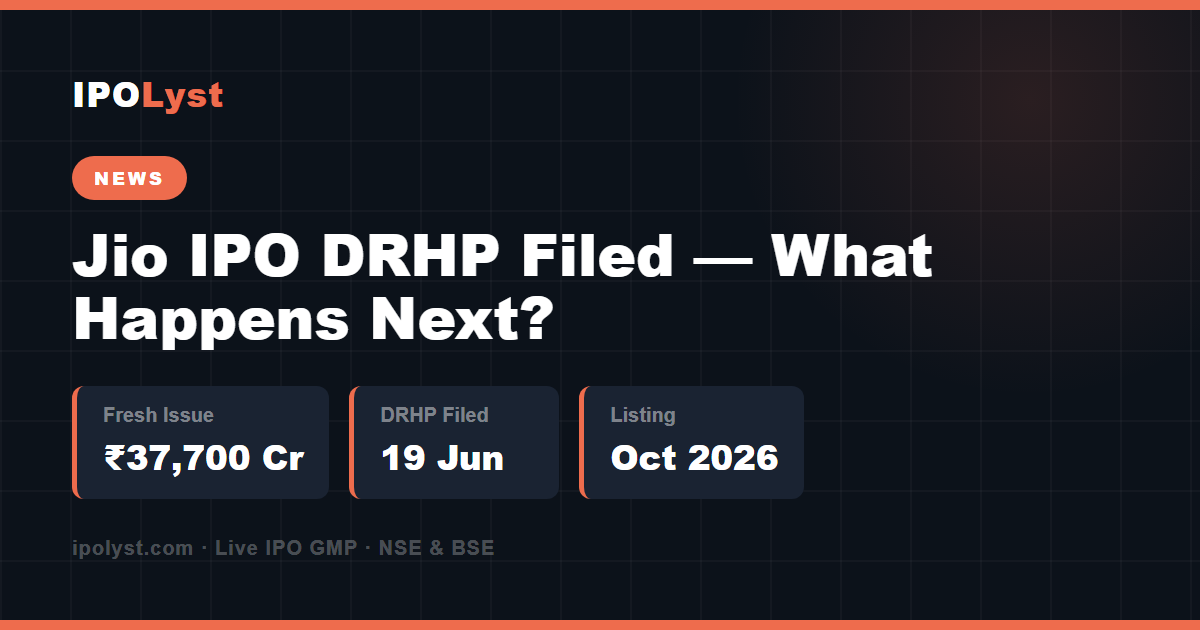
The moment India's capital markets community has been waiting for arrived on June 19, 2026 — Reliance Jio Platforms filed its Draft Red Herring Prospectus (DRHP) with SEBI, formally kicking off the process for what will become India's largest-ever IPO at ₹37,700 crore. Mukesh Ambani announced the filing at Reliance Industries' 49th Annual General Meeting, calling it 'a deeply emotional moment.'
Latest Update — Where This Stands on 28 August 2026
Jio has not received SEBI approval yet, despite a fair amount of coverage implying otherwise. Here is the accurate position as of today.
- SEBI has come back to Jio Platforms seeking clarifications on the DRHP
- No observation letter — the document people mean when they say 'SEBI approval' — has been issued
- No price band, lot size or subscription dates have been announced
- The DRHP remains listed on sebi.gov.in under its June 2026 public issue filings
A request for clarifications is routine. For an issue of this size it would be more surprising if SEBI had none. It is a normal stage of the review, not a setback, and it is the step that comes immediately before an observation letter rather than a substitute for one.
What it does mean is that the timeline has moved. The original expectation of observations by mid-August has passed, so every date downstream of it — price band, subscription, listing — shifts accordingly. The revised estimates in this article reflect that.
But what happens between the DRHP filing and the actual listing? For most retail investors, the IPO process is a black box. Here is a complete, step-by-step breakdown of exactly what happens next — and when you can expect to apply for Jio shares.
Quick Recap — Jio IPO Key Facts
- Company: Jio Platforms Limited (India's largest telecom operator, 470M+ subscribers)
- DRHP Filed: June 19, 2026 with SEBI
- Issue Size: ₹37,700 crore — India's largest ever IPO
- Issue Type: 100% Fresh Issue of 27 crore new equity shares (~2.9% of post-issue equity)
- Valuation: ~$137 billion (₹11.4–13.5 lakh crore)
- Use of Proceeds: ₹27,500 crore for debt repayment; balance for AI & network infra
- RIL Shareholder Quota: Existing Reliance Industries shareholders get a reserved category
Step 1: SEBI Review (Currently Ongoing — 30 to 75 Days)
After a DRHP is filed, SEBI's primary market department reviews the document in detail. SEBI checks for: completeness and accuracy of disclosures, compliance with ICDR (Issue of Capital and Disclosure Requirements) regulations, related-party transactions and conflict of interest disclosures, financial statement audits, and promoter/management background.
SEBI typically issues an 'observation letter' (commonly called SEBI approval, though it is not technically an endorsement) within 30 to 75 days of filing. Before that letter comes, SEBI usually goes back to the company with queries on the draft — which is exactly the stage Jio is at now. Its DRHP was filed on June 19, so it is past the 30-day mark and inside the normal window rather than outside it.
Step 2: Company Responds to SEBI Observations
After receiving SEBI's observations, the company and its investment bankers (Book Running Lead Managers — BRLMs) address each query. For Jio, the BRLMs include top-tier investment banks. The company then files an updated DRHP (U-DRHP) incorporating SEBI's feedback. This process typically takes 2 to 4 weeks.
Step 3: Price Band and Red Herring Prospectus (RHP) Filed
Once SEBI observations are addressed, the company's board meets to finalise the price band. The price band is the range within which investors can bid — for Jio, analysts expect this to reflect the ~$137 billion valuation. The Red Herring Prospectus (RHP), which contains the price band and final IPO dates, is then filed with SEBI and stock exchanges and made public.
The price band cannot be announced until SEBI's observation letter is in hand, so its timing depends entirely on how quickly Jio satisfies the regulator's current queries. If the response and observation letter land through September, a price band in October is realistic. Nothing has been announced, and any specific date you see quoted is an estimate rather than a confirmed schedule.
Step 4: Anchor Investor Allocation (1 Day Before IPO Opens)
The day before the IPO opens for public subscription, the company allocates shares to anchor investors — large institutional investors (mutual funds, insurance companies, foreign institutional investors) who receive guaranteed allotment. The anchor book tells you which institutions believe in the company at the IPO price. A strong Jio anchor book would be a very bullish signal for retail investors.
Step 5: IPO Subscription Window (3 Days)
The IPO opens for public subscription for three working days. This is when retail investors, HNIs, and QIBs submit their bids through their broker or UPI-ASBA. For Jio, given the expected demand, the subscription is likely to be heavily oversubscribed across all categories. The RIL shareholder reserved category will have its own separate bidding mechanism.
Working back from where the process actually stands, a subscription window before late October looks unlikely, and November is the more realistic case if the clarification round runs its normal course. This is an estimate, not a schedule — no dates have been confirmed by Jio, SEBI or the exchanges.
Step 6: Allotment and Listing
After the subscription window closes, shares are allotted (via lottery for oversubscribed retail) within 6 working days. Refunds (or unblocking of UPI mandates) follow the next day. The listing itself happens on Day 7 after close of subscription.
Realistic listing window on current progress: November–December 2026 on NSE and BSE. This has already slipped from earlier estimates once, which is normal for an issue of this size and not a sign of trouble.
What the RIL Shareholder Quota Means for You
Jio's DRHP mentions a reserved category for existing Reliance Industries (RIL) shareholders as of the record date. Historically, shareholder quotas in subsidiary IPOs (like Reliance Retail, if it ever lists) offer improved allotment odds vs. the general retail pool on heavily oversubscribed issues. If you own RIL shares, you may be eligible to apply under this quota in addition to the regular retail category — effectively giving you two bites at the apple.
Jio IPO Timeline Summary
- June 19, 2026: DRHP filed with SEBI
- Aug 2026: SEBI returns with queries on the DRHP (current stage)
- Sep–Oct 2026: Jio responds; SEBI observation letter expected 2–4 weeks after
- Oct–Nov 2026: Price band and RHP, then anchor investor day
- Nov 2026: IPO open for public subscription (3 working days)
- Nov–Dec 2026: Allotment and listing on NSE & BSE
Should You Be Excited About Jio IPO?
Jio is not just a telecom company — it is India's digital infrastructure layer. With 470 million subscribers, the country's largest 5G network, JioCinema, JioFiber, and enterprise AI ambitions, Jio touches every segment of India's digital economy. The 100% fresh issue means all ₹37,700 crore goes into the company to reduce debt and fund future growth — no promoter exit.
The key question for investors: is ₹11–13 lakh crore valuation ($137 billion) fair for a company of Jio's scale and growth? At listing, Jio would rank among the top 10 most valuable listed companies in Asia. For long-term investors, it could be a generational buying opportunity. For short-term traders, the listing gain depends entirely on market conditions at the time.
IPOLyst will track Jio IPO GMP, subscription data, and allotment status in real time as the IPO approaches. Bookmark ipolyst.com and check back as the price band announcement draws near.
Disclaimer: This article is for informational purposes only. IPOLyst is not a SEBI-registered investment advisor. Please conduct your own research before making any investment decision.