Most retail investors compete in the same pool when applying for an IPO — thousands of applicants chasing the same limited retail quota. But there is a lesser-known category that many investors completely overlook: the Shareholder Quota. If you already hold shares in a parent company, you may be eligible for a reserved allotment in its subsidiary's IPO — with far lower competition. Here is everything you need to know.
What Is the Shareholder Quota in an IPO?
When a parent company lists its subsidiary or associate company through an IPO, SEBI allows the company to reserve a portion of shares specifically for existing shareholders of the parent. This reserved category is called the Shareholder Quota or Shareholder Reservation Portion.
The key advantage: this quota is entirely separate from the retail and HNI (Non-Institutional Investor) pools. Because fewer people know about or qualify for it, the competition is significantly lower — meaning your chances of getting an allotment are much higher compared to applying in the retail category.
How Does the Shareholder Quota Work?
Step 1: Check the Record Date
Every IPO with a shareholder quota announces a 'record date' in their Red Herring Prospectus (RHP). You must hold at least 1 share of the parent company in your Demat account as of the record date to qualify. Buying shares after the record date will not make you eligible.
Step 2: Hold at Least 1 Share
SEBI rules typically require a minimum of 1 equity share of the parent company in your Demat account on the record date. Some IPOs may specify a higher minimum holding — always check the RHP or SEBI filing for the exact requirement.
Step 3: Apply Under the Shareholder Category
When the IPO opens for subscription, you will see a separate category option — 'Shareholder' or 'Shareholder Reservation' — on your broker's IPO application screen (Zerodha, Groww, Upstox, etc.). Select this category when applying. If you apply under Retail instead, you will not get the benefit of the reserved quota.
Step 4: Allotment
If applications in the shareholder quota are fewer than the shares reserved, every eligible applicant gets an allotment. If oversubscribed, it follows a lottery similar to the retail category — but because far fewer people apply here, your odds are better.
Which Upcoming 2026 IPOs Have a Shareholder Quota?
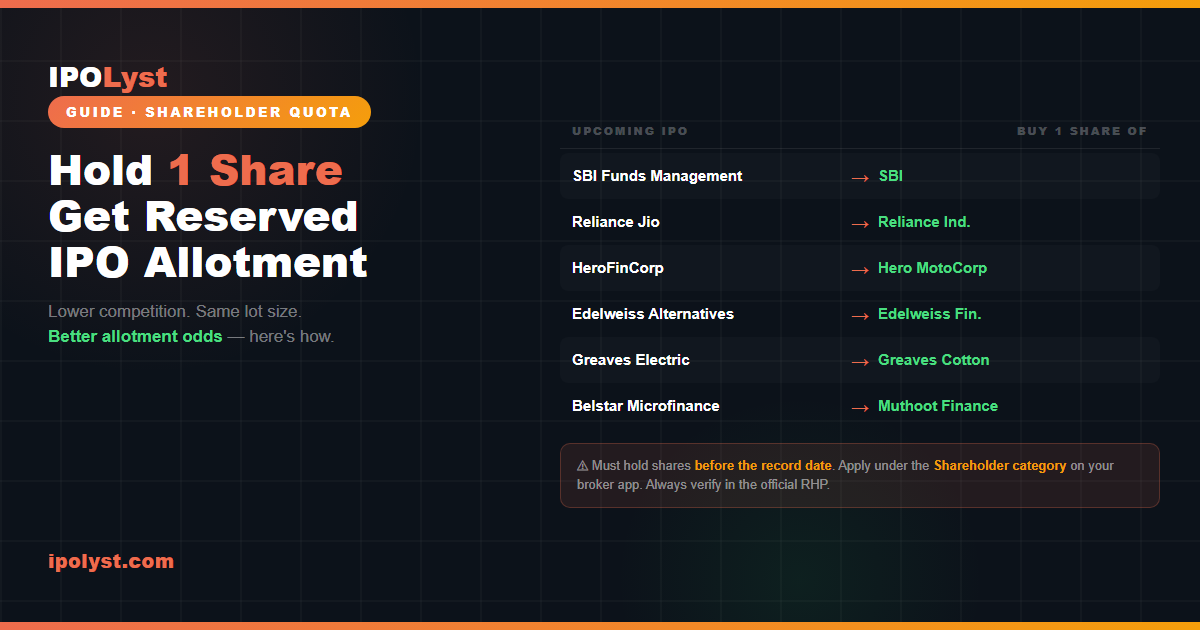
Several high-profile IPOs expected in 2026 are subsidiaries or associates of listed parent companies. Here is the list of upcoming IPOs with an expected shareholder reservation and the corresponding parent company to hold:
- SBI Funds Management IPO → Hold: State Bank of India (SBI)
- Reliance Jio IPO → Hold: Reliance Industries Limited (RIL)
- HeroFinCorp IPO → Hold: Hero MotoCorp Limited
- Edelweiss Alternatives IPO → Hold: Edelweiss Financial Services
- Greaves Electric Mobility IPO → Hold: Greaves Cotton Limited
- Belstar Microfinance IPO → Hold: Muthoot Finance Limited
Note: Always verify the record date and exact eligibility criteria in the official Red Herring Prospectus (RHP) or SEBI filings before purchasing shares. This list is indicative based on current DRHP filings and is subject to change.
How Much Can You Apply For in the Shareholder Quota?
The maximum application limit in the shareholder reservation category is typically the same as the retail category — up to ₹2 lakh per application. Some IPOs with larger shareholder reservation portions may allow higher limits, but ₹2 lakh is the most common cap. Check the specific IPO's prospectus for the exact limit.
Shareholder Quota vs Retail Quota — Key Differences
- Competition: Shareholder quota has significantly fewer applicants → better allotment odds
- Eligibility: Must hold parent company shares on the record date
- Application: Must select the correct 'Shareholder' category on your broker's platform
- Lot size: Usually the same minimum lot size as retail
- Refund: Same T+6 refund cycle if not allotted
Common Mistakes to Avoid
1. Buying shares after the record date
This is the most common mistake. You must hold shares before the record date — not on the IPO open date, not on the close date. The record date can be weeks before the IPO opens. Always check the RHP early.
2. Applying under the wrong category
Even if you hold parent company shares, applying under Retail will put you in the retail pool. You must explicitly select the Shareholder category during application to access the reserved quota.
3. Selling parent shares before the record date
Some investors buy shares of the parent company intending to qualify, but sell them before the record date is confirmed or passes. Hold your shares through the record date to maintain eligibility.
4. Assuming the quota always exists
Not every subsidiary IPO offers a shareholder reservation. The parent company has to specifically include this provision in the DRHP. Always verify in the official documents.
Is the Shareholder Quota Worth It?
For investors who already hold or plan to hold quality large-cap stocks like SBI, Reliance Industries, Hero MotoCorp, or Muthoot Finance — absolutely yes. You get an additional route to IPO allotment with less competition, at no extra cost beyond holding the parent share.
Even if you buy 1 share of the parent company specifically to qualify, the cost is often minimal compared to the potential listing gains from a high-demand IPO. For example, 1 share of Reliance Industries at current market price gives you access to the Reliance Jio IPO shareholder quota — potentially one of the largest and most anticipated IPOs in Indian market history.
How to Track Upcoming IPOs With Shareholder Quota
Keeping track of record dates, IPO timelines, and shareholder quota availability across multiple IPOs can be complex. IPOLyst tracks all upcoming and ongoing IPOs in India — including subscription dates, GMP (grey market premium), allotment dates, and listing details — all in one free platform.
Visit ipolyst.com to track live GMP, IPO dates, and allotment status for all upcoming IPOs including those with shareholder reservation quotas.
Disclaimer
Disclaimer: This article is for informational and educational purposes only and does not constitute financial advice. IPOLyst is not a SEBI-registered investment advisor. Shareholder quota eligibility, record dates, and reservation details are subject to the official Red Herring Prospectus (RHP) of each IPO. Please verify all details from SEBI filings and conduct your own research before making any investment decision.