Every time a big IPO opens, the same question floods investor WhatsApp groups: 'Bhai, GMP kitna hai?' Grey market premium has become the go-to pulse check for retail investors across India. But here is the uncomfortable truth — GMP gets it wrong more often than most people realize, and blindly chasing it has burned thousands of investors. In 2026, with IPO activity at a historic high, understanding what GMP actually tells you (and what it doesn't) is more important than ever.
What Is IPO GMP? A Quick Recap
Grey Market Premium (GMP) is the price at which IPO shares trade informally before they are officially listed on NSE or BSE. It operates entirely outside SEBI's regulatory framework — no exchange, no broker registration, no legal protection. When a stock has a GMP of ₹50 on an issue price of ₹200, the grey market is implying a listing price of ₹250, a 25% gain.
The formula is simple: Expected Listing Price = Issue Price + GMP. The grey market comes alive the moment an IPO opens for subscription and typically stays active until listing day. But the simplicity of the formula hides a far messier reality underneath.
How the IPO Grey Market Actually Works
The grey market is not a single place or platform — it is a loose network of informal dealers and brokers, operating mostly through phone calls, WhatsApp, and local dealer networks concentrated in cities like Ahmedabad, Surat, Mumbai, and Delhi. There is no central exchange, no screen, no official price feed.
Two key instruments operate in this market:
- Kostak Rate: The fixed price a buyer pays for your entire IPO application regardless of whether you receive allotment. If the Kostak rate is ₹500 and you applied for one lot, you receive ₹500 as soon as you sell — even before the allotment process is complete. The buyer takes the allotment risk.
- Subject to Sauda: A conditional deal activated only if you receive allotment. If you are not allotted shares, the deal is cancelled. This is the more common type and forms the basis for what most people track as 'GMP'.
Because these deals are between individual parties with no regulator watching, there is no enforcement mechanism if either side defaults. The entire system runs on trust and reputation within dealer networks.
How Accurate Is GMP? The Data Says '70-75%' — But That Hides the Full Story
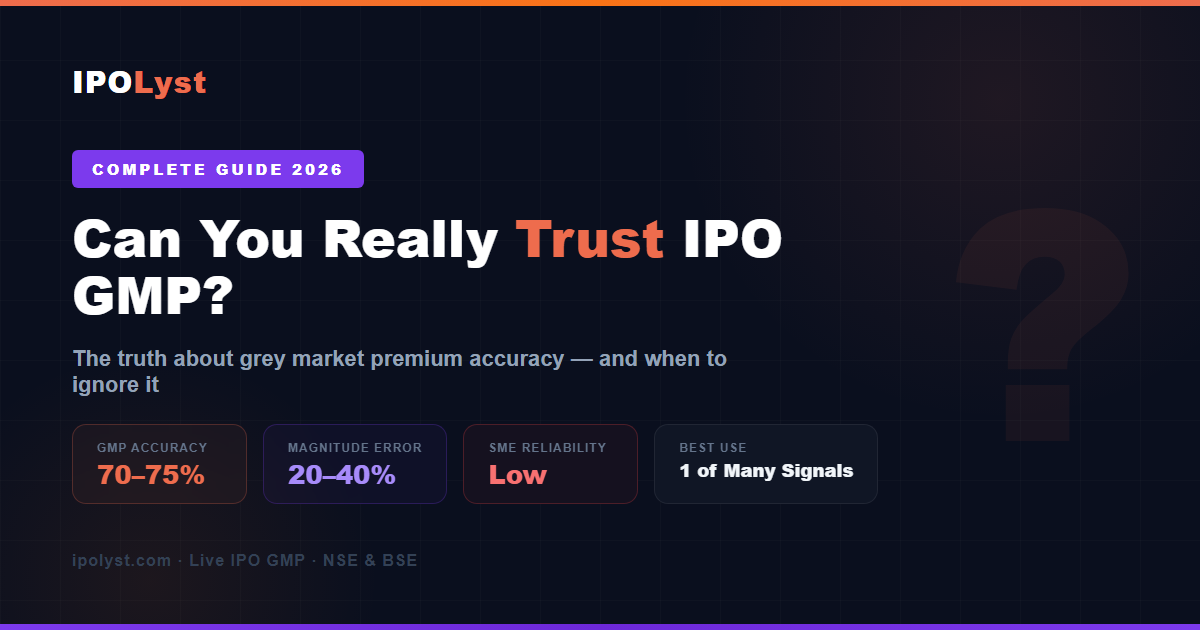
Historical analysis of Indian IPOs from 2020 to 2025 shows that GMP's direction (whether positive or negative) matches the actual listing direction roughly 70 to 75 percent of the time. In other words, when GMP is positive, there is roughly a 3 in 4 chance the IPO lists above its issue price. That sounds reassuring — until you think about the other side of the stat.
One in four IPOs with a positive GMP still lists at a loss. And GMP is notoriously poor at predicting magnitude. Even when GMP is directionally correct, the actual listing gain or loss can be dramatically different from what GMP implied. Studies of listed IPOs show that actual listing prices often deviate by 20 to 40 percent from GMP-implied prices — especially in volatile market conditions.
The relationship between GMP and listing returns is stronger for large mainboard IPOs (correlation close to 0.80) but falls sharply for SME IPOs (often below 0.50), for reasons we will cover shortly.
Famous Times GMP Got It Completely Wrong
Paytm — The Most Painful Example
When Paytm (One97 Communications) launched its ₹18,300 crore IPO in November 2021, grey market participants were bullish. The GMP pointed toward modest listing gains. Instead, Paytm listed at ₹1,950 against an issue price of ₹2,150 — a 9.3% loss on day one — and went on to fall dramatically further. The grey market had completely missed the valuation concerns and institutional selling pressure that crushed the stock.
SME IPOs — Where GMP Manipulation Is Rampant
The SME IPO segment has been a minefield for GMP-driven investors. In 2025, 268 SME IPOs collectively raised over ₹12,000 crore — but a significant percentage of these IPOs saw post-listing crashes despite strong pre-listing GMPs. SEBI has flagged several cases where promoters and operators artificially inflated GMP through circular trading in the grey market, creating artificial demand signals that retail investors mistook for genuine bullishness. Several SME stocks that listed with 30-50% GMP-implied gains were trading at 30-50% below issue price within three months of listing.
Groww — When GMP Was Too Pessimistic
Not all GMP failures are in the bearish direction. Groww (Billdesk parent Razorpay rival Groww — Acko, Zepto are similar cases) surprised investors by listing significantly above its muted GMP, catching grey market shorts off guard. GMP can be just as wrong in underestimating a stock as in overestimating one.
5 Red Flags That Mean You Should Distrust the GMP
- Thin issue size (under ₹500 crore): Smaller issues mean fewer shares circulating in the grey market, making it easier for a handful of operators to move the GMP in either direction.
- SME board IPO with high GMP: SME IPOs have far less institutional oversight than mainboard issues. A 50% GMP on an SME IPO deserves deep skepticism, not excitement.
- GMP spiked suddenly in the last 1-2 days of subscription: Late GMP spikes are sometimes manufactured to boost retail applications in the final window. Natural GMP builds gradually as subscription data comes in.
- GMP is very high but subscription from QIB is low: Institutional investors (QIBs) have access to far more research than grey market dealers. If the QIB portion is undersubscribed while GMP is high, take the institutions' side.
- GMP from only one or two sources: GMP is most reliable when multiple independent dealer networks are quoting similar numbers. If only one website or one WhatsApp group is reporting it, treat it with extreme caution.
Why GMP Is Particularly Unreliable Right Now
In 2025-2026, India's IPO market is at a historic high in terms of activity, with retail investor participation at record levels. This combination creates a feedback loop where high retail enthusiasm pushes GMP higher, which attracts more retail applications, which pushes GMP higher still — entirely disconnected from the IPO's actual fundamentals. When the listing finally arrives and institutional selling kicks in, retail investors holding shares bought on the basis of GMP are left exposed.
SEBI has taken notice. The regulator has been tightening SME IPO norms, increasing scrutiny of underwriters, and investigating suspected GMP manipulation cases. Regulatory risk for the informal grey market is higher in 2026 than at any point in recent memory.
The Right Way to Use GMP in Your IPO Research
None of this means GMP is useless. Used correctly — as one data point among several — it provides a real-time sentiment signal that can complement your fundamental research. Here is how to use it intelligently:
- Treat GMP as sentiment, not prediction: A high GMP tells you the grey market is bullish. It does not guarantee a good listing. It is market psychology, not market reality.
- Cross-check with subscription data: Strong QIB and NII oversubscription combined with healthy GMP is a much stronger signal than GMP alone. If GMP is high but retail is 90% of the subscription, be cautious.
- Track GMP trend, not just the current number: A GMP that has been rising steadily from ₹20 to ₹80 over five days is more meaningful than a GMP that jumped to ₹80 in the final day.
- Ignore GMP for long-term investing: If you are buying an IPO to hold for 1-3 years, GMP is completely irrelevant. It reflects listing-day sentiment only — not the company's 5-year business prospects.
- Use multiple sources: Check IPOWatch, Chittorgarh, and IPOLyst's live GMP tracker to see if quotes are consistent. Diverging quotes across sources are a warning sign.
Our Verdict: Trust GMP, But Verify Everything
GMP is like a weather forecast: directionally useful about 70-75% of the time, but never something you should bet your financial wellbeing on without checking the fundamentals. The biggest mistake Indian retail investors make is using GMP as a substitute for research rather than a supplement to it.
In 2026, with markets richly valued and IPO issuances at record pace, the risk of GMP disappointments is higher than usual. Before applying to any IPO, check the GMP — but also check the company's revenue growth, profit margins, peer valuations, and promoter track record. A strong GMP with weak fundamentals is a trap. Strong fundamentals with a weak GMP might be your best opportunity.
IPOLyst tracks live GMP daily for every mainboard and SME IPO on NSE and BSE. Use it as your starting point — not your ending point.
Disclaimer: This article is for informational purposes only and does not constitute financial advice. IPOLyst is not a SEBI-registered advisor. Please conduct your own research before investing.