Dhoot Transmission Limited — India's dominant wiring harness maker for two-wheelers, three-wheelers, and electric vehicles — has opened its ₹3,067 crore IPO for subscription from August 10 to August 12, 2026. With a 70% market share in EV wiring harnesses, 63% revenue growth over two years, and a GMP already at +28%, this is one of the most closely watched IPOs of August. Here is everything you need to know before applying.
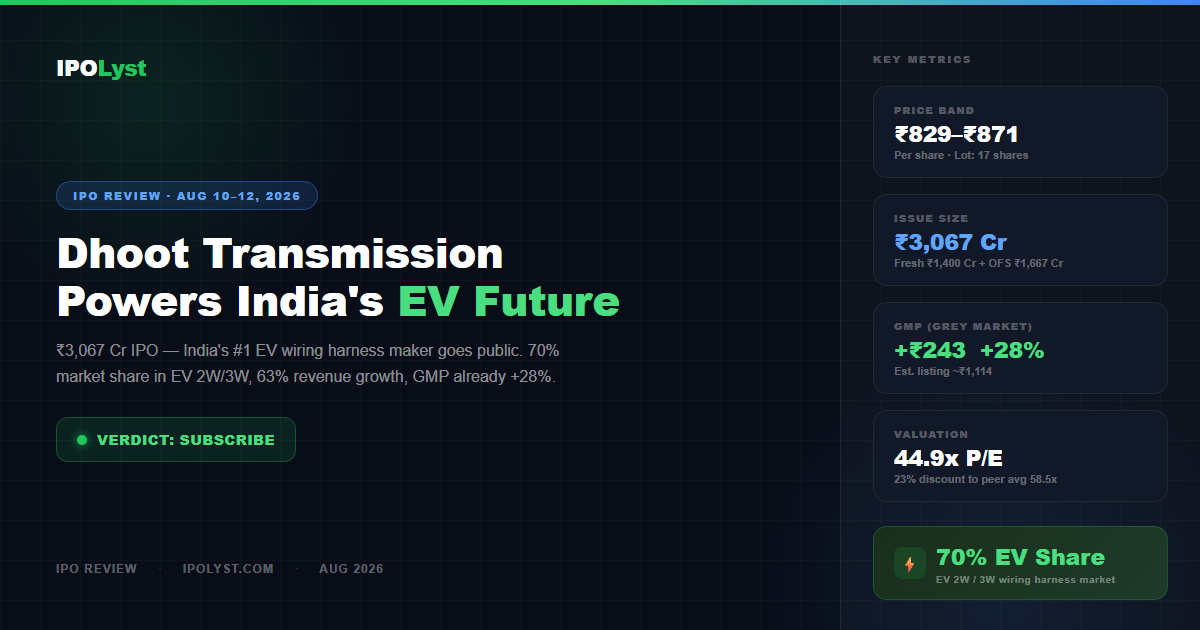
Dhoot Transmission IPO — Key Details at a Glance
- IPO Open Date: August 10, 2026
- IPO Close Date: August 12, 2026
- Allotment Date: August 13, 2026
- Listing Date: August 17, 2026 (NSE & BSE)
- Price Band: ₹829–₹871 per share
- Issue Size: ₹3,066.89 crore
- Fresh Issue: ₹1,400 crore (1.61 crore shares)
- Offer for Sale (OFS): ₹1,666.89 crore (1.91 crore shares — by BC Asia Investments XV & Mangalam Capital)
- Lot Size: 17 shares
- Minimum Investment (Retail): ₹14,807 at upper price band
- Day 1 Subscription: 63% overall — NII fully booked, Retail 74%, QIB 6%
- GMP (Aug 10, 2026): +₹243 per share (~28% premium)
About Dhoot Transmission Limited
Dhoot Transmission Limited, incorporated in April 1998, is one of India's largest manufacturers of wiring harnesses and electrical distribution systems for the automotive sector. The company designs, engineers, manufactures, and supplies wiring harnesses for two-wheelers, three-wheelers, commercial vehicles, off-road equipment, farm vehicles, and — most critically for future growth — electric vehicles.
The company holds approximately 41% market share in India's two-wheeler and three-wheeler wiring harness market. More importantly for investors, Dhoot commands a near-monopolistic 70% market share in electric two-wheeler and three-wheeler wiring harnesses — making it the dominant infrastructure supplier for India's EV revolution at the bottom of the vehicle pyramid.
Dhoot's client roster reads like a who's who of Indian automotive: Bajaj Auto (its largest customer at 31.84% of FY26 revenue), TVS Motor, Honda Motorcycle & Scooter India, Ather Energy, Ola Electric, and several other leading OEMs. With nearly 95% of its automotive portfolio either EV-specific or powertrain-neutral, the company is structurally positioned to win regardless of how fast India's EV transition accelerates.
Why the 70% EV Wiring Market Share Matters
India's electric two-wheeler and three-wheeler market is on a steep growth curve. Government schemes like FAME II and PM E-Drive, combined with falling battery costs and rising fuel prices, are driving rapid EV adoption at the mass-market level — exactly the segment Dhoot dominates.
Wiring harnesses in EVs are significantly more complex and higher-value than their ICE counterparts — more sensors, more data cables, more power management circuits. This means that as the EV mix in Dhoot's customer base rises, the per-unit revenue and margin potential increases. EV-related products already contributed ₹1,093.56 crore to FY26 revenue — approximately 24% of the total — and that share is growing.
For context: Dhoot's EBITDA margin of 15.71% in FY26 is already higher than Minda Corporation (11.66%) and Motherson Sumi Wiring India (9.24%) — two of its listed peers. This margin advantage is partly driven by the higher-value EV wiring harness business.
Financial Performance — Revenue Growing Faster Than Profit
- Revenue FY24: ₹2,797.73 crore
- Revenue FY26: ₹4,563.70 crore (+63% in two years)
- PAT FY24: ₹298.75 crore
- PAT FY26: ₹396.84 crore (+33% in two years)
- EBITDA Margin FY26: 15.71% (down from 18.31% in FY24)
- EV Revenue FY26: ₹1,093.56 crore (~24% of total revenue)
The headline financials tell a story of strong topline growth — 63% revenue increase in two years is exceptional for a manufacturing business of this scale. However, PAT growth at 33% has lagged revenue growth, which means margins are compressing. EBITDA margin declined from 18.31% in FY24 to 15.71% in FY26 — a 260 basis point drop that analysts attribute to rising raw material costs, higher capital expenditure for capacity expansion, and increased employee costs.
The fresh issue proceeds of ₹1,400 crore will be used for capital expenditure — expanding manufacturing capacity to capture the rising EV harness demand. This is a productive use of IPO capital and should support future margin recovery as capacity utilisation improves.
GMP — Grey Market Premium Analysis
As of August 10, 2026 (Day 1 of the IPO), the Dhoot Transmission IPO GMP stands at ₹243 per share — implying an estimated listing price of approximately ₹1,114 against the issue price of ₹871, a 28% premium. This is a strong grey market signal, though investors should note that Day 1 GMP often moderates as subscription progresses and more information enters the market.
Track the latest Dhoot Transmission GMP and all active IPO grey market premiums on ipolyst.com — updated daily throughout the subscription period.
Important: Grey market premiums are unofficial and unregulated. They represent speculative demand in the unlisted market and carry no guarantee of actual listing performance. Use GMP as a directional sentiment indicator, not an investment decision tool.
Valuation — Is the Pricing Attractive?
At the upper price band of ₹871, Dhoot Transmission is priced at approximately 44.9x FY26 post-issue earnings (P/E). This is a premium multiple — but context matters. The listed peer average P/E stands at approximately 58.5x, which means Dhoot is being offered at roughly a 23% discount to peers.
Given Dhoot's stronger EBITDA margins (15.71%) versus Minda Corporation (11.66%) and Motherson Sumi (9.24%), and its dominant EV market position, most brokerages consider the 44.9x P/E to be fair-to-attractive. The question for investors is how much of the future EV growth story is already priced in at this multiple.
Strengths — Why This IPO Has a Strong Case
- Market leader in EV wiring: 70% share in electric 2W/3W harnesses — highest-growth subsegment
- Revenue CAGR of ~27% over FY24–FY26: Consistent compounding at scale
- Margin superiority: 15.71% EBITDA — beats both listed peers in the same segment
- 95% portfolio powertrain-neutral: Wins in ICE and EV scenarios equally
- Productive IPO proceeds: ₹1,400 Cr fresh issue goes entirely into capacity expansion
- Structural tailwind: India's EV two-wheeler market growing at 40%+ annually
- Established OEM relationships: Bajaj, TVS, Honda, Ather, Ola — blue-chip customer base
- Peer discount: ~23% cheaper than listed comparable companies on P/E basis
Risks — What Could Disappoint
- Extreme customer concentration: Top 10 customers = 80.93% of revenue; Bajaj Auto alone = 31.84%
- Margin compression trend: EBITDA declined 260 bps from FY24 to FY26 despite revenue boom
- OFS component is large: ₹1,667 crore exits via promoters — signals partial cash-out
- Dependence on 2W/3W segment: Any slowdown in two-wheeler volumes directly hurts revenue
- Competitive intensity rising: Global players like Sumitomo and Yazaki expanding India presence
- Working capital intensive: Long receivable cycles with OEM customers create cash flow pressure
- Confidential data leak risk: IP exposure flagged in DRHP risk factors
Brokerage Recommendations
Multiple brokerages have initiated coverage with a 'Subscribe' rating on the Dhoot Transmission IPO, citing the company's EV market leadership, peer discount on valuation, and strong revenue trajectory. JM Financial, Sushil Finance, and Rupeezy have all flagged the 23% discount to the peer average P/E as a key reason to apply.
The key caveat from most research notes is customer concentration — with Bajaj Auto contributing nearly one-third of revenue, any disruption in that relationship (such as Bajaj in-sourcing its wiring harness needs or switching suppliers) would be a significant headwind.
Verdict — Should You Apply?
Dhoot Transmission IPO presents a compelling case for investors seeking exposure to India's EV manufacturing supply chain at a reasonable valuation. The 70% EV wiring market share is not easily replicable — building this position requires years of OEM relationships, certifications, and scale. At 44.9x P/E with a 23% discount to peers and stronger margins than both comparable listed companies, the pricing is fair.
For listing gains: The +28% GMP and Day 1 subscription momentum (especially NII fully booked) suggest reasonable listing pop potential. However, QIB participation at just 6% on Day 1 is worth watching — institutional buyers often move late but their absence through close would be a warning sign.
For long-term holding: The EV tailwind is real and multi-year. As India's electric two-wheeler market scales from ~5 million units today toward 15–20 million annually by 2030, Dhoot's wiring harness revenue should scale in proportion. The margin compression story needs to reverse for the stock to re-rate higher.
Our take: Subscribe — both for listing gains (GMP supports this) and for a 2–3 year hold if you believe in India's EV story at the base of the market.
Check Dhoot Transmission allotment status, live subscription numbers, and GMP updates on ipolyst.com — updated throughout the subscription period.
Frequently Asked Questions
What does Dhoot Transmission manufacture?
Dhoot Transmission manufactures wiring harnesses and electrical distribution systems for two-wheelers, three-wheelers, electric vehicles, commercial vehicles, and farm equipment. It holds 41% market share in 2W/3W wiring harnesses and 70% in EV 2W/3W wiring harnesses in India.
What is the Dhoot Transmission IPO price band and lot size?
The Dhoot Transmission IPO price band is ₹829 to ₹871 per share. The lot size is 17 shares. The minimum investment for retail investors at the upper price band is ₹14,807 (17 × ₹871).
What is the Dhoot Transmission IPO GMP today?
As of August 10, 2026, the Dhoot Transmission IPO GMP is approximately ₹243 per share, indicating an estimated listing price of ₹1,114 — a 28% premium over the issue price of ₹871. GMP is unofficial and subject to change daily.
What is the Dhoot Transmission IPO allotment and listing date?
The Dhoot Transmission IPO allotment will be finalised on August 13, 2026. The shares are expected to list on NSE and BSE on August 17, 2026.
Should I apply for the Dhoot Transmission IPO?
Most brokerages recommend 'Subscribe' for Dhoot Transmission IPO citing its EV market leadership, fair valuation at 44.9x P/E (23% discount to peers), and strong revenue growth. Key risk to watch: Bajaj Auto contributes 31.84% of revenue — high customer concentration. This is not financial advice. Please do your own research before investing.
Disclaimer: This review is for informational purposes only and does not constitute financial advice. IPOLyst is not a SEBI-registered advisor. Please conduct your own research before investing.
For a comprehensive view of all active IPOs, their GMP, and subscription status, visit the IPOLyst GMP Tracker — updated daily throughout every subscription window.
Dhoot Transmission's DRHP was filed with SEBI and is publicly available on the SEBI DRHP portal. Investors are encouraged to read the risk factors section before applying.
Once allotment is announced on August 13, 2026, check your Dhoot Transmission allotment status directly on ipolyst.com — results available as soon as the registrar publishes them.
Revenue and PAT figures are sourced from Dhoot Transmission's audited financials as submitted in the DRHP. The company's registrar is KFin Technologies — use their portal to check allotment status post-announcement.
Explore other mainboard IPOs opening this week on our upcoming IPO calendar — Molbio Diagnostics, LAPL Automotive, and LEAP India all close around the same date.
Key financial ratios for context: EBITDA margin 15.71%, Revenue CAGR ~27% (FY24–FY26), P/E ~44.9x (FY26 post-issue), EV/EBITDA approximately 28x. Return on Equity (RoE) for FY26 is approximately 22.4% based on post-IPO equity; this is expected to dilute slightly post-issue as fresh equity is raised. Debt-to-equity ratio is low, making Dhoot's balance sheet relatively clean entering the listing.
Peer comparison note: Minda Corporation trades at ~51x P/E with 11.66% EBITDA; Motherson Sumi Wiring India trades at ~66x P/E with 9.24% EBITDA. Dhoot's 44.9x with 15.71% EBITDA represents the best margin-to-valuation ratio in the listed peer set — the primary reason brokerages are bullish despite the customer concentration risk.