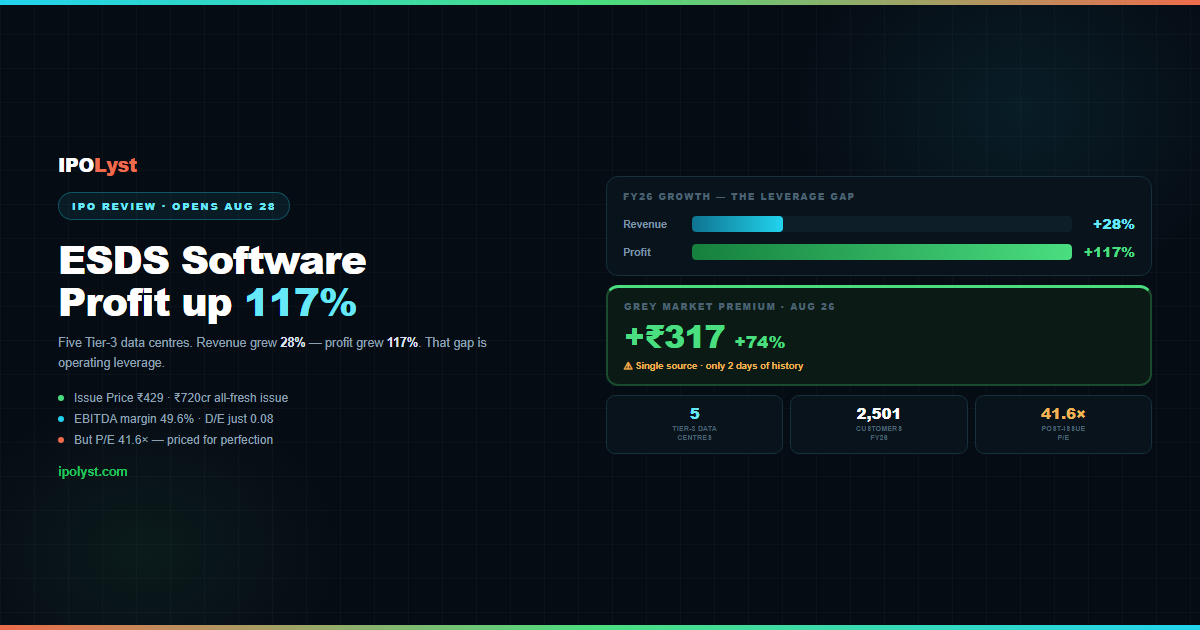
ESDS Software Solution opens on August 28 with a grey market premium of +₹317 (+74%) on an issue price of ₹429 — and a profit line that more than doubled last year. It is one of the more genuinely interesting businesses to come to the mainboard this cycle, and also one where the valuation and the grey market signal both deserve a closer look than the headline numbers invite.
Key IPO Details
- Issue Price: ₹429 per share (upper end of the ₹408–₹429 band)
- Face Value: ₹1 per share
- GMP: +₹317 (+74%) as of August 26, 2026 — single source
- Estimated Listing Price: ₹746
- IPO Opens: Friday, August 28, 2026
- IPO Closes: Tuesday, September 1, 2026
- Allotment: September 2, 2026
- Refund / Demat Credit: September 3, 2026
- Listing Date: September 4, 2026 on BSE and NSE
- Board: Mainboard
- Registrar: MUFG Intime
- Issue Size: approximately ₹720 crore — a 100% fresh issue
What ESDS Software actually does
ESDS Software Solution is a Nashik-headquartered provider of cloud services, managed hosting, data centre infrastructure and enterprise software. It was founded in 1999 and started life as a conventional data centre business selling colocation and managed hosting to Indian enterprises, before moving up the stack into managed cloud and AI-enabled services.
The physical footprint is the part that matters. ESDS runs five Tier-3 data centres — Nashik, Navi Mumbai, Bengaluru, Mohali and Noida — totalling more than 75,266 square feet, with a guaranteed uptime commitment of at least 99.95%. It served 2,501 customers during FY26 and employed 993 people as of June 30, 2026.
A Tier-3 rating means concurrently maintainable infrastructure: redundant power and cooling paths that let the operator service equipment without taking customer workloads offline. For enterprise and government clients with uptime obligations of their own, that certification is often a procurement prerequisite rather than a nice-to-have — which is what makes the physical estate a genuine barrier to entry rather than a commodity.
This matters because it separates ESDS from asset-light software companies that call themselves cloud providers. ESDS owns the buildings, the power and the racks. That is capital intensive, slower to scale, and much harder for a competitor to replicate quickly.
The financials — where this gets interesting
Based on publicly reported figures for FY26 against FY25:
- Revenue: ₹376.64 crore → ₹480.65 crore, up roughly 28%
- Profit after tax: ₹55.61 crore → ₹120.82 crore, up roughly 117%
- EBITDA margin: 49.60%
- PAT margin: 25.59%
- Return on equity: 25.12%
- Return on capital employed: 32.78%
- Debt-to-equity: 0.08
The headline here is the gap between the two growth rates. Revenue grew 28% while profit grew 117% — profit expanded more than four times as fast as the top line. That is operating leverage, and it is exactly what you expect from a data centre business that has crossed its utilisation threshold.
Why the operating leverage works this way
A data centre carries most of its cost regardless of how full it is. The building, the power infrastructure, the cooling and the core staff are largely fixed. Once enough racks are sold to cover that base, additional customers arrive at very high incremental margin — which is how a business posts a 49.6% EBITDA margin.
The same mechanism runs in reverse. If utilisation stalls or a large customer leaves, the fixed cost does not shrink with the revenue, and margins compress far faster than the topline falls. Operating leverage is not a one-way benefit, and a single exceptional year should not be read as the new baseline.
The balance sheet is the quiet standout
Debt-to-equity of 0.08 is genuinely unusual for a data centre operator. This is a capital-hungry industry that normally funds expansion with substantial borrowing, so a company running five Tier-3 facilities on almost no leverage has either been unusually disciplined or unusually cash-generative. Either reading is favourable, and it means the ₹720 crore raised is expansion capital rather than a balance sheet repair.
Where the money is going
This is a 100% fresh issue. No offer for sale component, which means no existing shareholder is selling down and every rupee raised goes to the company rather than to a promoter's bank account.
Approximately ₹576 crore of the proceeds is earmarked for purchasing and installing cloud computing equipment and data centre infrastructure, with the balance for general corporate purposes.
That structure is worth weighting. In a cycle where a substantial share of issues carry large OFS components, an all-fresh issue directed at capacity expansion signals that the promoters are funding growth rather than monetising their stake. It is not a guarantee of anything, but it removes one of the more common reasons to be sceptical of an IPO.
Valuation — the part that gives pause
At the upper band of ₹429, the post-issue price-to-earnings multiple works out to approximately 41.61 times, with a price-to-book of around 8.15 times.
That is a full valuation. It is not indefensible for a business compounding profit at this rate with these return ratios, but it prices in continued execution rather than offering a discount for the risk of stumbling. At roughly 41 times earnings, the market is paying for the FY26 performance to be repeated and extended.
The specific concern is that the P/E is calculated against a year in which profit more than doubled. If FY27 profit growth normalises toward the revenue growth rate rather than continuing to outrun it, the multiple looks considerably less comfortable in hindsight.
GMP analysis — read this one carefully
Here is the complete grey market history we have on record:
- August 25: +₹260 (+61%)
- August 26: +₹317 (+74%)
Two observations, and both argue for caution rather than enthusiasm.
First, this is a two-day history. Most IPOs we track accumulate a grey market record over five to eight sessions before opening. Two data points establish very little about where a premium settles.
Second, and more importantly, this is a single-source reading. We record how many independent grey market desks contribute to each GMP figure, and ESDS currently rests on one quote. A premium confirmed across multiple desks carries materially more weight than one operator's number, because grey market liquidity is thin and a single participant can move a quoted price without much volume behind it.
The premium also jumped from ₹260 to ₹317 in a single session — a 22% move in one day, on one source, with no subscription data yet to corroborate it. That is a thin basis for a decision.
None of this means the +74% is wrong. It means the number has not yet been tested. Compare it with Lumino Industries, opening the day before, whose +61% has held across five sessions with two-source confirmation — a smaller headline resting on considerably firmer ground.
We publish the source count beside every GMP reading we track, which you can see on our GMP performance tracker.
What our listing data says
We follow every IPO through to its actual Day 1 listing price. Across the 81 listings where the outcome is now confirmed:
- 59 of 81 listed at a premium — a 73% positive rate
- Average listing gain +19.1%, median +10.1%
- Mainboard issues specifically: 83% positive across 29 listings, averaging +17.4%
- Where GMP read 50% or higher, all 8 such IPOs listed positive, averaging +67.3% actual against +72.9% predicted
ESDS falls in that top bucket at +74%. On our record, a GMP above 50% has been directionally reliable in every case so far — while consistently running slightly ahead of the actual gain. GMP has been a strong guide to whether a listing goes positive and a weak guide to by how much.
Hold the median in mind alongside the average. A handful of outstanding outcomes pull the mean to +19.1%, but half of everything we have tracked returned under 10.1%.
Strengths
- Profit up roughly 117% against 28% revenue growth — strong operating leverage from a data centre estate that has crossed its utilisation threshold
- EBITDA margin of 49.60% and PAT margin of 25.59%, both high for the sector
- Debt-to-equity of 0.08 — remarkably low for a capital-intensive data centre operator
- Return on equity 25.12% and return on capital employed 32.78%
- 100% fresh issue with no OFS — all proceeds go into the business, no promoter selling down
- Five Tier-3 certified data centres across five cities, over 75,266 sq ft, with 99.95% guaranteed uptime
- 2,501 customers in FY26 — a diversified base rather than dependence on a handful of accounts
- Physical infrastructure is a real barrier to entry, unlike asset-light software competitors
Risks
- Post-issue P/E of about 41.61x and P/B of about 8.15x leave little margin for execution disappointment
- That multiple is set against a year in which profit more than doubled — a growth rate unlikely to repeat indefinitely
- Operating leverage cuts both ways; if utilisation stalls, fixed costs do not fall with revenue and margins compress quickly
- Data centre expansion is capital intensive and returns lag the spend, so the ₹576 crore deployment will take time to show in earnings
- Competition from hyperscale providers with vastly deeper capital resources is structural and will not ease
- GMP is single-sourced with only two days of history and jumped 22% in one session — an untested signal
- Customer concentration and contract duration are not visible from summary figures; check the RHP
Verdict — apply or avoid?
ESDS is a better business than most of what has come to the mainboard this cycle. Five Tier-3 data centres, a customer base in the thousands, near-50% EBITDA margins, return on capital above 32% and almost no debt is a combination that does not appear often. The all-fresh issue directed at capacity expansion is the right structure, and the AI and cloud infrastructure theme it sits inside has genuine structural demand rather than narrative demand.
The hesitation is entirely about price and signal quality. At roughly 41 times post-issue earnings on a year when profit doubled, you are paying for continued outperformance rather than buying a discount. And the +74% grey market premium — the number most people will anchor on — rests on a single source with two days of history and a 22% one-day jump behind it.
Our view: worth applying, but size the application for a business you would be comfortable holding if the listing pop disappoints, rather than one you are buying purely for the GMP. The fundamentals justify a position; the grey market number does not yet justify conviction.
Subscription data will be far more informative than GMP once the issue opens on August 28. Watch the qualified institutional buyer portion in particular — institutional appetite is the better read on whether the valuation is accepted, and with a two-day grey market history there is little else to go on.
Live GMP, subscription and allotment tracking for ESDS and every other active IPO is on our upcoming IPO page, updated through the day.
Frequently Asked Questions
What is the ESDS Software IPO GMP today?
As of August 26, 2026, the grey market premium is +₹317 (+74%) on an issue price of ₹429, implying an estimated listing price of around ₹746. Two caveats matter: this is a single-source reading rather than a multi-desk consensus, and we have only two days of grey market history — the premium moved from ₹260 to ₹317 in one session.
When does the ESDS Software IPO open and close?
It opens on Friday, August 28, 2026 and closes on Tuesday, September 1, 2026. Allotment is expected September 2, refunds and demat credits September 3, and listing on both BSE and NSE on September 4, 2026. MUFG Intime is the registrar.
What does ESDS Software Solution do?
ESDS is a Nashik-based provider of cloud services, managed hosting, data centre infrastructure and enterprise software, founded in 1999. It operates five Tier-3 data centres in Nashik, Navi Mumbai, Bengaluru, Mohali and Noida totalling over 75,266 square feet, and served 2,501 customers in FY26.
Is the ESDS Software IPO expensive?
At the upper band of ₹429, the post-issue P/E is approximately 41.61 times with a price-to-book near 8.15 times. That is a full valuation. It is arguably supportable given return on equity of 25.12% and return on capital employed of 32.78%, but it is calculated against a year in which profit rose roughly 117%, and it prices in that momentum continuing.
Is ESDS Software IPO good for listing gains?
The grey market currently indicates +74%, and on our tracking of 81 listings every IPO with a GMP above 50% has so far listed positive. However, that GMP is single-sourced with only two days of history, so it is a weaker signal than the number alone suggests. Fundamentals are strong; the valuation is full. Review the RHP and watch Day 1 subscription before deciding.
Is ESDS Software a mainboard or SME IPO?
Mainboard. It lists on both BSE and NSE, allocates 50% to qualified institutional buyers, 15% to non-institutional investors and 35% to retail, and the minimum retail application is well under ₹15,000 — SME issues require a minimum application of ₹2 lakh.
A note on figures: the price band, GMP, GMP history, source count, dates and registrar come from our own tracked IPO database and are current as of August 26, 2026. Company background, financials, valuation multiples and issue structure are from public reporting. Lot size and minimum application should be confirmed on the exchange, and the red herring prospectus is the authoritative source for financials and risk factors.
Disclaimer: This review is for informational and educational purposes only and does not constitute financial advice. IPOLyst is not a SEBI-registered investment advisor. Grey market premium is an informal indicator from unregulated channels and is not a guarantee of listing performance. Past listing results do not predict future outcomes. Please review the RHP and conduct your own research before investing.