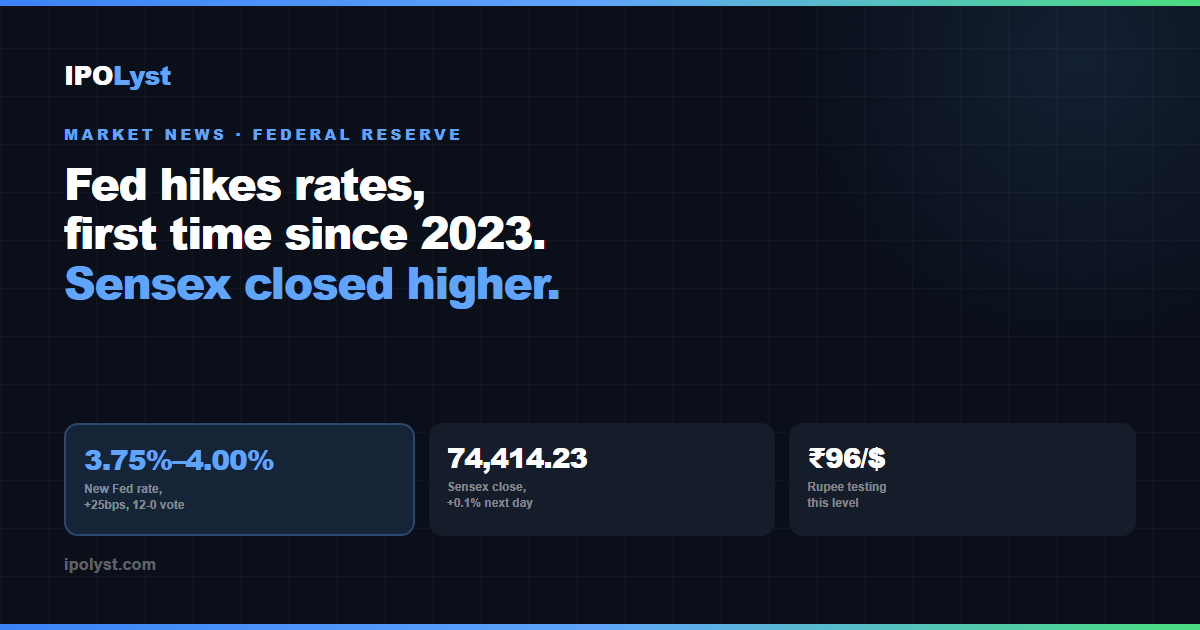
The Fed decision the market had been bracing for all week finally landed on September 16: the Federal Reserve raised its benchmark rate by 25 basis points to a target range of 3.75%-4.00% — its first hike since 2023. The vote was unanimous, 12-0. Here's what actually happened, how Indian markets reacted the next day, and why it matters for IPOs right now.
What the Fed actually did
- Rate hike: 25 basis points, taking the target range to 3.75%-4.00%
- Vote: unanimous, 12-0 — no dissent, unlike July's meeting where three members had pushed for a hike instead of a hold
- Stated reason: inflation remains elevated, largely tied to an energy-price shock from the ongoing Middle East conflict rather than domestic demand overheating
- Forward guidance: 16 of the 18 FOMC participants' projections point to at least one more hike before year-end; officials currently see no rate cuts in 2027
Fed Chair Kevin Warsh had already signaled the direction at Jackson Hole, flagging that underlying inflation wasn't slowing. This wasn't a surprise decision — it's the same ~91% hike probability the market had already priced in for days before the meeting.
How Indian markets actually reacted
This is the part worth paying attention to, because it didn't go the way a "hawkish Fed" headline usually suggests. Indian benchmarks opened under pressure on September 17, weighed down by the rate hike, still-elevated crude, and a widening Middle East conflict — but recovered through the session as investors bought banking and financial stocks following the recent multi-week selloff. The Sensex closed up 77.78 points (+0.1%) at 74,414.23, and the Nifty 50 closed up 76.75 points (+0.33%) at 23,294.35.
- Nifty MidCap +0.98%, Nifty SmallCap +0.69% — broader markets outperformed
- Nifty Realty, Auto, and Metal outperformed on the day
- Nifty IT underperformed — continuing its rough stretch through September
The rupee didn't share in the recovery. It was expected to test or cross ₹96/$ after closing at ₹95.9550 the day before, pressured by both the hawkish Fed and the crude oil backdrop that's been building since early September.
So why did the market go up on a rate hike?
Because the hike itself wasn't news — it was already priced in. What actually moved the market on September 17 was bargain-buying in beaten-down banking and financial stocks after five straight weeks of declines, not optimism about the Fed. The rupee's separate weakening shows the underlying pressure from the rate differential is still real; it just didn't show up in the headline index numbers that day.
We cross-checked the Fed decision against CNBC's coverage of the rate hike and the Sensex/Nifty close against Business Standard's live market wrap — both matched.
This Fed decision was exactly the pressure we flagged as driving IPO GMP declines across five live issues this week — worth reading alongside this piece if you're tracking how it's hitting specific IPOs.
Frequently Asked Questions
Did the US Federal Reserve raise interest rates in September 2026?
Yes. On September 16, 2026, the Federal Reserve raised its benchmark rate by 25 basis points to a target range of 3.75%-4.00%, its first hike since 2023. The FOMC vote was unanimous, 12-0.
How did Indian stock markets react to the Fed rate hike?
Indian markets opened under pressure on September 17 but recovered through the day on buying in banking and financial stocks after a recent selloff. The Sensex closed up 0.1% at 74,414.23 and the Nifty 50 closed up 0.33% at 23,294.35. The rupee, however, was expected to weaken past ₹96/$, showing the rate-differential pressure separately from the headline index move.
Will the Fed raise rates again in 2026?
Based on the FOMC's September 2026 projections, 16 of the 18 participants expect at least one more rate hike before the end of the year, with officials currently projecting no rate cuts in 2027.
Disclaimer: This article is for informational and educational purposes only and does not constitute financial or investment advice. IPOLyst is not a SEBI-registered investment advisor. Market data reflects the last available trading session and is subject to change. Please conduct your own research or consult a registered advisor before investing.