The listing day is the most exciting — and the most dangerous — day for an IPO investor. Stocks can surge 30–80% at open, or crash below the issue price within minutes. The difference between booking a profit and sitting on a loss often comes down to one thing: having a clear strategy before the bell rings. This guide walks you through everything you need to know to trade IPO listing day in India in 2026.
What Happens on IPO Listing Day?
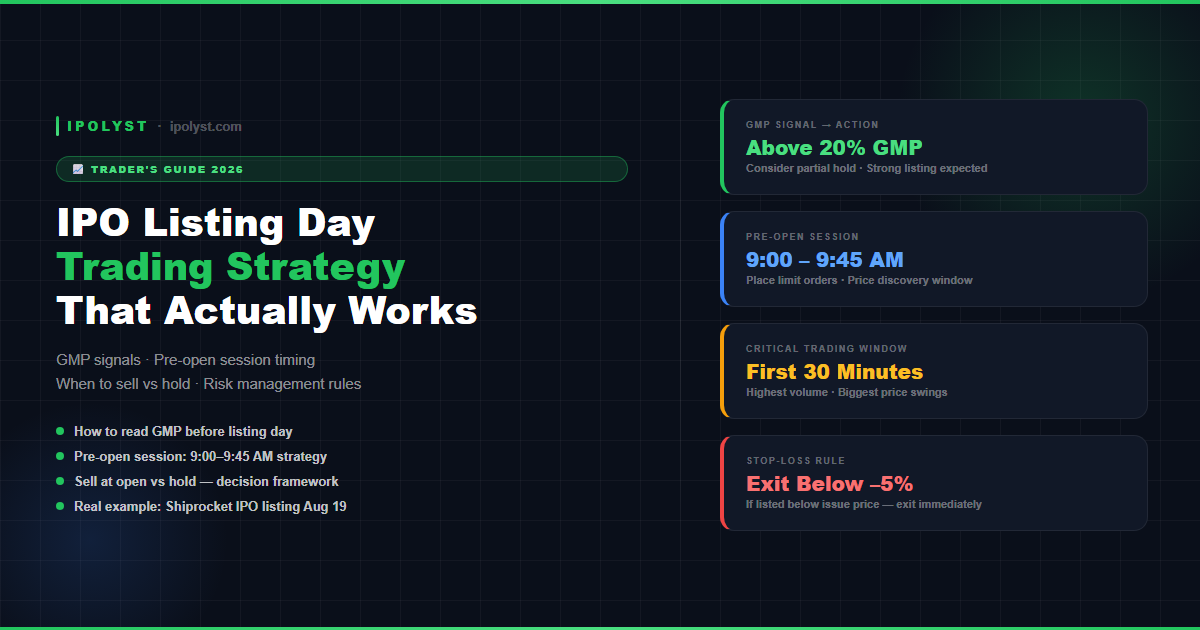
When an IPO lists on NSE or BSE, it does not open at a single fixed price. Instead, the exchange runs a special Pre-Open Session between 9:00 AM and 9:45 AM. During this window, buyers and sellers submit orders and the exchange calculates the equilibrium price — called the Discovered Price — which becomes the opening price.
After 9:45 AM, normal trading begins. This is when listed shares from your demat account become available to buy or sell like any regular stock. The price can move sharply in either direction during the first 30–60 minutes as early sellers book profits and new buyers enter.
Step 1 — Read the GMP Before Listing Day
Grey Market Premium (GMP) is the unofficial price at which IPO shares trade in informal markets before they list on the exchange. While GMP is not a guarantee, it is one of the strongest real-time signals of market sentiment heading into listing day.
How to Interpret GMP
- GMP above 20%: Strong listing expected. Consider holding for a partial exit at open.
- GMP between 10–20%: Moderate listing likely. Plan to exit at open unless you have conviction.
- GMP below 10%: Flat or weak listing. Exit at open to protect capital.
- GMP negative: Listing below issue price likely. Consider selling in the pre-open or at open immediately.
Example: Shiprocket IPO (listed August 19, 2026) had a GMP of +₹34 (+35%) the day before listing. Investors who saw this signal were positioned to either hold for gains or set a sell order near ₹131 at market open.
Track live GMP for every active IPO at ipolyst.com — updated multiple times daily.
Step 2 — Decide Your Strategy the Night Before
The worst time to make a trading decision is in the heat of the pre-open session. Prices flash rapidly, FOMO kicks in, and panic or greed take over. Make your plan the night before listing using three simple rules:
The Three-Rule Framework
- Rule 1 — Set a target sell price: Based on GMP, estimate your listing price. Set a limit sell order 5–10% below GMP to ensure execution even if the stock opens slightly lower.
- Rule 2 — Set a stop-loss: If the stock lists below your issue price by more than 5%, exit immediately. Do not average down on a listing day crash.
- Rule 3 — Decide your hold percentage: If you believe in the company long-term, decide how much to sell at listing (e.g., 50%) and how much to hold as a long-term investment.
Step 3 — The Pre-Open Session (9:00 AM – 9:45 AM)
The NSE/BSE pre-open session for newly listed IPOs runs from 9:00 AM to 9:45 AM on listing day. During this time:
- You can place, modify, or cancel orders (market or limit).
- The exchange matches buy and sell orders to discover the opening price.
- No actual trades execute until 9:45 AM.
Key tip: Place your sell order as a limit order — not a market order — during pre-open. Market orders on listing day can execute at prices far below the discovered price if there is low liquidity or sudden volatility.
Step 4 — First 30 Minutes Are the Most Critical
Between 9:45 AM and 10:15 AM, IPO stocks experience their highest trading volume. This is when:
- Early allottees who got shares at IPO price start booking profits.
- Grey market operators who bought shares informally begin squaring their positions.
- Momentum traders enter if the stock is running hard.
This combination creates sharp price swings. A stock that opens at +40% can fall to +20% within 30 minutes — or keep running to +60% if demand is overwhelming. Watch the volume closely: rising price + high volume = strength. Rising price + falling volume = potential reversal ahead.
Sell at Open vs. Hold — When to Do What
Sell at Open — Best For
- IPOs where the company is loss-making or the valuation is stretched (e.g., high P/E vs peers).
- IPOs where GMP has been declining in the last 2–3 days before listing.
- IPOs you applied to for listing gains, not long-term holding.
- When you need the capital for another upcoming IPO.
Hold After Listing — Best For
- IPOs of fundamentally strong, profitable companies with a clear growth runway.
- IPOs where the issue price is at a discount to the sector P/E.
- Situations where GMP has been rising consistently before listing.
- Companies with strong promoter track record, debt-free balance sheets, and sector tailwinds.
Risk Management Rules Every IPO Trader Must Follow
Listing day trading is not passive investing — it requires active risk management. Here are the non-negotiable rules:
- Never invest more in an IPO than you can afford to lose. Even strong GMP stocks can list flat or negative on a bad market day.
- Do not apply to too many IPOs simultaneously if you plan to trade listings — you stretch your capital thin and cannot monitor each stock.
- If an IPO lists below your issue price, do not panic-hold hoping for a recovery on the same day. Most listing-day losers stay weak for weeks.
- Keep a trade journal: note your entry, exit, reason, and result for every IPO trade. Patterns in your wins and losses are your best teacher.
- Beware of oversubscription hype: an IPO subscribed 200x does not guarantee a 200% listing. Subscription data tells you demand; GMP tells you probable listing price.
Real Example: How to Apply This on Shiprocket IPO
Shiprocket (IPO open Aug 12–14, 2026, listing Aug 19, 2026) is a textbook case for applying this framework. Price band: ₹97. GMP the day before listing: +₹34 (+35%). Expected listing price: ~₹131.
A trader applying the three-rule framework would:
- Set a limit sell order at ₹125–₹128 (slightly below GMP estimate) in the pre-open session.
- Set a mental stop-loss at ₹92 (5% below issue price of ₹97) — if listed below this, exit immediately.
- Decide in advance to sell 70% at open (booking the listing gain) and hold 30% long-term since Shiprocket has a large logistics TAM despite being loss-making.
This approach ensures you lock in most of the listing gain while not leaving money on the table if the stock runs further — and protects you with a clear exit if things go wrong.
Common Mistakes to Avoid on Listing Day
- Waiting for the stock to go 'a little higher' before selling — and watching it reverse sharply.
- Placing market orders in the pre-open session — this can result in poor execution.
- Applying to IPOs purely based on subscription numbers without checking GMP trend.
- Selling too early in panic during a normal 5–10% dip in the first few minutes of trading.
- Not having a pre-decided plan and making emotional decisions during live trading.
Tools to Use on Listing Day
- ipolyst.com — Live GMP tracking, IPO calendar, and subscription data for all active IPOs.
- NSE India app — Real-time pre-open order book and live price feed.
- Your broker's order management system — Place pre-open limit orders the evening before listing if available.
- NSE/BSE announcements — Check for any last-minute regulatory updates or allotment issues before trading.
Conclusion — Plan First, Trade Second
IPO listing day is not a lottery — it rewards preparation. If you understand how GMP works, when to place your order, when to hold and when to exit, and how to protect yourself with simple risk rules, you are already ahead of most retail traders who react emotionally on listing day.
Track every upcoming IPO listing, live GMP updates, and allotment results at ipolyst.com — India's cleanest IPO data platform.
Disclaimer: This article is for informational and educational purposes only and does not constitute financial advice. IPOLyst is not a SEBI-registered investment advisor. Please conduct your own research and consult a qualified financial advisor before making any investment decisions. Past GMP trends do not guarantee future listing performance.