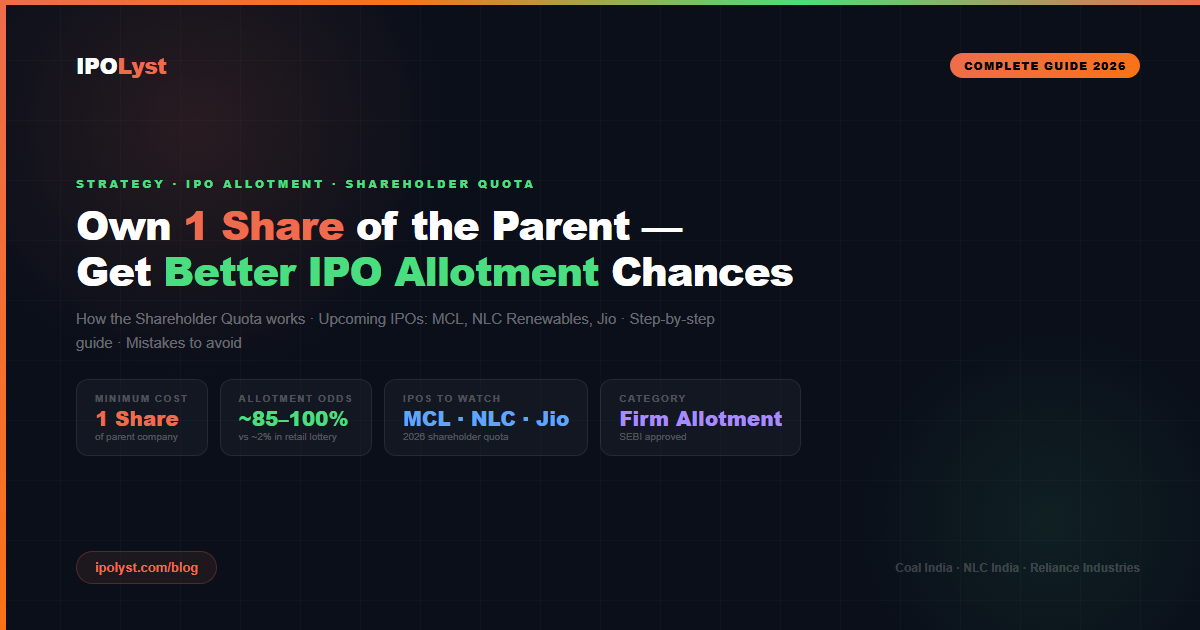
Did you know that owning just one share of a parent company can significantly improve your chances of getting IPO allotment — through a special category called the Shareholder Quota? This is one of the most underused strategies among retail investors in India. In 2026, several major IPOs including Mahanadi Coalfields Limited (MCL), NLC India Renewables, and the highly anticipated Jio IPO are expected to reserve a portion of shares for existing shareholders of their parent companies. This guide explains exactly how shareholder quota works, which IPOs to watch, and how to use this strategy step by step.
Key Takeaways
- Shareholder quota reserves 5–10% of IPO shares for existing shareholders of the parent/promoter company
- You only need to hold 1 share of the parent company before the record date to be eligible
- Allotment in the shareholder category is on a firm-allotment basis — much better odds than the retail lottery
- Upcoming 2026 IPOs with expected shareholder quota: Mahanadi Coalfields (parent: Coal India), NLC Renewables (parent: NLC India), Jio (parent: Reliance Industries)
- You must hold the parent share in your demat account before the record date announced in the DRHP
- This strategy works best for PSU (government) company IPOs — private IPOs rarely offer shareholder quota
How we researched this: This guide is based on SEBI IPO prospectus guidelines, historical shareholder quota allotment data from PSU IPOs between 2020–2026, and DRHP filings for upcoming 2026 IPOs. IPOLyst tracks all shareholder quota opportunities and posts updates on ipolyst.com.
What Is the IPO Shareholder Quota?
Definition
When a company's parent or promoter entity already has publicly listed shares, SEBI allows the IPO to reserve a portion of shares specifically for existing shareholders of that parent company. This reserved portion is called the 'Shareholder Quota' or 'Shareholders Category.'
For example, when Coal India Limited (CIL) brings its subsidiary Mahanadi Coalfields Limited to the stock market, it can reserve 5% of the IPO shares for people who already own Coal India shares. This is a reward for existing long-term investors of the parent company.
How Is It Different From the Retail Category?
In the regular retail category (RII), allotment is done by lottery when the IPO is oversubscribed. If an IPO is subscribed 80x in retail, your chances of getting even one lot can be as low as 1 in 80. The shareholder quota, by contrast, is a firm allotment category — meaning eligible shareholders are guaranteed at least one lot if they apply, up to the number of shares reserved for the category.
How the Shareholder Quota Works — Step by Step
Step 1: Identify the Parent Company
When an IPO is announced, check the DRHP (Draft Red Herring Prospectus) on SEBI's website or on ipolyst.com/blog. Look for a section titled 'Reservation for Shareholders of the Promoter Company' or similar. This will name the parent company and the exact record date by which you must hold shares.
Step 2: Buy at Least 1 Share Before the Record Date
You must own at least one share of the parent company in your demat account on or before the record date. The record date is usually 2–4 weeks before the IPO opens. If you buy the share on the record date itself, note that Indian stock settlement takes T+1 day — so buy one trading day before the record date to ensure the share is in your demat in time.
Step 3: Apply Under the Shareholder Category
When the IPO opens, log in to your broker app (Zerodha, Groww, Angel One, Upstox, etc.) and apply for the IPO. You will see a category option — select 'Shareholder' instead of 'Retail.' Apply for 1 lot (minimum). The application amount will be blocked via ASBA as usual.
Step 4: Collect Your Allotment
On allotment day, shareholders category applicants receive firm allotment — if the category is undersubscribed (which it often is, since many retail investors don't know about this), every eligible applicant gets shares. Even if oversubscribed, the allotment ratio in shareholder category is almost always better than retail.
Upcoming 2026 IPOs With Shareholder Quota
1. Mahanadi Coalfields Limited (MCL) IPO
Mahanadi Coalfields Limited is a wholly-owned subsidiary of Coal India Limited (CIL) — one of India's largest PSU companies and the world's biggest coal producer. MCL is expected to launch its IPO in 2026 as part of the government's disinvestment programme. Coal India shareholders on the record date are expected to be eligible for the shareholder quota.
- Parent Company: Coal India Limited (NSE: COALINDIA)
- Sector: Mining / Energy
- Expected IPO: 2026 (exact date subject to SEBI approval)
- Strategy: Buy 1 share of Coal India (CIL) before the record date
- Coal India price: approximately ₹380–420 (check current price before buying)
2. NLC India Renewables IPO
NLC India Limited (formerly Neyveli Lignite Corporation) is a Navratna PSU under the Ministry of Coal. Its renewable energy subsidiary is being prepared for a separate listing. NLC India shareholders on the record date are expected to qualify for the shareholder quota in this IPO.
- Parent Company: NLC India Limited (NSE: NLCINDIA)
- Sector: Renewable Energy / Power
- Expected IPO: 2026
- Strategy: Buy 1 share of NLC India before the record date
3. Jio Platforms / Reliance Jio IPO
The Jio IPO is arguably the most anticipated listing in Indian market history. While no confirmed date has been announced, market participants widely expect Jio Platforms (the telecom and digital services arm of Reliance Industries) to go public before 2027. As a Reliance Industries subsidiary, shareholders of Reliance Industries Limited (RIL) may be eligible for the shareholder quota when Jio lists.
- Parent Company: Reliance Industries Limited (NSE: RELIANCE)
- Sector: Telecom / Digital Services / Retail
- Expected IPO: 2026–2027
- Strategy: Hold at least 1 share of Reliance Industries before the record date
- Note: Jio IPO dates are unconfirmed — track updates on ipolyst.com/blog
Past Shareholder Quota Wins — Real Examples
Coal India Subsidiaries Pattern
Coal India has a history of listing its subsidiaries with shareholder quotas. Long-term Coal India investors who understood this pattern have consistently received allotments in subsidiary IPOs at issue price, while retail investors competed in an oversubscribed lottery. The cost to participate? Owning one Coal India share — a fraction of the allotment value received.
How to Calculate Your Return
Here is a simple framework to evaluate whether a shareholder quota opportunity is worth pursuing: If the parent share costs ₹400 and the IPO lists at a 20% premium (₹X issue price × 1.2), the listing gain on one lot must exceed the cost of holding the parent share minus its market price movement during the holding period. In most PSU IPOs with strong GMP, the one-lot listing gain has significantly exceeded the cost of buying one parent share.
Common Mistakes to Avoid
Mistake 1: Missing the Record Date
This is the most common mistake. Many investors learn about a shareholder quota IPO after the record date has passed. By then, it is too late — you cannot retroactively qualify. Always check the DRHP section on shareholder reservation and mark the record date in your calendar the moment an IPO is announced.
Mistake 2: Buying on the Record Date Itself
Indian stock settlement is T+1. If you buy Coal India shares on the record date (say, Monday), the shares will be credited to your demat account on Tuesday — the day after the record date. You will not qualify. Always buy at least one trading day before the record date.
Mistake 3: Applying in the Wrong Category
Some investors eligible for the shareholder quota accidentally apply in the retail (RII) category. Once submitted, IPO applications cannot be switched between categories. Always double-check the category dropdown in your broker app before submitting.
Mistake 4: Assuming It Is Guaranteed
Shareholder quota allotment is on a firm-allotment basis, not a guaranteed allotment. If the shareholder category receives more applications than shares reserved, allotment is done on a pro-rata basis. However, in practice, shareholder categories in PSU IPOs are undersubscribed because retail investors are unaware of this option — making it one of the better bets available to informed investors.
Mistake 5: KYC Mismatch
Your demat account holding the parent company shares must be the same account you use to apply for the IPO, and the PAN must match across your demat, bank, and IPO application. Any KYC mismatch will result in application rejection.
Myth Busting — Does 1 Share Really Guarantee Allotment?
The honest answer is: not guaranteed, but dramatically better odds than retail. Here is the reality:
- In retail (RII) for a 50x subscribed IPO: ~2% chance of allotment
- In shareholder quota (undersubscribed, which is common): ~85–100% chance of allotment
- In shareholder quota (oversubscribed): pro-rata, but still much better than retail lottery
The shareholder quota is not a loophole or a hack — it is a SEBI-approved, legally structured allocation category designed to reward existing investors in the parent company. Using it is entirely legitimate and encouraged.
How to Stay Updated on Shareholder Quota IPOs
The key to this strategy is advance notice — you need to know about the record date before it passes. Here is how to track upcoming opportunities:
- Follow ipolyst.com/blog for IPO analysis and shareholder quota alerts
- Subscribe to SEBI's DRHP filing updates on sebi.gov.in
- Track NSE and BSE IPO section for upcoming listings
- Check GMP and subscription data on ipolyst.com — IPOs with strong GMP are worth evaluating for shareholder quota
- Follow @ipolyst2025 on Instagram for daily IPO alerts
Frequently Asked Questions
Who is eligible for the IPO shareholder quota?
Any investor who holds at least 1 share of the parent/promoter company in their demat account on or before the IPO's record date is eligible to apply under the shareholder quota category. The eligibility criteria (minimum shares required) are specified in the company's DRHP.
How many lots can I apply for in the shareholder quota?
The maximum application size in the shareholder quota is typically the same as the retail category — applications up to ₹2 lakh at the cut-off price. You can apply for 1 lot or multiple lots up to this limit. Applying for 1 lot is the most common strategy since allotment for 1 lot is more likely when the category is proportionally allocated.
Can I apply in both the retail and shareholder category?
No. SEBI rules do not allow the same PAN to apply in two different categories for the same IPO. You must choose one — either retail (RII) or shareholder quota. Most informed investors choose the shareholder quota for better allotment odds.
Does holding shares in a joint account qualify?
The shares must be held in the same demat account from which you are applying for the IPO. If the parent company shares are in a joint demat account, the IPO application must also come from the same joint account with the same primary holder. Check with your broker for specific guidance.
What happens to my parent company shares after the IPO?
Nothing — you continue to hold the parent company shares as normal. You only needed to hold them on the record date to qualify for the shareholder quota. After the record date, you can sell the parent shares if you wish, without affecting your IPO application eligibility.
Is the shareholder quota available in SME IPOs?
Shareholder quota is primarily found in large mainboard IPOs where the issuing company has a publicly listed parent. SME IPOs rarely have a parent company structure that qualifies for this. Focus this strategy on PSU IPOs and large conglomerate subsidiary listings.
Disclaimer: This article is for informational and educational purposes only and does not constitute financial advice or investment recommendations. IPOLyst is not a SEBI-registered investment advisor. Shareholder quota allotment is not guaranteed. Please read the DRHP and consult a SEBI-registered financial advisor before making any investment decisions. Stock prices and IPO details are subject to change.