India's biggest healthcare IPO of 2026 is finally here. Manipal Health Enterprises — the Temasek-backed hospital chain operating 49 hospitals with 13,037 licensed beds — has set its price band at ₹560–₹590 per share and opens for subscription on July 29, 2026. At ₹9,275 crore, this is one of the largest IPOs of the year. Here is everything you need to know before applying.
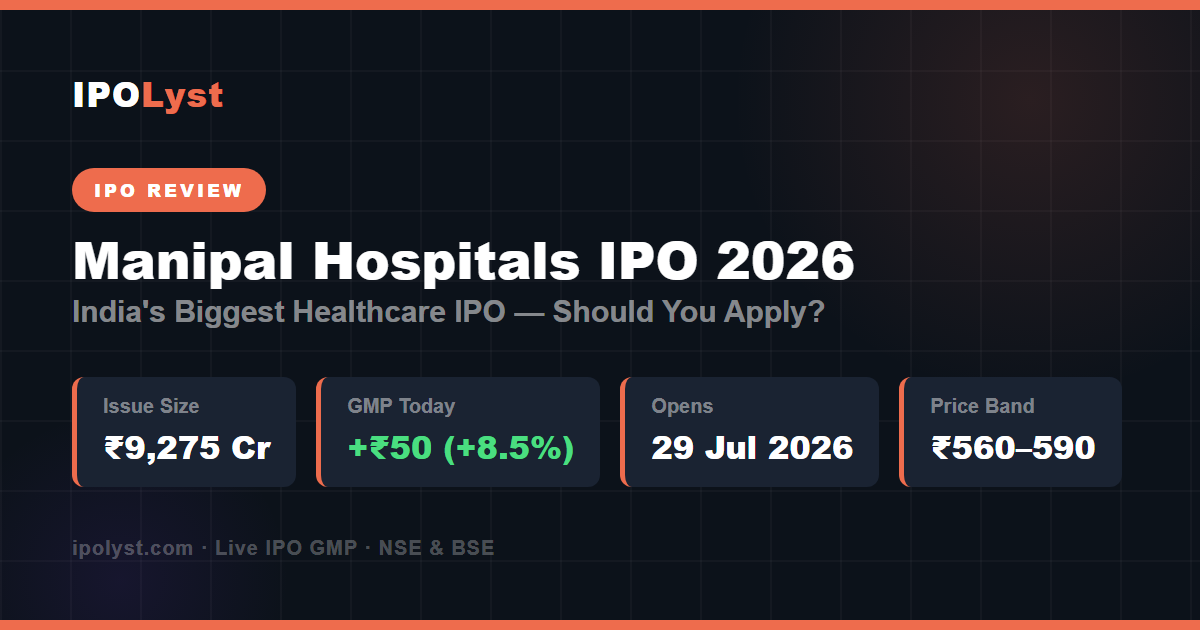
Manipal Health IPO — Key Details at a Glance
- IPO Open Date: July 29, 2026
- IPO Close Date: July 31, 2026
- Price Band: ₹560–₹590 per share
- Issue Size: ₹9,275.22 Cr (Fresh Issue: ₹8,000 Cr + OFS: 2.16 Cr shares)
- Lot Size: 25 shares | Min Investment: ₹14,750
- Allotment Date: August 3, 2026
- Listing Date: August 5, 2026 (BSE & NSE)
- Valuation at Upper Band: ~₹77,607 Cr
- GMP Today: +₹50 | Est. Listing Price: ~₹640 (+8.5%)
- Promoters: Temasek (majority stakeholder)
About Manipal Health Enterprises
Manipal Health Enterprises is the largest private hospital network in India by bed capacity. As of March 2026, the company operates 49 hospitals with 13,037 licensed beds spread across 14 states and union territories. The network includes flagship hospitals in Bengaluru, Mangaluru, Pune, Kolkata, Jaipur, and Vijayawada, among others.
Founded in 1953, Manipal Hospitals has grown into a full-spectrum tertiary and quaternary care network, specialising in complex procedures across oncology, cardiac sciences, neurosciences, orthopaedics, and organ transplants. The hospital chain serves over 5 million patients annually and has a significant presence in Tier-1 and Tier-2 cities across India.
The company is majority-owned by Temasek, Singapore's state investment firm, which has been investing in India's healthcare sector for over a decade. This institutional backing gives Manipal Hospitals a significant advantage in capital access, governance standards, and global credibility.
Financials — Strong Growth Story
Manipal Health's financial performance over the last two years has been impressive:
- Revenue FY2024: ₹6,171.6 Cr
- Revenue FY2026: ₹10,335.8 Cr — growth of +67% in just 2 years
- Net Profit FY2024: ₹533.2 Cr
- Net Profit FY2026: ₹916.5 Cr — growth of +72% in 2 years
This is not incremental growth — this is a hospital chain that has nearly doubled its revenue in two years, driven by aggressive capacity expansion (from 38 hospitals in September 2025 to 49 by March 2026) and strong occupancy rates in existing facilities. The profit trajectory shows improving operational efficiency as new hospitals mature and reach breakeven.
The fresh issue component of ₹8,000 Cr will primarily be used to fund new hospital construction, equipment upgrades, and debt repayment — meaning this capital goes into business growth, not promoter exits.
IPO Structure — Mostly Fresh Issue, Small OFS
Of the ₹9,275 Cr total issue, ₹8,000 Cr is a fresh issue — the company itself raises and uses this money for expansion. Only ₹1,275 Cr is an Offer for Sale (OFS), where Temasek partially divests its stake. The OFS portion is just 13.7% of the total issue, which is a very healthy ratio compared to many recent large IPOs (like SBI MF, which was 100% OFS).
This structure signals that Manipal Hospitals needs capital to grow — not that promoters are cashing out at the top. That is a fundamentally different and more investor-friendly signal.
Quota Breakdown
- QIB (Qualified Institutional Buyers): 75%
- NII / HNI (Non-Institutional Investors): 15%
- Retail Individual Investors: 10%
Note: Only 10% of the issue is reserved for retail investors. Given the large issue size and high institutional interest expected, retail allotment probability will depend heavily on oversubscription. Apply at cut-off price to maximise chances.
GMP — What the Grey Market Is Saying
As of July 24, 2026, Manipal Health IPO GMP (grey market premium) is +₹50, suggesting an estimated listing price of ~₹640 — a gain of approximately 8.5% over the upper price band of ₹590. The GMP has ranged between ₹0 and ₹50 since the IPO was announced, currently sitting at the higher end of that range.
A GMP of +₹50 for a ₹9,275 Cr issue is moderate — large IPOs rarely see GMP exceeding 15–20% because institutional investors price them more efficiently. The grey market is pricing in a modest but positive listing. Do not apply solely based on GMP — the long-term case here is far more compelling than the listing gain.
Strengths — Why Manipal Health Is a Compelling IPO
1. Largest Private Hospital Network in India
With 49 hospitals and 13,037 licensed beds, Manipal Hospitals is the largest private hospital chain by bed capacity in India. Scale in healthcare creates a compounding moat — more hospitals means more specialists recruited, more complex cases referred, and a stronger brand that drives patient preference in a trust-driven sector.
2. Temasek Backing — Institutional Quality
Temasek is not a financial investor looking for a quick exit. As Singapore's sovereign wealth fund, they take multi-decade positions in healthcare assets across Asia. Their continued ownership (majority stake even post-IPO) signals strong confidence in the long-term trajectory. Temasek's governance standards also mean Manipal Hospitals operates with higher transparency than most Indian hospital chains.
3. 67% Revenue Growth in 2 Years
Growing revenue from ₹6,171 Cr to ₹10,335 Cr in two years is exceptional for a capital-intensive hospital business. This growth comes from both organic improvement (higher occupancy, better procedure mix) and inorganic expansion (11 new hospitals added in 6 months in late 2025). Both drivers are sustainable.
4. India's Healthcare Demand Is Structurally Underserved
India has approximately 1.4 beds per 1,000 population — far below the WHO-recommended 3 beds per 1,000. With a growing middle class, rising health insurance penetration (from 37% in 2021 to 55%+ by 2026), and an aging population, demand for quality hospital care will only increase. Manipal is positioned directly in this long-term structural tailwind.
5. Mostly Fresh Issue Capital Goes Into Growth
₹8,000 Cr of fresh capital earmarked for hospital expansion means the company will continue growing its bed count and geographic footprint. New hospitals take 3–5 years to mature, meaning today's expansion investment will drive revenue for the next decade.
Risks — What Could Go Wrong
1. High Valuation — ₹77,607 Cr Market Cap
At ₹590 (upper band), Manipal Health is valued at ~₹77,607 Cr. This prices in significant future growth and leaves limited margin of safety for short-term investors. Comparable listed peers — Apollo Hospitals (₹95,000+ Cr), Max Healthcare (₹85,000+ Cr), Fortis (₹38,000 Cr) — suggest Manipal is priced between Max and Apollo. Given Manipal's scale is closer to Apollo, the valuation is defensible but not cheap.
2. Capital-Intensive Expansion
Building new hospitals requires enormous upfront capital with a 3–5 year breakeven timeline. If economic conditions deteriorate or health insurance growth slows, new hospitals could drag on profitability before reaching maturity. The ₹8,000 Cr fresh issue buys growth, but growth carries execution risk.
3. Competition From Apollo, Max, Fortis
India's premium hospital market is increasingly competitive. Apollo Hospitals has the strongest brand in South India (Manipal's home turf), Max Healthcare dominates North India, and Fortis has been reviving under IHH. Manipal will need to maintain its edge in clinical outcomes and specialist recruitment to defend market share.
4. Regulatory Risk in Healthcare
Healthcare pricing in India faces periodic government intervention — price caps on procedures, stents, implants, and drugs. Any expansion of price regulation to hospital fees could compress margins. The sector also faces scrutiny on billing practices and insurance claim disputes.
Manipal Health vs Apollo Hospitals — Quick Comparison
- Manipal Health: 49 hospitals, 13,037 beds, Revenue ₹10,335 Cr, PAT ₹916 Cr, Valuation ₹77,607 Cr
- Apollo Hospitals: 73 hospitals, 10,000+ beds, Revenue ~₹21,000 Cr, PAT ~₹1,600 Cr, Valuation ~₹97,000 Cr
Manipal has fewer hospitals but more beds per hospital — indicating larger, more complex tertiary care facilities rather than a network of smaller centres. Per-bed revenue comparison suggests Manipal's hospitals are highly productive. Apollo's premium valuation reflects its longer listing history, diversified pharmacy business, and stronger brand recall in urban India.
Should You Apply for Manipal Health IPO? Our Verdict
Verdict: APPLY — with a long-term perspective.
Manipal Health Enterprises is not a listing-gain trade. With GMP at just +₹50 (+8.5%), short-term listing gains will be modest. However, the medium to long-term case is one of the strongest of any IPO in 2026:
- India's largest private hospital network with a clear expansion roadmap
- 67% revenue growth in 2 years with improving profitability
- Temasek backing ensures governance quality and long-term commitment
- Fresh issue dominant — capital goes into real business growth
- Structural healthcare demand tailwind for the next decade
If you are a retail investor looking for a quick listing flip, the GMP suggests only 8–10% gains — apply one lot and evaluate. If you are a long-term investor with a 2–3 year horizon, this is one of the highest-quality assets coming to the Indian primary market in 2026. Accumulate on any post-listing dip below ₹580.
Target: ₹800–₹950 over 24–36 months (35–60% upside from issue price), driven by hospital network maturation and India's healthcare demand cycle.
How to Apply for Manipal Health IPO
- Open: July 29, 2026 | Close: July 31, 2026
- Apply through your broker app (Zerodha, Groww, Angel One, Upstox, HDFC Sky)
- Apply at cut-off price (₹590) to maximise allotment probability
- Lot size: 25 shares | Min application: ₹14,750
- Max retail: 13 lots (325 shares) = ₹1,91,750
- UPI mandate: approve within 30 minutes of application for guaranteed processing
Disclaimer
Disclaimer: This article is for informational and educational purposes only and does not constitute financial advice. IPOLyst is not a SEBI-registered investment advisor. All data cited is based on publicly available sources as of July 24, 2026. GMP figures are indicative and sourced from grey market operators — they do not guarantee listing performance. Please consult a qualified financial advisor before making any investment decisions.