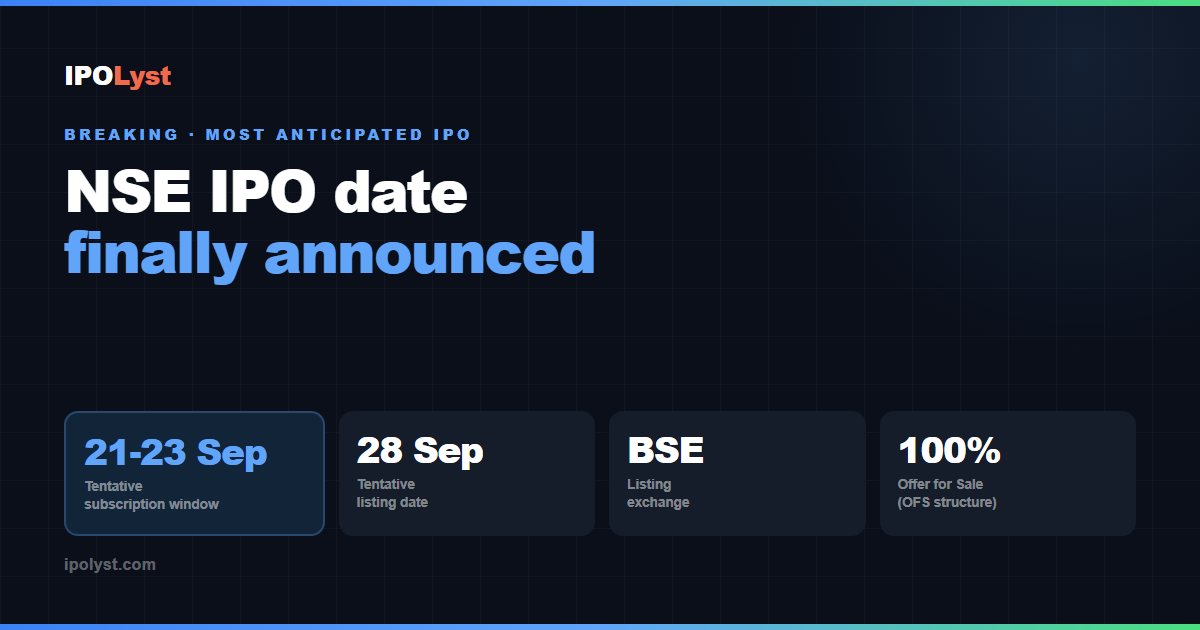
After nearly a decade of waiting, the National Stock Exchange has a tentative date for its own IPO. The timeline: opening 21 September, closing 23 September, allotment on 24 September, and listing on 28 September 2026. This is the single most anticipated listing in Indian market history, and for the first time it has an actual calendar attached to it rather than a vague "second half of 2026."
One thing to be precise about before anything else: NSE itself has confirmed the tentative dates and that it has received SEBI's no-objection certificate, but the exact price band has not been officially announced. Numbers circulating in the market — a band around ₹2,000-2,100 per share and a valuation near ₹5.26 lakh crore — are market expectations, not confirmed figures. We are treating them as such throughout this article.
NSE IPO 2026: what's confirmed
- Tentative opening date: 21 September 2026
- Tentative closing date: 23 September 2026
- Tentative allotment date: 24 September 2026
- Tentative listing date: 28 September 2026
- Listing exchange: BSE — NSE cannot list its own shares on its own exchange, so this listing happens on BSE, a detail that surprises a lot of first-time applicants.
- Regulatory status: NSE CEO Ashishkumar Chauhan has confirmed the exchange has received a no-objection certificate (NOC) from SEBI.
- Structure: 100% Offer for Sale (OFS) — NSE itself raises no fresh capital from this IPO. Every rupee goes to the selling shareholders, not to the company.
What's still unconfirmed — and why that matters
Price band and lot size have not been officially announced by NSE. The ₹2,000-2,100 range and ~₹5.26 lakh crore valuation you may be seeing elsewhere are market estimates built off unlisted-share trading and analyst projections, not the offer document. Until NSE files its price band, there is no basis for a real grey market premium either — GMP requires a price to trade a premium against, and right now there isn't one to quote against.
This distinction is not pedantic. Every year, a handful of the most-hyped IPOs see retail investors plan around whisper numbers that shift meaningfully once the actual price band drops. Given the scale of interest in this specific listing, that gap between rumour and filing is likely to be wider than usual.
Why this IPO is different from anything else on the calendar
NSE is not just another company going public — it is the exchange that processes the vast majority of India's daily equity trading volume. A handful of things make this listing structurally unusual.
It's a pure OFS
Because 100% of the issue is an Offer for Sale, none of the proceeds fund NSE's own operations or growth. You are buying into an already-profitable, already-dominant business from its existing shareholders — a materially different proposition from a fresh-issue IPO funding expansion.
It lists on a rival exchange
BSE hosting NSE's IPO is a genuinely unusual structural quirk of Indian market regulation, and it is worth understanding before you apply — your shares will trade on BSE, not NSE, at least initially.
The scale changes the allotment math
A listing of this size and profile typically draws QIB demand far in excess of anything on the current mainboard calendar. Retail allotment odds in an oversubscribed marquee IPO are governed by lottery within the retail quota regardless of how many lots you apply for — applying through more demat accounts under different family members increases entries, applying for more lots per account does not.
We cover the full ownership structure, financials and OFS mechanics in our earlier deep-dive on the NSE IPO, published when the DRHP was first filed. This article covers what's changed since — the confirmed dates.
What to actually do right now
- Do not plan your application around the ₹2,000-2,100 whisper price — wait for the official price band, which typically arrives roughly a week before the issue opens.
- Do not expect a meaningful GMP reading until the price band is filed. Anything quoted before that point is not measuring against a real number.
- If you plan to apply, make sure your demat account and UPI mandate are set up well before 21 September — an IPO of this profile typically sees banking-side delays on day one from sheer application volume.
- Track the price band announcement, not the listing date — the price band is the number that actually determines whether this is a buy for you.
We will publish the confirmed price band, lot size and live GMP the moment NSE files them. Track it on our IPO GMP tracker alongside every other live and upcoming issue.
Frequently Asked Questions
What is the NSE IPO date in 2026?
NSE has announced tentative dates: the issue opens 21 September 2026, closes 23 September 2026, allotment is finalised 24 September 2026, and listing is scheduled for 28 September 2026. These dates are tentative and could shift slightly, but represent the first confirmed timeline for this IPO.
What is the NSE IPO price band?
NSE has not officially announced a price band as of this article. Market estimates place it around ₹2,000-2,100 per share with a valuation near ₹5.26 lakh crore, but NSE CEO Ashishkumar Chauhan has confirmed these figures are not yet official. The confirmed price band typically arrives about a week before an issue opens.
Will NSE IPO list on NSE or BSE?
NSE's own IPO will list on BSE, not on NSE itself. An exchange cannot list its own shares on its own trading platform, so BSE hosts the listing — a structural detail unique to this IPO among the current mainboard pipeline.
Is the NSE IPO a fresh issue or an Offer for Sale?
The NSE IPO is a 100% Offer for Sale (OFS). NSE itself will not receive any of the IPO proceeds — all funds raised go to the existing shareholders who are selling their stake, not to NSE's own balance sheet.
Disclaimer: This article is for informational and educational purposes only and does not constitute financial advice. IPOLyst is not a SEBI-registered investment advisor. Dates and figures reflect information available as of 2 September 2026 and are subject to change until NSE's official filing. Please verify current details against NSE's offer document before applying, and consult a registered advisor for investment decisions specific to your situation.