The National Stock Exchange of India — the platform where millions of retail investors place their trades every single day — is finally going public. After nearly a decade of regulatory hurdles, failed attempts, and a high-profile co-location controversy, NSE filed its Draft Red Herring Prospectus (DRHP) with SEBI on June 17, 2026. If all goes to plan, this could become the largest IPO in Indian stock market history.
Here is a complete breakdown of everything retail investors need to know about the NSE IPO 2026.
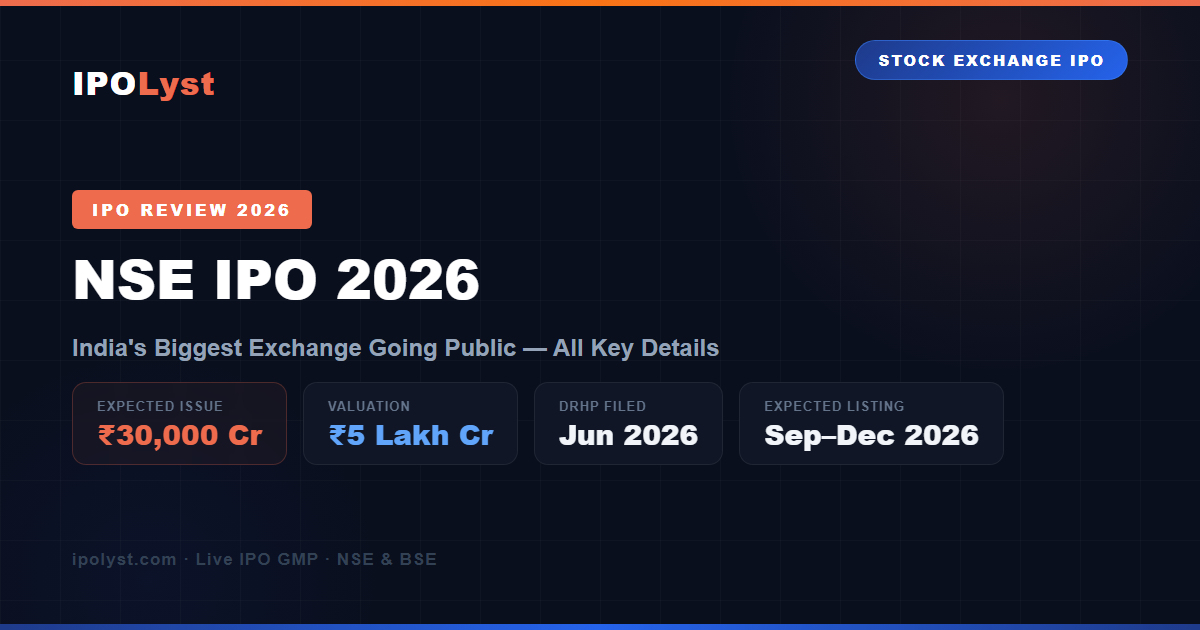
NSE IPO 2026 — Key Details at a Glance
- DRHP Filed: June 17, 2026
- Issue Type: 100% Offer for Sale (OFS) — NSE raises no fresh capital
- Shares on Offer: Up to 14.89 crore equity shares (~6% dilution)
- Expected Issue Size: ₹25,000–30,000 crore
- Valuation: ~₹5 lakh crore (~$60–65 billion)
- Unlisted Share Price (Grey Market): ₹1,950–2,050 per share
- Expected SEBI Approval: August 2026
- Expected Listing: September–December 2026 on BSE
- Price Band & Lot Size: Not yet announced
- GMP: No formal GMP yet — price band not announced
What Is the NSE IPO Structure?
The NSE IPO is a pure Offer for Sale (OFS) — meaning NSE itself will not receive a single rupee from the proceeds. All money raised goes directly to the selling shareholders who are divesting a portion of their existing stakes.
The key selling shareholders include State Bank of India (up to 2.48 crore shares), Canada Pension Plan Investment Board (CPPIB), MS Strategic (Mauritius), Aranda Investments (Mauritius), Bank of Baroda, and Stock Holding Corporation of India.
Notably, NSE's largest shareholder, Life Insurance Corporation of India (LIC) with a 10.72% stake, is NOT participating in the OFS. Premji Invest (2.35%) and Radhakishan Damani (1.58%) are also not selling. This is generally a bullish signal — long-term institutional investors choosing to hold rather than exit at IPO valuation.
NSE Financials — FY26 Performance
- Revenue from Operations FY26: ₹16,601 crore (down 3.1% from ₹17,141 crore in FY25)
- Net Profit FY26: ₹10,302 crore (down 15.5% from ₹12,188 crore in FY25)
- Net Profit Margin: 55%+ — among the highest of any exchange globally
- EBITDA Margin: 75.48%
- Return on Equity: 32.98%
- Debt: Zero — completely debt-free
- Dividend FY26: ₹35 per share (includes a special one-time component)
Revenue breakdown for FY26: Trading Services contributed ₹15,044 crore, Clearing Services ₹1,762 crore, and others ₹644 crore — highlighting how dependent NSE is on derivatives trading volumes.
The revenue and profit dip in FY26 was primarily driven by SEBI's new F&O (futures and options) regulations introduced in 2024–25, which reduced speculative derivatives volumes. This is a one-time regulatory adjustment, not a structural decline. India's long-term derivatives market growth story remains intact.
Valuation — Is ₹5 Lakh Crore Fair?
At an expected valuation of ₹5 lakh crore, NSE would be priced at approximately 48–50x its FY26 earnings of ₹10,302 crore. For context:
- BSE (listed on NSE) currently trades at ~50–60x earnings
- CME Group (world's largest derivatives exchange) trades at ~25x earnings
- London Stock Exchange Group trades at ~25–30x earnings
On a global comparison basis, NSE looks expensive. But India's equity market penetration is still low (demat accounts at ~17 crore out of 100 crore+ eligible adults), and NSE is effectively the monopoly infrastructure play on India's financial growth story. Premium valuation for monopoly assets is not unusual in emerging markets.
The unlisted market has been pricing NSE shares at ₹1,950–2,050 per share, which broadly supports the ₹5 lakh crore valuation range.
NSE's Strengths
- Effective monopoly in equity derivatives — handles over 90% of India's futures and options volume
- Ultra-high margins: EBITDA at 75%+ is rare in any industry globally
- Debt-free balance sheet with massive cash generation — ₹10,302 crore profit on ₹16,601 crore revenue
- Long structural runway — India's equity market participation is still in early innings
- Technology moat: NSE's NEAT trading platform handles millions of orders per second with sub-millisecond latency
- Diversified revenue: trading, clearing, data services, listing fees, co-location
- LIC, Premji Invest, and Damani NOT selling — strong institutional confidence signal
Key Risks — What Investors Must Watch
1. The Co-location Controversy
The biggest overhang on NSE's IPO is the decade-old co-location and dark fibre case. Between 2010 and 2014, certain high-frequency traders allegedly received preferential access to NSE's co-location servers, allowing them to see tick-by-tick data milliseconds before others. This gave them an unfair trading advantage.
SEBI has been probing this case for years. NSE's statutory auditors have flagged it as an 'emphasis of matter' in audit reports for FY24, FY25, and FY26. NSE has made provisions of ₹1,297 crore (plus ₹100 crore deposited earlier, with 12% interest) for a potential settlement. A special CBI court has accepted a closure report in one linked case — suggesting the worst may be behind NSE legally. However, reputational risk remains.
2. FY26 Revenue Decline
NSE's FY26 revenue fell 3.1% and profit fell 15.5% — both moving in the wrong direction at IPO time. This was driven by SEBI's F&O curbs reducing speculative volumes. If SEBI introduces further restrictions on derivatives, NSE's earnings could be under pressure in the near term.
3. 100% OFS — No Growth Capital
Since the entire IPO is OFS, NSE receives no fresh funds to invest in technology, new markets, or international expansion. All proceeds go to existing shareholders. Retail investors are effectively buying secondary stakes, not funding NSE's future.
4. Regulatory Concentration Risk
NSE's business model depends entirely on SEBI's regulatory framework. Any major changes to derivatives trading rules, STT (Securities Transaction Tax), or market structure can materially impact NSE's revenue overnight.
5. Single-Exchange Dependency
Despite launching commodity and currency futures, NSE remains overwhelmingly dependent on equity derivatives. Over 90% of revenue comes from trading and clearing — primarily the derivatives segment. True diversification is still work in progress.
NSE IPO Timeline — What Happens Next?
- June 17, 2026: DRHP filed with SEBI
- August 2026 (expected): SEBI observations / approval
- September 2026 (expected): Roadshows and price band announcement
- September–October 2026 (expected): IPO subscription window opens
- October–December 2026 (expected): Listing on BSE
SEBI typically takes 30–75 days to issue observations after a DRHP filing. Based on the June 17 filing date, SEBI approval is expected by late July to September 2026. IPOLyst will update this article as official dates are announced.
Should You Apply for the NSE IPO?
The NSE IPO is not a standard retail IPO decision. This is a once-in-a-generation opportunity to directly own a piece of India's primary market infrastructure — the very platform that facilitates every equity trade in the country.
The core thesis is simple: as India's GDP grows, as more Indians open demat accounts, as SIP culture deepens, and as institutional participation increases — NSE's volumes and revenues will grow structurally over the next decade. The FY26 earnings dip is cyclical, not structural.
The risks are real — the co-location legacy, the F&O regulatory overhang, and a premium valuation. But for long-term investors with a 5–10 year horizon, NSE represents a monopoly infrastructure business in the world's fastest-growing major economy.
IPOLyst will publish a detailed apply/avoid verdict once the price band and subscription dates are officially announced. In the meantime, track all upcoming IPOs on NSE and BSE for the latest GMP and subscription data.
Also read: Jio Platforms is pursuing a similarly historic IPO — see our coverage of the Jio IPO 2026 DRHP filing and what happens next.
New to grey market premiums? Our complete guide to IPO GMP explains what GMP means and how accurate it really is.
Disclaimer
Disclaimer: This review is for informational purposes only and does not constitute financial advice. IPOLyst is not a SEBI-registered advisor. Please conduct your own research before investing.