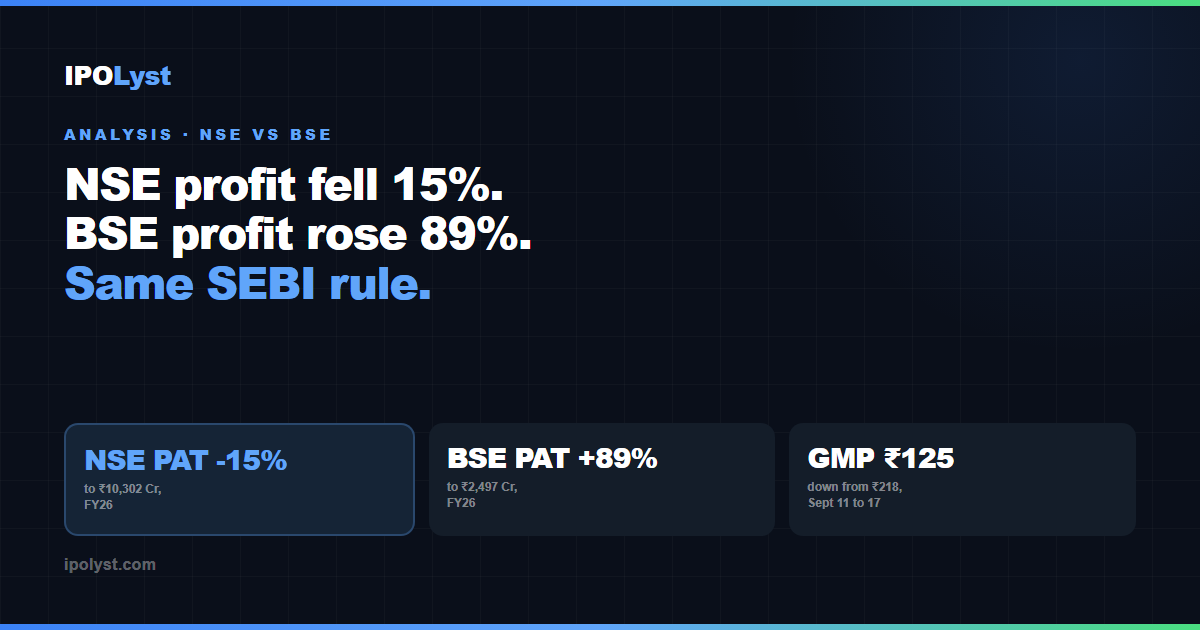
NSE's IPO grey market premium has been sliding hard this week. It was at ₹218 on September 11. By September 16 it had dropped to ₹145, a fall of about 33.5%. Our own tracker had it down further to ₹125 on September 17, the day bidding opened. A lot of people online are calling this the result of a new SEBI rule. That's not quite right, and the real story is more interesting than that.
The rule everyone's blaming isn't actually new
SEBI's crackdown on retail derivatives speculation, higher securities transaction tax, bigger contract sizes, stricter margin requirements, and fewer weekly expiries, was introduced back in July 2024. That's over a year old. What's actually driving sentiment right now isn't a fresh rule change. It's NSE's full FY26 annual results, which just came out and show the cumulative damage that older rule has done to the exchange's own business, right as it's trying to go public.
What NSE's FY26 numbers actually show
- Total income: ₹18,713.37 Cr in FY26, down about 2% from ₹19,176.83 Cr in FY25
- Profit after tax: ₹10,302.06 Cr in FY26, down 15% from ₹12,187.69 Cr in FY25
- Equity options alone make up 77% of NSE's total transaction revenue
- Options average daily volume fell from ₹62,449 Cr per day in FY25 to ₹57,662 Cr per day in FY26
In other words, NSE is heavily dependent on options trading for its own income, and the exact SEBI rules meant to reduce speculative options volume have hit that dependency directly. This is showing up in NSE's own results right at the moment investors are deciding whether to subscribe to its IPO.
BSE, under the same rules, had its best year ever
Here's the part that makes this genuinely interesting rather than just bad news for one company. BSE operates under the exact same SEBI framework, and its FY26 results tell almost the opposite story.
- Total income: ₹5,148 Cr, up 51.6% year on year
- Revenue from operations: ₹4,834 Cr, up 63.1%
- EBITDA margin expanded to 75.2%, up 2.6 percentage points
- Profit after tax: ₹2,497 Cr, up 88.9%
- EPS: ₹60.61, up 89.0%
The engine behind this was BSE's own derivatives business, where revenue more than doubled to ₹3,134 Cr in FY26. BSE relaunched equity derivatives trading a few years ago from a much smaller base, and it's been steadily taking share even as the overall market for speculative options trading has been shrinking under SEBI's rules.
Same regulator, same year, opposite outcomes
NSE has 77% of its revenue riding on a product category that SEBI has been actively trying to shrink. BSE, meanwhile, was small enough in that same product category that it had room to grow market share while the overall pie got smaller. Same rulebook, same twelve months, completely different financial outcome. That contrast, not a new regulation, is what's actually weighing on how the market is pricing NSE's IPO right now.
So is the falling GMP really about the rules, or about the price?
Both, honestly. NSE's price band was set at ₹1,700 to ₹1,785 based on a valuation that assumed a certain level of derivatives income. As FY26 results confirm that income line is under real pressure, some of the earlier GMP enthusiasm looks like it was priced for a business that's growing faster than it currently is. Analyst views reflect that split too. Angel One is still recommending the IPO on the strength of NSE's dominant market position and India's long term capital market growth story. Religare has gone Neutral specifically because of the earnings dependence on trading activity and the regulatory overhang. Neither view is wrong. They're just weighing the same facts differently.
We checked NSE's FY26 numbers against this coverage of its profit decline, and BSE's results against Angel One's writeup of BSE's Q4. Both matched.
For the full week by week GMP numbers across NSE and four other live IPOs, see our IPO GMP falling analysis.
Frequently Asked Questions
Is there a new SEBI rule causing NSE's IPO GMP to fall?
No. The SEBI measures affecting NSE's derivatives revenue, higher STT, bigger contract sizes, stricter margins, and fewer weekly expiries, were introduced in July 2024. What's new is that NSE's FY26 annual results, released around now, show the full year impact of that older rule just as investors are deciding whether to subscribe to its IPO.
Why did NSE's profit fall in FY26?
NSE's profit after tax fell 15% to ₹10,302.06 Cr in FY26 from ₹12,187.69 Cr in FY25. Equity options make up 77% of NSE's transaction revenue, and SEBI's derivatives curbs pushed options average daily volume down from ₹62,449 Cr per day to ₹57,662 Cr per day, hitting that revenue line directly.
Why did BSE grow while NSE's profit fell under the same rules?
BSE's derivatives business was much smaller than NSE's and had room to gain market share even as the overall speculative options market shrank under SEBI's rules. BSE's own derivatives revenue more than doubled to ₹3,134 Cr in FY26, driving total income up 51.6% and profit up 88.9%, while NSE's heavier reliance on the same product category worked against it.
Disclaimer: This article is for informational and educational purposes only and does not constitute financial or investment advice. IPOLyst is not a SEBI-registered investment advisor. Market data reflects the last available information and is subject to change. Please conduct your own research or consult a registered advisor before investing.