SBI Funds Management IPO was supposed to be the blockbuster listing of July 2026. With a GMP of +₹101 (+17.6%) heading into listing day, investors were expecting shares to debut near ₹675. Instead, the stock listed at ₹613.30 on July 21 — a 6.85% gain, less than half of what the grey market predicted. And it has only gone downhill since: ₹591 on July 22, and ₹586 on July 23. If you got allotment and are wondering what went wrong — here is the full picture.
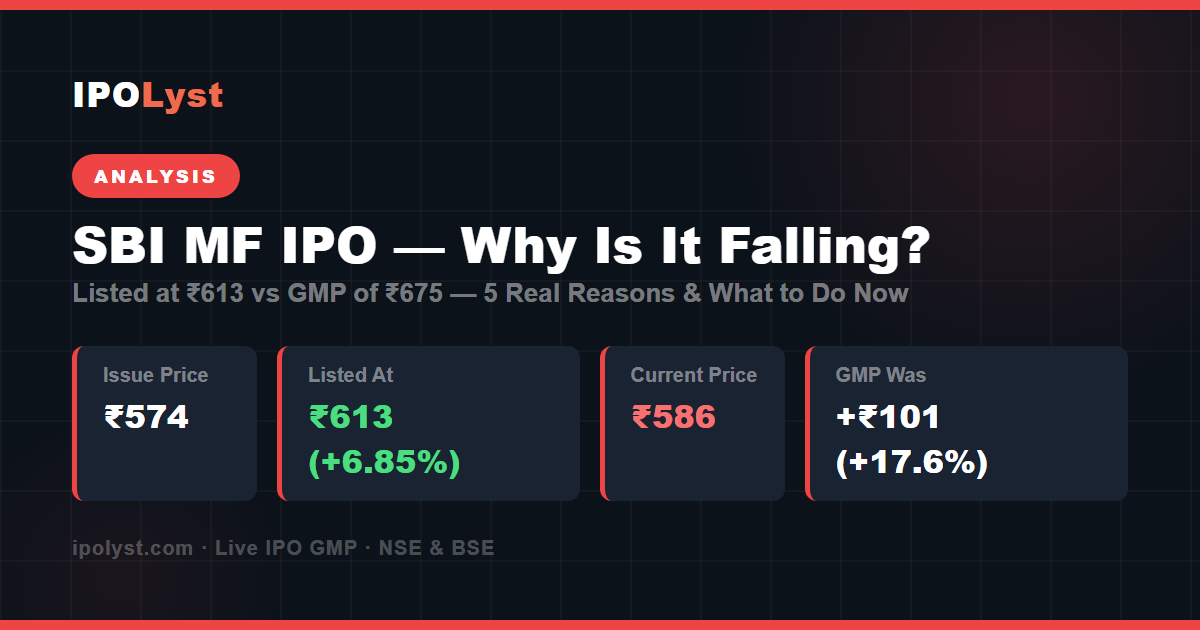
SBI MF IPO — What the Numbers Say
- Issue Price: ₹574 per share
- GMP Before Listing: +₹101 → Implied listing ~₹675 (+17.6%)
- Actual Listing Price: ₹613.30 on NSE (+6.85%), ₹610 on BSE (+6.27%)
- July 22 Close: ₹591.30 — down 3% from listing
- July 23 Price: ₹586.25 — just ₹12 above issue price
- 52-Week Low: ₹574 — the issue price itself
In plain terms: investors who expected ₹100+ listing gains got ₹39. And those who bought on listing day are already sitting at a loss. So what happened?
5 Reasons SBI MF IPO Is Underperforming
1. GMP Was Inflated — The Grey Market Mispriced It
The biggest reason for disappointment is not the stock — it is the expectation. A GMP of +₹101 before listing was wildly optimistic for a company of SBI MF's profile. Grey Market Premium reflects speculative demand from unregulated operators, not fundamental valuation. For a ₹9,812 crore OFS-heavy issue with no fresh capital, sophisticated institutional investors were never going to pay a 17% premium on day one. The GMP set up retail investors for disappointment by inflating expectations beyond what the fundamentals justified.
2. 100% OFS — The Company Gets No Money
This is the most important structural red flag. The entire ₹9,812.91 crore raised in the SBI MF IPO is an Offer for Sale — meaning SBI (divesting 6.3%) and Amundi (divesting 3.7%) were cashing out, not the company raising funds for growth. When promoters sell at the peak, the market reads it as a signal that the stock may already be fully valued. There is no fresh capital going into the business to accelerate growth — which limits the upside story for new investors.
3. Premium Valuation Left No Room for Error
At the issue price of ₹574, SBI Funds Management was valued at approximately ₹1.27 lakh crore — pricing in near-perfect execution. The P/E multiple implied by the issue price was higher than peers like HDFC AMC and Nippon India AMC, both of which have stronger recent fund performance track records. When you price perfection into an IPO, any sign of weakness — including post-listing profit booking — causes disproportionate selling.
4. Fund Performance Concerns — 11 Schemes in Bottom Quartile
Here is the part most retail investors missed before applying. As of FY2026, 11 of SBI MF's 128 schemes — managing ₹94,109 crore — were in the bottom quartile for performance over the past three years. In the asset management business, poor fund performance leads to redemptions, AUM decline, and fee pressure. While SBI MF's total AUM of ₹12.51 lakh crore is undeniably impressive, the quality of returns generated for investors in a significant portion of those schemes is under scrutiny.
5. Profit Booking by Anchor & HNI Investors
SBI MF received massive anchor investor and HNI subscription before the IPO. These investors — who applied at ₹574 — had a clear incentive to book profits at listing around ₹613 and above. The systematic selling pressure from this profit booking suppressed the stock price through listing day and the days that followed. This is a common pattern in large OFS-heavy IPOs where institutional investors flip on listing day, leaving retail buyers to absorb the selling pressure.
Is This a Temporary Dip or a Structural Problem?
The honest answer: it is a mix of both. The immediate sell-off is largely technical — profit booking, GMP disappointment, and post-listing correction. These factors are temporary and typically stabilize within 2–4 weeks of listing.
However, the structural concerns are real and worth watching:
- Continued underperformance of schemes relative to peers could lead to AUM outflows
- The AMC sector globally is under pressure from passive investing (index funds, ETFs) eating into active fund market share
- Regulatory changes from SEBI on expense ratios could compress margins
- SBI's majority ownership means corporate governance and business decisions are influenced by a government-owned parent
The Long-Term Case — Why SBI MF Could Still Win
Despite the rough listing, dismissing SBI MF as a long-term investment would be premature. The bull case remains intact:
- India's mutual fund penetration is still very low — less than 20% of savings are in financial assets vs 80%+ in developed markets
- SBI MF has 15.3% market share of India's total mutual fund AUM — an unassailable distribution moat through SBI's 22,000+ branches
- SIP culture is accelerating — monthly SIP inflows crossed ₹26,000 crore in 2026, and retail investors are just getting started
- Revenue grew 23.6% and profit grew 22.6% in FY2025, with similar trajectory in FY2026 — the fundamentals are strong
- As India's GDP grows and per capita income rises, AUM growth is structurally guaranteed over 5–10 years
The AMC business model is one of the best in financial services — low capital requirements, high operating leverage, and recurring fee income. SBI MF's brand, distribution, and scale make it difficult to dislodge from its leadership position.
Hold, Add, or Exit? Our Verdict
If you got allotment at ₹574 and are currently sitting at ₹586, your paper profit is just ₹12 per share. Here is our view based on your investment horizon:
- Short-term traders (1–4 weeks): The momentum is weak. If the stock breaks below ₹574 (issue price), consider cutting losses. There is no immediate catalyst to re-rate the stock sharply higher.
- Medium-term investors (3–12 months): HOLD. The stock is likely to stabilize once profit booking by anchor investors is absorbed. Any correction to ₹560–570 would be a strong buying opportunity for long-term investors.
- Long-term investors (2–5 years): ACCUMULATE on dips. The SIP growth story in India is a decade-long theme. SBI MF, as the largest AMC, will be a direct beneficiary. Target: ₹750–900 over 24–36 months.
The listing disappointment was about expectations, not fundamentals. Those are very different problems. The company remains India's largest AMC with a moat that will be very hard for competitors to breach.
Key Things to Watch
- Monthly AUM growth data — watch for any outflows from the bottom-quartile schemes
- Q1 FY2027 earnings (Aug/Sep 2026) — revenue and PAT growth will be the next major catalyst
- SEBI regulatory announcements on AMC expense ratio caps
- Broader market conditions — if Nifty corrects, AMC stocks tend to fall harder
- SBI MF fund performance rankings — improvement here would be a strong re-rating trigger
Disclaimer
Disclaimer: This article is for informational and educational purposes only and does not constitute financial advice. IPOLyst is not a SEBI-registered investment advisor. All data cited is based on publicly available sources as of July 23, 2026. Past IPO performance is not indicative of future results. Please consult a qualified financial advisor before making any investment decisions.