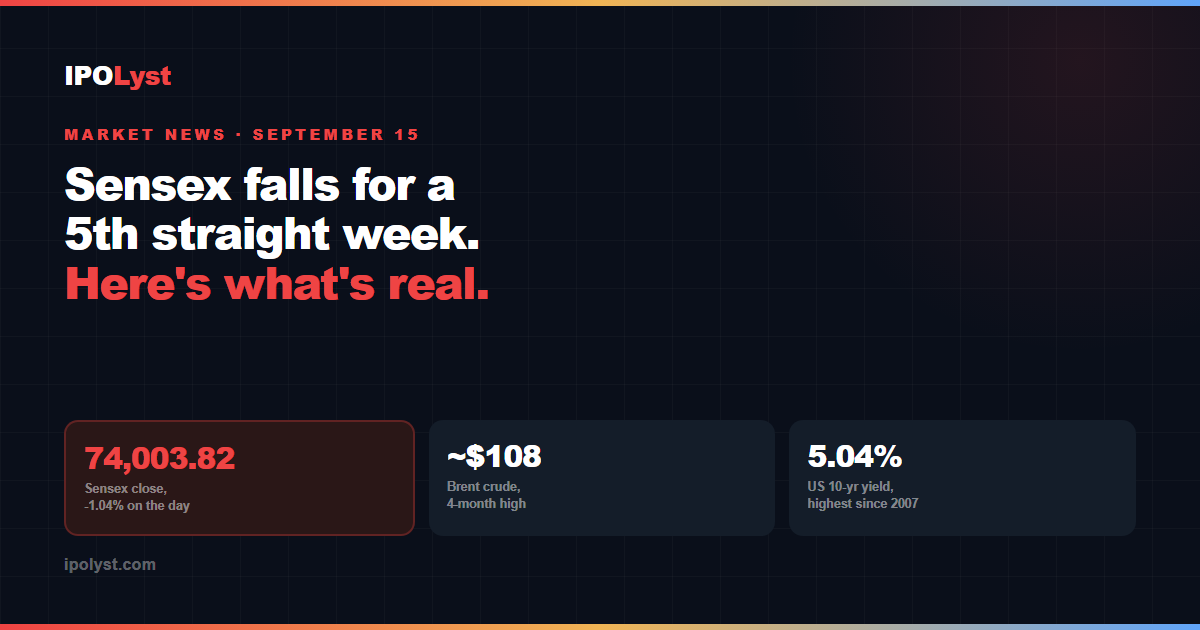
The Sensex closed at 74,003.82 on September 15, down 777.94 points (-1.04%), with the Nifty 50 down 279.50 points (-1.19%) to 23,118.60. That's the fifth straight weekly decline for both indices — roughly a 5% cumulative fall over five weeks. If you've seen a post going around with these numbers, most of it checks out. Two specific claims in circulation don't, though, and one of them flips the actual story. Here's the real picture.
Oil, yields, and the Fed — three forces colliding this week
Brent crude has been the dominant story. It's risen toward $108 a barrel, but the "first time since 2022" framing going around is off — this is a 4-month high, the highest close since May 22, 2026, not a multi-year one. The move is real and sharp: Brent is up more than 8% in September alone, driven by escalating US-Iran military exchanges, including a Saudi Arabian pipeline shutdown after drone attacks disrupted a key route used to bypass the Strait of Hormuz. Goldman Sachs has flagged the possibility of Brent clearing $120 if shipping attacks keep intensifying.
That oil spike is feeding directly into bond markets. The US 10-year Treasury yield hit 5.04% this week, its highest level since July 2007, rising for a fifth consecutive session as oil-driven inflation fears build ahead of the Fed's decision. Higher US yields pull global capital toward safer dollar assets and away from emerging markets like India — part of why FII selling has continued.
- FOMC decision: Wednesday, September 16, 2:00 PM ET
- Current Fed funds target range: 3.5%–3.75%, unchanged since December 2025
- Market-implied probability of a 25bp rate HIKE: 91% — this would be the Fed's first hike since 2023, not a cut
So the FOMC framing in circulating posts is actually correct: the market is bracing for a hawkish surprise, not rate relief.
FII selling, DII cushioning
Foreign institutional selling has been a real drag, though we couldn't verify a clean September month-to-date total — the specific figure claimed in some posts isn't something we could confirm from available data. What is confirmed: on September 4, FIIs sold ₹3,111.94 crore while DIIs bought ₹8,930 crore; on September 11, FIIs sold ₹930.90 crore while DIIs bought ₹1,968.20 crore. The pattern is consistent — domestic institutional buying has been absorbing a large share of foreign outflows through the month, which is part of why the index declines have been steady rather than sharp single-day crashes.
The Nifty IT twist — and where the "bull vs bear" story actually gets it backwards
This is the correction that matters most. A claim going around says Nifty IT gained 5% this week because rupee weakness created an opportunity for IT exporters. That's not what happened — and it's close to the opposite.
Nifty IT was the single biggest drag on the market for most of the week. It fell 3.2% on September 9-10, its steepest single-day drop in three months, and the sector is down roughly 24% year-to-date, making it India's worst-performing major sector in 2026. Then, specifically on September 15, Nifty IT surged 3.74% to 30,004.40 — a real, sharp move, but the trigger was not currency. It happened because AI-disruption fears eased after industry leaders signaled a slower pace of AI development, easing investor concern about IT services demand. That rally helped cushion the broader market's same-day fall; it didn't reverse it — Sensex and Nifty both still closed lower on September 15 despite the strong IT rally.
So is this the real bull vs bear picture this week?
The real contrast is: a battered sector (IT, down 24% YTD) had one strong single-day bounce on sentiment-specific news, while the broader market kept sliding under oil, yield, and pre-FOMC pressure. That's a genuinely interesting story — it's just a different one from "weak rupee helps IT exporters," which isn't what the data shows for this move.
We cross-checked the index levels and the five-week losing streak against Business Standard's market wrap and the crude oil price move against CNBC's coverage of the US-Iran-driven oil spike — both matched.
For live GMP and how this kind of macro volatility is feeding into IPO demand this week, see our IPO GMP tracker.
Frequently Asked Questions
Did Brent crude cross $108 for the first time since 2022?
No. Brent rose toward $108 a barrel in mid-September 2026, but that's a 4-month high — the highest closing price since May 22, 2026 — not the first time since 2022. The move is still significant: Brent is up more than 8% in September, driven by escalating US-Iran tensions and a Saudi pipeline shutdown after drone attacks near a Hormuz-bypass shipping route.
Did Nifty IT rise 5% this week because of rupee weakness?
No, and this reverses the actual story. Nifty IT was the market's worst-performing sector for most of the week, falling 3.2% on September 9-10 (its steepest single-day drop in three months) and sitting around 24% down year-to-date. It then rallied 3.74% specifically on September 15 — not due to rupee weakness, but because AI-disruption fears eased after industry comments pointed to a slower pace of AI development.
Is the Fed expected to cut or hike rates on September 16?
The market is pricing a hike, not a cut. As of mid-September 2026, the market-implied probability of a 25 basis point rate increase at the September 16 FOMC meeting was around 91% — which would be the Federal Reserve's first hike since 2023, driven by inflation concerns tied to the recent oil price surge.
Disclaimer: This article is for informational and educational purposes only and does not constitute financial or investment advice. IPOLyst is not a SEBI-registered investment advisor. Market data reflects the last available trading session and is subject to change. Please conduct your own research or consult a registered advisor before investing.