Deutsche Bank says the silver market could flip from a six-year deficit to a surplus in 2027, and the reason is weak demand, not a surge in mine supply. In its October 5 note, metals research head Daniel Ghali points to solar manufacturers using far less silver after prices more than doubled, with global solar demand for silver down over 20% in 2026 and China down about a third. But 2026 is still a deficit year: the Silver Institute puts it at 46.3 million ounces. Both statements are true, because the surplus is a 2027 forecast. Here is how the two stories fit together, what the inventory data shows, and what it means for prices in dollars and in India.
Why the Shortage Story Is Changing
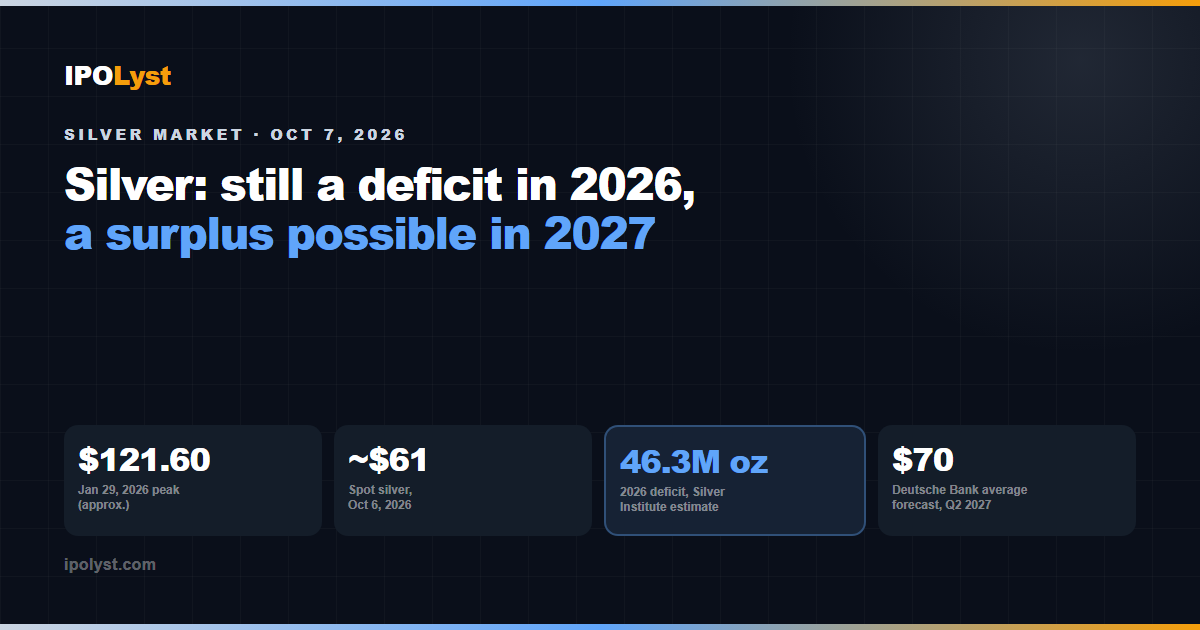
Silver ended 2025 near $72 an ounce after starting the year at $28.92, a gain of about 144%. It then peaked at roughly $121.60 on January 29, 2026, and fell more than 25% the next day, according to one market report. At that level the metal became a major cost for solar panel makers, and they responded.
- Cost share: silver was under 10% of the cost of a solar module in early 2025, over 30% in early 2026, and is roughly 14% now, according to Deutsche Bank as reported by IndexBox.
- Thrifting: manufacturers cut silver per cell with thinner electrical contacts, copper-coated silver pastes and designs that need less metal. Deutsche Bank estimates silver use per cell fell 17% in 2026.
- Solar demand: global silver use in solar is down over 20% this year, and Chinese demand is down about 33%. Whalesbook's summary puts China's contraction at roughly 30%.
Demand destruction means high prices themselves shrink demand. It is slower to reverse than a temporary dip, because redesigned production lines do not simply switch back when the price falls.
What the Inventory Data Shows
- London vaults held 914.08 million ounces of silver at the end of August 2026, about 28,431 tonnes, according to London bullion market vault data reported by aggregators. Total holdings were up 16.6% year on year in July.
- The part that is readily available to buyers, about 300 million ounces, is up 70% since October 2025, according to Deutsche Bank. Kitco reports free-floating London inventory is at its highest since November 2024.
- COMEX holds a stockpile that is too large for its open interest, and Shanghai inventories have risen too, per Ghali.
The 914 million ounces is the total in London, not the figure that rose 70%. That 70% applies to the readily available portion. Metal building up in London, the US and China at the same time is consistent with softer demand and not just stock moving between exchanges, which is our reading of the data and not a statement from the report.
Why 2026 Is Still a Deficit Year
The World Silver Survey 2026, from the Silver Institute and Metals Focus, put the 2026 deficit at 46.3 million ounces. Demand is forecast at 1,112.6 million ounces against supply of 1,066.4 million. That is about 15% bigger than the 40.3 million ounce shortfall in 2025 and the sixth straight deficit year, and the market has drawn about 762 million ounces from above-ground stocks since 2021.
- 2026: still a deficit, 46.3 million ounces (Silver Institute and Metals Focus, published April 15).
- 2027: a possible surplus. Deutsche Bank describes a shrinking deficit and perhaps a physical primary market surplus in the coming year.
- The turning point has started, but the shortage itself has not ended yet.
The two numbers come from different sources and different dates, and forecasts for a year that has not started can change. The survey was compiled in April, and the Deutsche Bank note is from October.
What It Means for the Silver Price
Deutsche Bank sees spot silver averaging $70 an ounce by the second quarter of 2027. Silver traded at about $61 on October 6, according to Fortune and others, and was at $60.99 in Deutsche Bank's note. That makes the forecast about 14% above today's price, by our calculation, and about 42% below the January peak.
- Against the peak of about $121.60: the forecast is far lower.
- Against today's roughly $61: the forecast is higher, so it does not describe a fall from here.
- Against the start of 2025 at $28.92: even $61 is about 2.1 times that level.
- 2026 so far: roughly 14% lower for the year, per the Deutsche Bank note.
A surplus does not automatically push prices down, and a deficit does not automatically push them up. Investment demand for bars and coins, the dollar and interest rates all move silver too, and it has been very volatile this year.
What It Means in India
MCX silver hit a record of about ₹4.10 lakh per kg on January 29 to 30, 2026, according to reports, and the September contract was at ₹2,28,035 per kg on September 28. That is about 44% below the peak, by our calculation. The rupee near ₹96 to the dollar raises the rupee price of silver, so a weaker rupee cushions the fall for Indian buyers.
At $61 an ounce and ₹96.3 to the dollar, silver converts to about ₹1.9 lakh per kg before duties, taxes and local premiums, by our calculation. Indian prices run higher than the converted spot price because of those extras.
Check current Indian silver and gold prices on our gold and silver rates page.
Two Narratives, Both True
- Narrative one: silver has been in deficit for six years and 2026 is another deficit year. This is backed by the Silver Institute data.
- Narrative two: demand destruction, mainly in solar, and rising inventories could produce a surplus in 2027. This is Deutsche Bank's forecast and is not certain.
The headline "silver shortage" can still be accurate for 2026 while the direction of travel has already changed. Anyone reading a silver headline should check which year and which measure it describes.
What Could Change the Surplus View
- A lower silver price makes silver cheaper in solar again, since its cost share is already down to about 14% from over 30%.
- Investment demand and industrial demand outside solar could stay stronger than expected.
- Forecasts differ. Whalesbook's summary cites a 2027 range of $63 to $75, and a surplus year is still only a forecast.
What to Watch Next
- Monthly London vault data and COMEX and Shanghai inventories, to see whether the stock build continues.
- Chinese solar production and silver use, the main source of demand destruction.
- The dollar and US interest rate expectations, which have driven much of silver's recent volatility.
- Updates to deficit and surplus estimates from the Silver Institute and the banks.
This is not advice to buy, hold or sell silver. Silver is volatile, with a drop of over 25% in a single day in January, so any decision depends on your goals, horizon and risk tolerance. Consider speaking to a SEBI-registered advisor.
Figures were checked against IndexBox's summary of the Deutsche Bank note, Kitco's report on Daniel Ghali's views, Northern Miner's report, a summary of the World Silver Survey 2026, Fortune's silver price page, London vault data from the LBMA and Sunday Guardian's MCX silver reports.
Frequently Asked Questions
Is there still a silver shortage in 2026?
Yes. The Silver Institute and Metals Focus put the 2026 market in deficit by 46.3 million ounces, the sixth straight deficit year. Deutsche Bank's view is that the deficit is shrinking and could turn into a surplus in 2027.
Will silver be in surplus in 2027?
Deutsche Bank says it could be, mainly because high prices cut solar demand and inventories are rising. It is a forecast, not a fact, and other analysts' views and the underlying data can change.
What is Deutsche Bank's silver price forecast?
Deutsche Bank sees spot silver averaging $70 an ounce by the second quarter of 2027. Silver was about $61 in early October 2026, so that forecast is above today's price but far below the January 2026 peak of about $121.60.
Why is solar demand for silver falling?
When silver became over 30% of solar module costs in early 2026, manufacturers cut silver use with thinner contacts and copper-coated pastes. Deutsche Bank estimates global solar silver demand is down over 20% in 2026, and China's is down about a third.
How much silver is in London vaults?
About 914 million ounces at the end of August 2026, of which roughly 300 million ounces is readily available. Deutsche Bank says that readily available portion is up 70% since October 2025.
Disclaimer: This article is for informational and educational purposes only and does not constitute financial or investment advice. IPOLyst is not a SEBI-registered investment advisor. Commodity prices are volatile and forecasts can be wrong. Past performance is not a guarantee of future returns. Please verify figures with official sources and consult a registered advisor before making investment decisions.