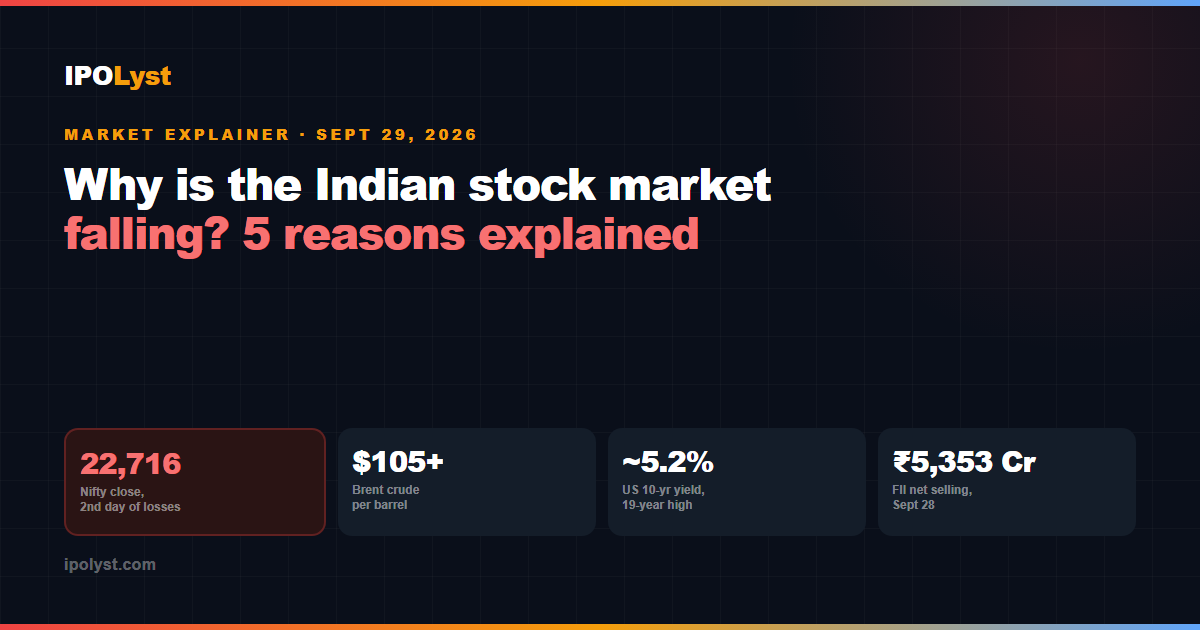
The Nifty 50 closed at 22,716.20 on September 29, 2026, its second straight day of losses, after touching an intraday low of 22,569.65. More than 220 companies hit fresh 52-week lows during the session. Five things are behind the pressure: crude oil holding near $105 to $107 a barrel, US bond yields at a roughly two-decade high, steady foreign selling, a volatile monthly derivatives expiry, and a fresh worry over Tata Sons. Here is how each one fits together, and what we could and could not verify.
This follows Monday's sharper fall, when the Nifty dropped 360.25 points to 22,780.25. See our report on everything that moved the market on September 28.
1. Crude Oil Stays Near $105 to $107
Brent crude has held in the $105 to $107 range through the week, trading near $105.31 a barrel on September 29. The cause reports point to is the unresolved standoff between the US and Iran, which keeps a risk premium in the oil price.
For India, which imports most of the crude oil it uses, an expensive barrel raises the import bill, adds to inflation worries and can squeeze margins at companies that cannot fully pass on higher input costs. The businesses to watch are oil marketing companies, aviation, paints and chemicals, along with the rupee itself. How much any single company is hurt depends on its ability to raise prices, so treat this as a sector-wide pressure rather than a company-specific verdict.
2. US Bond Yields Near a Two-Decade High
The US 10-year Treasury yield has been at its highest level in roughly 19 years this month. Reports put it at 5.23% on a recent Friday, the highest since 2007, and around 5.24% on September 29. When US yields rise, dollar-denominated bonds become more attractive relative to emerging-market stocks, and that can pull foreign money out of markets like India's.
What to watch next is whether US yields hold near these levels or ease, along with the dollar index and upcoming US inflation and employment data. Higher yields do not automatically mean more selling every single day, but they set the backdrop foreign investors are trading against.
3. Foreign Investors Kept Selling, Domestic Investors Kept Buying
On Monday, September 28, foreign institutional investors sold about ₹5,353 Cr of Indian stocks on a provisional basis. Domestic institutional investors bought almost as much, about ₹5,189 Cr, on the same day. That domestic buying cushioned some of the fall, but it did not stop the Nifty from closing lower that day, and it has not stopped the slide from continuing into Tuesday.
These are single-day, provisional figures. Extending a one-day selling number into a trend is a common mistake, so track the next few sessions of FII and DII data rather than assuming Monday's pace continues at the same size every day.
4. Monthly Expiry Added to the Swings
September 29 was the monthly futures and options expiry, and that added volatility to an already weak market. The Nifty's intraday low of 22,569.65 versus its close of 22,716.20, a swing of about 147 points, is a sign of the kind of position adjustment that expiry days often produce.
A large intraday move on an expiry day can reflect traders squaring off positions as much as fresh conviction about where the market is headed next. A sharp swing by itself is not confirmation of a new trend.
5. A Tata Sons Listing Worry, in Two Parts
Tata group stocks have been under pressure across two separate sessions, for related but not identical reasons.
- On Monday, September 28, Tata Chemicals and Tata Investment Corporation fell amid general uncertainty over whether Tata Sons would eventually list, as Reuters reported at the time.
- On Tuesday, September 29, the shares fell again after Tata Trusts, the majority shareholder in Tata Sons, proposed on Monday evening to merge two of its unlisted units, Tata Electronics and Tata Consulting Engineers, into Tata Sons. That structure could let Tata Sons remain private and avoid a listing that the Reserve Bank of India has been pushing for as a non-banking finance company. Business Today reported Tata Chemicals down 3.2% to ₹620.6 and Tata Investment Corporation down 2.01% to ₹631.85 in Tuesday's trade, though figures varied across reports during the session.
A listing had been expected to unlock value for the Tata companies that hold stakes in Tata Sons. The market's reaction reflects that a private, merged structure is now seen as a real possibility, not a confirmed outcome. Watch for a formal regulatory or company announcement rather than treating the current share-price move as a final answer.
What This Means for IPO Watchers
A falling, choppy market usually cools sentiment for new listings and grey market premiums, even when a specific issue has strong fundamentals. Track how current IPOs are trading on our IPO GMP tracker, and see how premiums held up in the last big listing spike in our report on Robokidz Eduventures listing at a 90% premium. None of this tells you whether any specific IPO is worth applying to.
What to Watch Next
- Whether Brent crude holds above $105 or eases as US-Iran talks develop.
- US 10-year Treasury yields, the dollar index, and upcoming US inflation and jobs data.
- The next FII and DII figures, rather than assuming Monday's pace repeats.
- Any official Tata Sons or Tata Trusts announcement on the merger proposal.
Figures were checked against Whalesbook's September 29 market report, Business Standard's September 28 close report, NewsBytes' FII/DII data, Business Today's report on Tata stocks and CNBC's report on the 10-year Treasury yield.
Frequently Asked Questions
Why is the Indian stock market falling this week?
Five factors are combining: crude oil near $105 to $107 a barrel on US-Iran tension, US 10-year Treasury yields near a two-decade high, continued foreign institutional selling only partly offset by domestic buying, volatility from the monthly F&O expiry on September 29, and fresh uncertainty over whether Tata Sons will list after a new restructuring proposal.
Did FII selling cause the market fall by itself?
Not by itself. FIIs sold about ₹5,353 Cr on September 28, but DIIs bought nearly as much, about ₹5,189 Cr, on the same day. The fall reflects FII selling combined with high oil prices, high US yields and expiry-day volatility, not FII selling alone.
What is the Tata Sons listing issue about?
Tata Sons, the Tata group's holding company, has faced pressure to list as a non-banking finance company under Reserve Bank of India rules. Tata Trusts, the majority shareholder, proposed merging two unlisted units into Tata Sons, a structure that could let it remain private. Tata Chemicals and Tata Investment Corporation, which hold stakes in Tata Sons, fell on the news because a listing had been expected to unlock value for them.
Is a sharp intraday move on expiry day a sign of a trend?
Not necessarily. Large intraday swings on a monthly futures and options expiry day often reflect traders closing out positions rather than a fresh directional view on the market. A single sharp move is not confirmation of where prices are headed next.
Disclaimer: This article is for informational and educational purposes only and does not constitute financial or investment advice. IPOLyst is not a SEBI-registered investment advisor. Market data, corporate announcements and price levels can change quickly. Please verify figures with official sources and consult a registered advisor before making investment decisions.