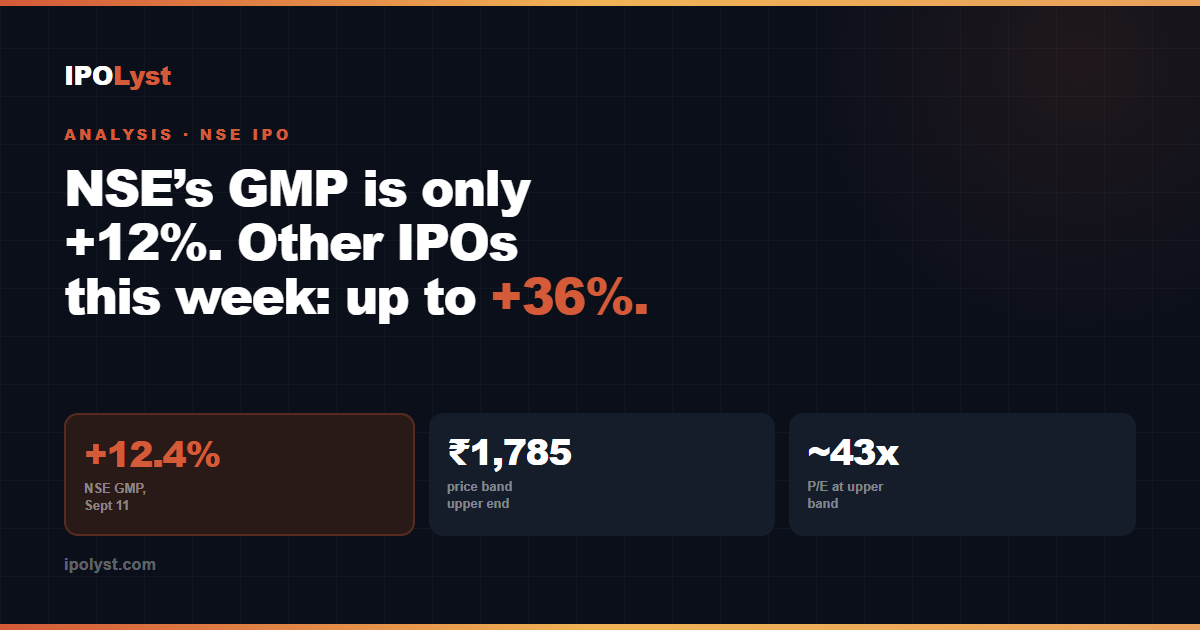
NSE's grey market premium is +₹222, or +12.4%, on a freshly announced price band of ₹1,700-1,785. For most IPOs that would be a solid, respectable number. For NSE — the exchange every other stock in this list trades on — it's noticeably lower than what the rest of this week's mainboard board is showing. Kanohar Electricals is at +36%. Glass Wall Systems is at +31%. Rentomojo is at +35%. NSE, arguably the single most anticipated IPO of the year, is sitting at a third of that. Here's why that isn't really about valuation.
The number, finally confirmed
- Price band: ₹1,700 - ₹1,785 per share
- Lot size: 8 shares (minimum retail investment: ₹14,280 at the upper band)
- GMP: +₹222 (+12.4%) as of September 11, 2026
- Bidding opens: September 17, 2026
- Bidding closes: September 21, 2026
- Listing: September 24, 2026
This is the third time NSE's schedule has moved since it was first confirmed — each revision has pulled the dates earlier, not later. The price band, however, is genuinely new: for most of the run-up, NSE's own listing showed a placeholder price and a GMP quoted only in rupees, which made any percentage figure meaningless. Now that there's an actual price to measure against, +12.4% is the real number — not a placeholder.
GMP has been anything but stable
Before today, NSE's GMP moved in rupee terms with no price to anchor it to: ₹285 for three straight days (Sept 5-7), then a drop to ₹200 on Sept 8, a bounce to ₹255 on Sept 9, and now ₹222 today — the first day it's expressed as a real percentage rather than a floating number. That kind of swing, even before a price band existed, tells you the grey market itself wasn't confident about where this would land.
Why +12.4% isn't really a valuation problem
The instinctive explanation for a lower GMP is "it's priced too rich." That's not quite what's happening here. At the confirmed upper band of ₹1,785, NSE is valued at roughly 43 times earnings. Its closest listed comparison — BSE, the smaller rival exchange already trading on NSE itself — trades at a P/E in the high-40s. On that basis, NSE is actually pricing in at a discount to BSE, not a premium.
So what is actually holding the GMP back?
Growth trajectory, not price. According to one detailed NSE-vs-BSE comparison, BSE's profit grew roughly 88% in FY26, riding gains in Sensex weekly options market share, while NSE's own FY26 profit declined — both exchanges are absorbing the same F&O regulatory changes, but BSE has so far navigated them better. A cheaper entry price on paper doesn't excite the grey market as much when the company's own recent earnings trend is moving the wrong direction, especially when a smaller competitor is visibly taking share in the same period.
That comparison is one analyst's read (via unlistedzone.com), not an official NSE disclosure — worth treating as one informed perspective rather than settled fact, but it's a more coherent explanation than "the market thinks it's overpriced," which the P/E numbers don't actually support.
How NSE stacks up against this week's other mainboard IPOs
- Kanohar Electricals — Mainboard, +36% GMP, 61x+ subscribed on closing day
- Rentomojo — Mainboard, +35% GMP
- Glass Wall Systems — Mainboard, +31% GMP, 46x+ subscribed on closing day
- NSE — Mainboard, +12.4% GMP, not yet open for bidding
None of these are direct comparisons — different sectors, different sizes, different float — but they illustrate the point. This week's grey market has shown it's willing to bid IPOs up sharply when the story is simple growth. NSE's story is more complicated: the most important financial market infrastructure in the country, priced reasonably against its closest peer, but carrying a recent earnings wobble that a lower price band alone doesn't erase.
What this means if you're planning to apply
A 12.4% GMP is not a warning sign by itself — plenty of IPOs with modest pre-open premiums have listed solidly, and NSE's scale and market position aren't in question. But it's also not the explosive, priced-for-a-pop number some may have expected from India's most anticipated listing of the year. Treat it as the market pricing in genuine respect for the business alongside genuine uncertainty about near-term earnings growth — not as either a red flag or a steal.
We're tracking NSE's live GMP alongside every other open and upcoming issue on our IPO GMP tracker, and you can see how this schedule has changed over time in our previous NSE date-change coverage.
Frequently Asked Questions
Why is NSE IPO's GMP lower than other IPOs this week?
NSE's GMP of +12.4% (as of September 11, 2026) is lower than this week's other mainboard IPOs — Kanohar Electricals (+36%), Rentomojo (+35%), and Glass Wall Systems (+31%) — likely because NSE's FY26 profit declined while its smaller rival BSE's profit grew roughly 88%, not because NSE is priced expensively. At its ₹1,785 upper band, NSE trades at a lower P/E (~43x) than BSE (~47-49x).
What is NSE IPO's price band and GMP today?
As of September 11, 2026, NSE's confirmed price band is ₹1,700-1,785 per share, with a grey market premium of +₹222 (+12.4%). This is the first time the GMP has been expressed as a real percentage, since the price band was undisclosed for most of the run-up to this announcement.
Is NSE IPO overvalued?
Not obviously, on a P/E basis. At the upper price band of ₹1,785, NSE is valued at roughly 43 times earnings, which is a discount to BSE's price-to-earnings ratio in the high-40s. The lower GMP appears more connected to NSE's recent earnings trend than to its pricing.
Disclaimer: This article is for informational and educational purposes only and does not constitute financial advice. IPOLyst is not a SEBI-registered investment advisor. GMP is indicative only, sourced from informal grey market channels, and can change significantly before listing. P/E and valuation comparisons cited from third-party analysis should be independently verified. Please conduct your own research or consult a registered advisor before investing.