Foreign institutional investors sold ₹43,395 Cr of Indian stocks over the six sessions from September 29 to October 7, 2026, according to exchange data. The headline "FIIs are leaving India" is mostly right. The sector data does show a selective tilt, with foreign money moving out of rate-sensitive sectors and into consumer services, services and healthcare, but the buying is small next to the selling. In September, NSDL data shows a net equity outflow of ₹35,861 Cr, and the sectors that attracted money took in only about a fifth of what the sold sectors lost. Here is what the numbers say, and where the popular "rotation" story goes too far.
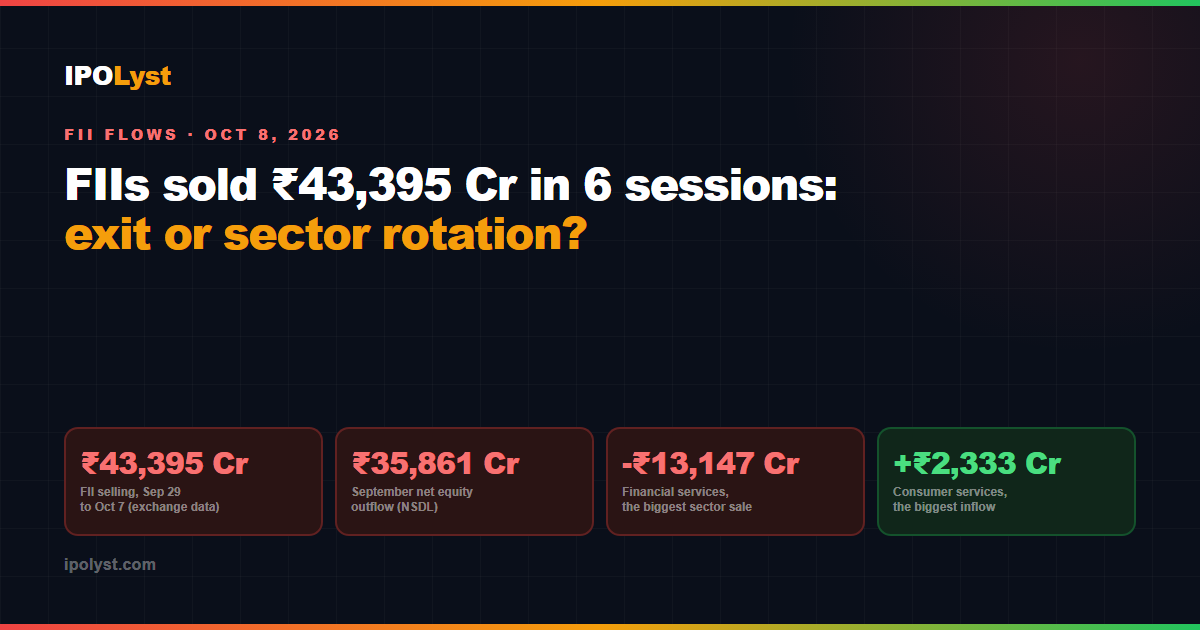
Six Sessions, ₹43,395 Cr: What FIIs Did Day by Day
Exchange provisional data shows these net FII sales:
- September 29: ₹9,980.22 Cr
- September 30: ₹10,148.41 Cr, the largest single-day outflow since March
- October 1: ₹9,484.22 Cr
- October 5: ₹4,699.14 Cr
- October 6: ₹2,961.30 Cr
- October 7: ₹6,121.37 Cr, the day the RBI raised the repo rate
The six figures add up to about ₹43,395 Cr. Selling was heaviest in the last two sessions of September and the first of October, eased on October 5 and 6, and picked up again on the day of the RBI hike. October 2 was a market holiday.
For the earlier part of this run, including DIIs buying ₹76,030 Cr in September, see our report on the Nifty's eight-week losing streak.
September's Sector Flows: What Was Sold, What Was Bought
NSDL's fortnightly sector data, reported by Finnovate and Business Standard, shows net FPI equity flows for September 2026 of ₹35,861 Cr out. By sector:
Sold
- Financial services: ₹13,147 Cr, the sharpest outflow of the month
- Oil, gas and consumable fuels: ₹6,854 Cr
- Automobiles and auto components: ₹6,212 Cr
- Telecommunication: ₹3,414 Cr
- Metals and mining: ₹3,003 Cr
- FMCG: ₹3,001 Cr
Bought
- Consumer services: ₹2,333 Cr, the biggest inflow
- Services: ₹2,302 Cr
- Healthcare: ₹2,117 Cr
The named buying adds up to about ₹6,750 Cr, against roughly ₹35,600 Cr of named selling, so the sectors that gained money offset about 19% of what the others lost, by our calculation. NSDL files banks inside financial services, and we did not find a separate bank figure in the sources we could verify.
Where Did the Money Go? The Primary Market Question
Some of the foreign money did go into IPOs. A mid-September depositories report found FPIs sold ₹25,682 Cr on exchanges but put ₹8,551 Cr into the primary market, which cut the net outflow for that stretch to ₹17,131 Cr. That is the only primary-market figure we could verify, and it covers the first half of the month. We could not confirm a full-month September total. Foreign investors were also still taking part in new issues while selling secondary-market shares.
This matters because September was a busy month for IPOs. Business Today reported 34 companies raised ₹39,380 Cr, of which the NSE's own issue was ₹22,562 Cr, even as the market fell.
Rotation or Exit? Weighing the Evidence
Evidence for a selective rotation
- Foreign investors sold the sectors most exposed to high interest rates and costly oil: financial services, oil and gas, and autos. Business Standard headlined its report that FPIs sold rate-sensitive sectors and favoured consumer services.
- They bought consumer services, services and healthcare.
- Some money went into IPOs, at least in the first half of September.
Evidence that it is mostly an exit
- The net equity outflow in September was ₹35,861 Cr, so most of the sold money did leave. The six-session exchange total of ₹43,395 Cr is larger still, although the two figures use different data sources and should not be compared directly.
- The buying was small, about ₹2,100 Cr to ₹2,300 Cr in each of the three sectors.
- Defensive sectors were sold too. FMCG saw ₹3,001 Cr of selling and telecom ₹3,414 Cr, so "defensive sectors" is not a clean description of what was bought.
Our reading is that this is a risk-off exit with some selective buying inside it, not a full rotation. That conclusion is our interpretation of the data.
The Banks Paradox: Selling Financials While Banks Rebound
On October 7, the RBI raised the repo rate by 25 basis points to 5.50% and said near-term rate cuts are off the table. The Sensex closed 429 points lower at 72,638.70 and the Nifty ended at 22,603. Business Standard, Upstox and Outlook Money reported that bank and NBFC shares rebounded from early losses after the announcement, while auto and realty stocks stayed weak. FIIs still sold ₹6,121.37 Cr that day.
That sits oddly with foreign investors being the biggest sellers of financial services. Reports do not explain why banks held up, and domestic institutional buying is one possible reason. We do not have data on that day's DII flows, so treat any explanation as a hypothesis.
The rebound did not last. On October 8 the Sensex fell 1,045.46 points, or 1.44%, to 71,593.24, and the Nifty fell 371.25 points, or 1.64%, to 22,231.80, a 2026 low, with Brent crude near $104 and the volatility index up more than 10%.
What About Jio and Small IPOs?
Jio Platforms' IPO is tentatively set for October 21 to 23, with listing on October 28. It is reported at roughly ₹32,000 to ₹33,000 Cr, and the red herring prospectus and price band have not been filed yet. Against the ₹8,551 Cr that FPIs put into IPOs in the first half of September, an issue of that size is about 3.8 times larger, by our calculation.
It is reasonable to ask whether a very large issue could absorb institutional demand that smaller IPOs would otherwise get. That is our inference, not something the data shows. September also showed that many IPOs can raise money in a weak market, so liquidity for small issues is something to watch and not a forecast.
See our updated Jio IPO review for the latest terms, and track how current issues are doing on the IPO GMP tracker.
What to Watch Next
- Whether FII selling slows, as it did on October 5 and 6, or keeps running near ₹5,000 to ₹10,000 Cr a day.
- NSDL's first-half October sector data, to see if consumer services, services and healthcare keep attracting money.
- Brent crude and the rupee, which have driven much of the pressure on rate-sensitive sectors.
- The Jio red herring prospectus and price band, and how institutional demand responds.
- The next DII figures, to see whether domestic buying keeps absorbing the selling.
Figures were checked against Finnovate's NSDL sector-wise report, Business Standard's report on FPIs and rate-sensitive sectors, WION's report on the six-session FII outflow, Business Standard's October 7 market close report, Business Standard's report on the RBI hike and Business Standard's October 8 close report.
Frequently Asked Questions
How much did FIIs sell in the last six sessions?
Foreign institutional investors sold about ₹43,395 Cr of Indian stocks over the six sessions from September 29 to October 7, 2026, according to exchange provisional data. The largest day was September 30 at ₹10,148.41 Cr.
Which sectors did foreign investors sell in September 2026?
NSDL data shows the biggest net selling in financial services (₹13,147 Cr), oil and gas (₹6,854 Cr) and automobiles (₹6,212 Cr), followed by telecom, metals and mining, and FMCG at about ₹3,000 Cr each.
Which sectors did foreign investors buy?
Consumer services (₹2,333 Cr), services (₹2,302 Cr) and healthcare (₹2,117 Cr) saw net foreign buying in September. That is small compared with the ₹35,861 Cr net equity outflow for the month.
Is this sector rotation or FIIs leaving India?
The data shows both, but mostly an exit. Foreign investors sold rate-sensitive sectors and bought a few others and some IPOs, yet the net equity outflow was ₹35,861 Cr in September, and defensive sectors such as FMCG were sold as well.
Why did bank stocks rise on October 7 if FIIs were selling financials?
Bank and NBFC shares rebounded from early losses after the RBI hiked the repo rate to 5.50%. Reports did not give a reason, and the FII and DII flows for that day do not explain it fully, so any explanation is a hypothesis. Bank stocks fell with the rest of the market on October 8.
Disclaimer: This article is for informational and educational purposes only and does not constitute financial or investment advice. IPOLyst is not a SEBI-registered investment advisor. Investments in securities markets are subject to market risk. Flow data differs by source and method, and figures can be revised. Please verify figures with official sources and consult a registered advisor before making investment decisions.