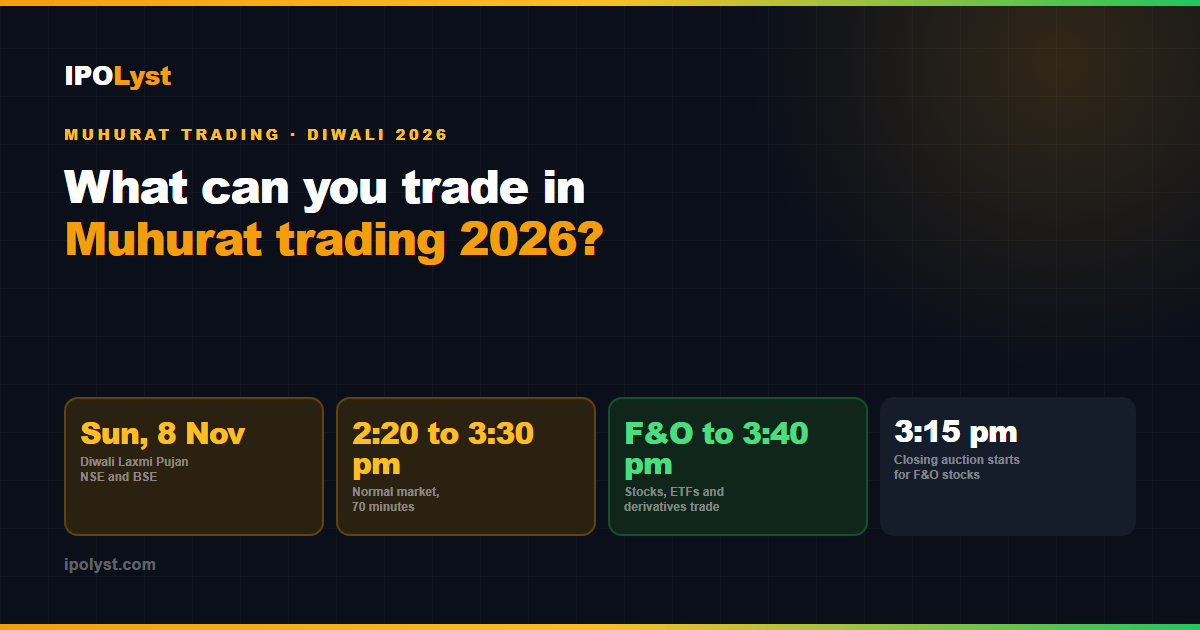
Muhurat trading 2026 takes place on Sunday, November 8, the day of Diwali Laxmi Pujan, with NSE and BSE running the same schedule. Normal trading starts at 2:20 pm, and this is the first Muhurat session since the Closing Auction Session (CAS) was introduced in August 2026. The session is a real market: stocks, ETFs and futures and options trade, and trades carry binding settlement obligations. This guide explains what you can trade, when each segment runs, and what to be careful about.
Muhurat Trading 2026 at a Glance
- Date: Sunday, November 8, 2026 (Diwali Laxmi Pujan), on both NSE and BSE.
- Block deal window: 1:50 pm to 2:05 pm.
- Pre-open: from 2:05 pm. Market and limit orders are accepted until 2:10 pm, and only limit orders after that. Order matching runs from 2:15 pm to 2:17 pm.
- Normal market: 2:20 pm to 3:30 pm, a 70 minute window.
- F&O: 2:20 pm to 3:40 pm.
- Closing auction: stocks covered by CAS stop continuous trading at 3:15 pm and close through an auction.
These times come from broker and news summaries of the circulars the exchanges issued on October 19, 2026, including Business Today's full schedule and JM Financial's segment-wise table. We could not open the circulars themselves, so please confirm the exact times with NSE, BSE or your broker before you place an order.
What Can You Trade During Muhurat Trading?
The short answer is almost everything you can trade on a normal day, but in a shorter window and with thinner volumes. Here is how each product works, according to the exchange schedules and a StudyCafe explainer (flagged where it is the only source).
Stocks (Cash Segment)
Listed equity shares trade as usual. StudyCafe reports that both intraday and delivery trades are allowed, and that normal price bands and circuit limits apply. Buying stocks with the aim of holding them through the new Samvat year is the traditional way people use the session, but nothing stops you from trading actively.
ETFs
ETFs are listed securities, so they trade like stocks through your demat account. StudyCafe names index ETFs and gold ETFs as examples. Separately, Angel One's summary of the exchange schedules lists Electronic Gold Receipts (EGR) trading from 2:20 pm to 3:30 pm, which is a different product from a gold ETF.
Futures and Options (F&O)
Index and stock derivatives trade in the session. JM Financial lists the derivatives window as 2:20 pm to 3:40 pm, ten minutes longer than the cash market, and Angel One gives the same 3:40 pm end for BSE equity derivatives. StudyCafe says lot sizes, margin rules and expiry dates are the same as on a regular trading day. If you trade options, remember that thin liquidity can mean wide bid-ask gaps, so use limit orders.
Commodity and Currency Derivatives
Commodity derivatives run from 2:20 pm to 3:30 pm according to JM Financial and Angel One. Currency derivatives also open at 2:20 pm, but the sources we checked disagree on the end time (3:30 pm in one, 3:40 pm in the other), so check your broker before relying on it.
MTF (Margin Trading Facility)
StudyCafe says MTF is generally available during Muhurat trading, but only on stocks approved by your broker, with the shares pledged to the broker and interest charged on the funded amount, subject to broker terms. We did not find MTF mentioned in the exchange schedules we read, so treat this as something to confirm with your broker, especially because the session falls on a Sunday.
How the Closing Auction Session Works This Year
The Closing Auction Session began on August 3, 2026, following a SEBI circular of January 16, 2026. In its first phase it covers stocks that have F&O contracts on both exchanges, roughly 220 stocks according to broker explainers. Other stocks keep the older closing method based on a volume-weighted average price.
In the Muhurat session, stocks covered by CAS stop continuous trading at 3:15 pm. A closing reference price is then calculated, order entry runs from 3:20 pm to 3:30 pm with only limit orders in the last five minutes, and matching happens from 3:30 pm to 3:35 pm. Stocks outside CAS keep trading until 3:30 pm. If you want to exit a position in a CAS stock, do not wait for the last minutes of the normal session.
Do Muhurat Trades Settle?
Yes. NSE's circular states that all trades executed in the special session result in binding settlement obligations, and JM Financial notes the same. The session is not ceremonial. Because November 8 is a Sunday, we did not find a published settlement date, so ask your broker how and when your trades will settle.
What Happened in Muhurat Trading 2025?
Last year's session was held on Tuesday, October 21, 2025, with the main window from 1:45 pm to 2:45 pm, an hour long compared with 70 minutes this year. The Sensex closed at 84,426.34, up 62.97 points or 0.07%, and the Nifty at 25,868.60, up 25.45 points or 0.10%, according to reports such as the Free Press Journal and The Week.
One session is not a forecast. A 0.1% move in a one hour window says little about the year ahead, and the wider market has been through a rough patch, as we covered in our report on the Nifty's eight-week losing streak.
Risks to Keep in Mind
- Thin volumes: StudyCafe notes that low participation can cause sharp price moves and wider bid-ask spreads.
- Short window: you have 70 minutes in the cash market, and the closing auction adds extra steps for F&O stocks.
- Order types: market orders can fill at poor prices when liquidity is thin, so prefer limit orders.
- Sunday logistics: broker apps, funds transfer and MTF handling can differ on a weekend, so check in advance.
- Real money: the session is symbolic in tradition only. Gains and losses are real.
What This Means for IPO Watchers
Muhurat trading is separate from IPO listings. If you follow new issues, track the current grey market premiums on our IPO GMP tracker, see what is open on the upcoming IPO page, and remember that GMP is unofficial sentiment, as we showed in how GMP compares with listing prices. JM Financial also notes that special pre-open windows exist for securities such as new listings, so check the exchange notice if a listing falls near the session.
Further reading and sources: StudyCafe's explainer on what you can trade, Angel One's Muhurat timings for BSE and NSE and Free Press Journal's 2025 session report.
Frequently Asked Questions
When is Muhurat trading in 2026?
Muhurat trading is on Sunday, November 8, 2026, for Diwali Laxmi Pujan. NSE and BSE follow the same schedule, with normal trading starting at 2:20 pm. Pre-open begins at 2:05 pm.
What can I trade during Muhurat trading?
You can trade listed stocks, ETFs, and index and stock futures and options, and the exchanges also run commodity and currency derivatives sessions. Cash-market trades can be intraday or delivery, according to StudyCafe. Check your broker for MTF availability.
Is F&O trading allowed in Muhurat trading 2026?
Yes. The derivatives session runs from 2:20 pm to 3:40 pm according to JM Financial. Lot sizes, margins and expiry dates are the same as on a regular day, as per StudyCafe.
Do Muhurat trades have settlement obligations?
Yes. NSE states that all trades in the special session result in binding settlement obligations. Because the session is on a Sunday, confirm the settlement timeline with your broker.
What is different about Muhurat trading in 2026?
It is the first Muhurat session since the Closing Auction Session was introduced on August 3, 2026. Stocks covered by CAS, mainly those with F&O contracts, stop continuous trading at 3:15 pm and close through an auction. The window is also 70 minutes, against one hour in 2025.
Disclaimer: This article is for informational and educational purposes only and does not constitute financial or investment advice. IPOLyst is not a SEBI-registered investment advisor. Session timings and rules were compiled from broker and news summaries of exchange circulars and can change, so please verify them on the NSE and BSE websites or with your broker before trading. Investments in securities markets are subject to market risk.