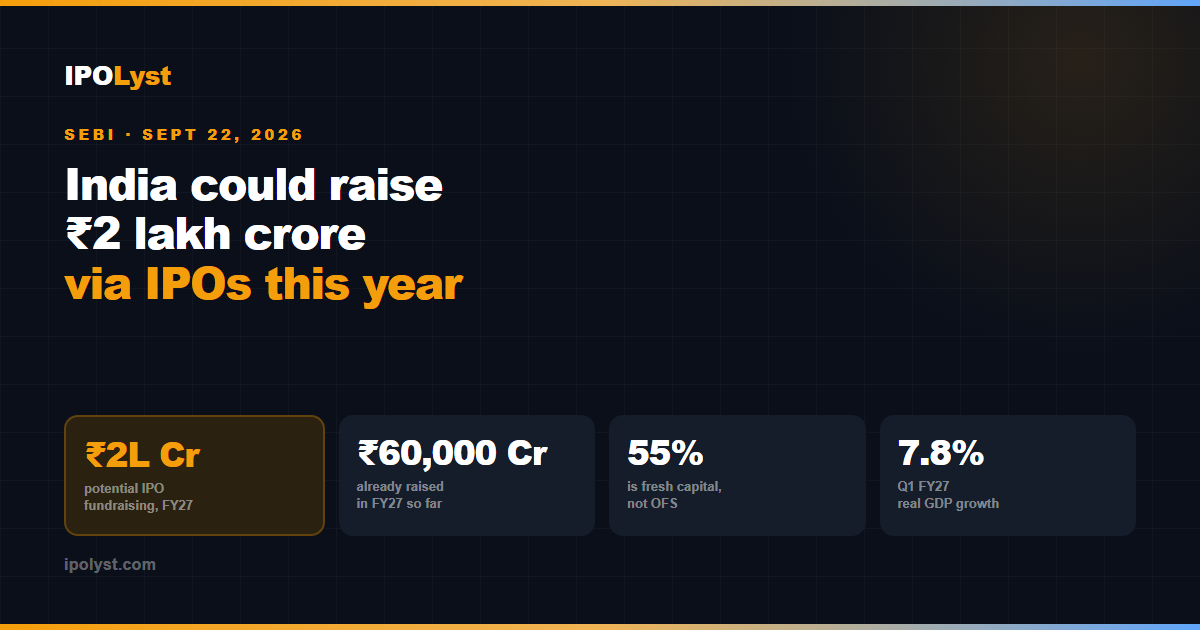
Speaking at the 11th J.P. Morgan India Conference on September 22, 2026, SEBI Chairman Tuhin Kanta Pandey said India could potentially raise about ₹2 lakh crore (₹2 trillion) through IPOs going ahead. He said about ₹60,000 Cr has already been raised through IPOs in FY2026-27 so far, and that 55% of that money is fresh capital going into companies rather than shares sold by existing investors. Here is what he said, in context, and what the numbers actually add up to.
What Pandey Said
- "Going ahead, potentially, around ₹2 trillion can be raised through IPOs," Pandey said, addressing the conference.
- About ₹60,000 Cr has been raised through IPOs in FY2026-27 so far.
- 55% of that FY27 IPO money is fresh capital flowing to the companies themselves, not an offer for sale by existing shareholders.
- India's equity market capitalisation is about $5 trillion.
- More than ₹100 lakh crore has been raised through equity and debt issuances over the past decade.
- Real GDP growth in the first quarter of FY2026-27 was 7.8%.
Pandey framed the IPO potential as part of a broader push to simplify access to public markets. He said SEBI's goal is to "reduce unnecessary friction, deepen markets and strengthen safeguards" and to remove requirements that do not add commensurate protection for investors.
What ₹2 Lakh Crore Actually Means
FY2026-27 runs from April 2026 to March 2027. Pandey's ₹60,000 Cr figure covers roughly the first six months of that year, April to September. By our own subtraction, if ₹2 lakh crore is the full-year potential he sees, that leaves about ₹1.4 lakh crore of further IPO fundraising for the remaining six months. That gap is our own calculation, not a number Pandey stated directly, and it depends on market conditions holding up through the rest of the fiscal year.
The 55% fresh-capital figure is the more telling number. In past years, large Indian IPOs have often leaned heavily on offer for sale, where promoters or early investors cash out rather than the company raising new money. A majority-fresh-capital mix means more of this year's IPO proceeds are actually funding company operations, expansion or debt repayment, not just an exit for existing shareholders.
Where This Fits With What's Already Happening
The comments came the same week the ₹22,561.57 Cr NSE IPO closed, on September 21, after being subscribed 5.71 times overall and 12.68 times among qualified institutional buyers. NSE is set to list on September 24. Neither BusinessToday nor Inkl's report says whether NSE's issue size is counted inside Pandey's ₹60,000 Cr figure, so this article does not assume either way.
Seven more mainboard IPOs, led by the ₹2,100 Cr Elevate Campuses issue, opened this same week. Runwal Enterprises has also announced a ₹500 Cr mainboard IPO opening September 25. A busy pipeline like this is consistent with Pandey's ₹2 lakh crore estimate, even though none of these individual issues were named in his remarks.
Why This Matters If You Apply to IPOs
A market this active means more choices and more competition for allotment on popular issues. It does not tell you which specific IPO is a good investment; SEBI's numbers describe the size of the primary market, not the quality of any single company raising money in it.
You can track every open IPO, including this week's seven mainboard issues, on our IPO GMP tracker. For the biggest single issue in this pipeline so far, see our review of the NSE IPO's GMP and listing outlook.
Pandey's remarks were reported by BusinessToday and Inkl, both citing the 11th J.P. Morgan India Conference on September 22, 2026. NSE subscription and listing figures come from IPOLyst's own tracker.
Frequently Asked Questions
How much money did SEBI's chairman say India could raise through IPOs?
Tuhin Kanta Pandey said around ₹2 lakh crore, or ₹2 trillion, could potentially be raised through IPOs going ahead, speaking at the 11th J.P. Morgan India Conference on September 22, 2026.
How much has already been raised through IPOs in FY2026-27?
About ₹60,000 Cr, according to Pandey, with 55% of that as fresh capital going to the companies rather than shares sold by existing investors.
Does the ₹2 lakh crore figure include the NSE IPO?
Neither report of Pandey's remarks says so directly. The ₹22,561.57 Cr NSE IPO closed on September 21, 2026, the day before this statement, and is part of the same FY2026-27 window Pandey was describing, but whether SEBI's own count already includes it is not stated in the available reports.
Disclaimer: This article is for informational and educational purposes only and does not constitute financial or investment advice. IPOLyst is not a SEBI-registered investment advisor. Figures are based on remarks reported from a single conference and may be revised. Please read official SEBI communications and consult a registered advisor before making investment decisions.