If you follow IPO news, you probably saw the headline last year: SEBI is cutting the retail quota in large IPOs from 35% to 25%. It was reported widely, shared widely, and for a lot of retail investors it landed as bad news about losing ground in the biggest listings. Here is the part that got far less coverage — SEBI dropped the idea. The retail quota in Indian IPOs is still 35%. Nothing was cut. But a great deal did change in 2026, just not the thing everyone was talking about, and the changes that did go through affect your allotment odds more than the quota headline ever would have.
First, the correction: your quota was never cut
On 31 July 2025, SEBI released a consultation paper proposing a new allocation structure for large IPOs — specifically those above ₹5,000 crore. Under the proposal, the retail individual investor share would have dropped from 35% to 25%, with the qualified institutional buyer portion rising from 50% to 60%.
A consultation paper is not a rule. It is SEBI putting a proposal into the public domain and inviting feedback from investors, issuers, merchant bankers and industry bodies before deciding anything. Plenty of consultation papers become regulation. Plenty do not. This one did not.
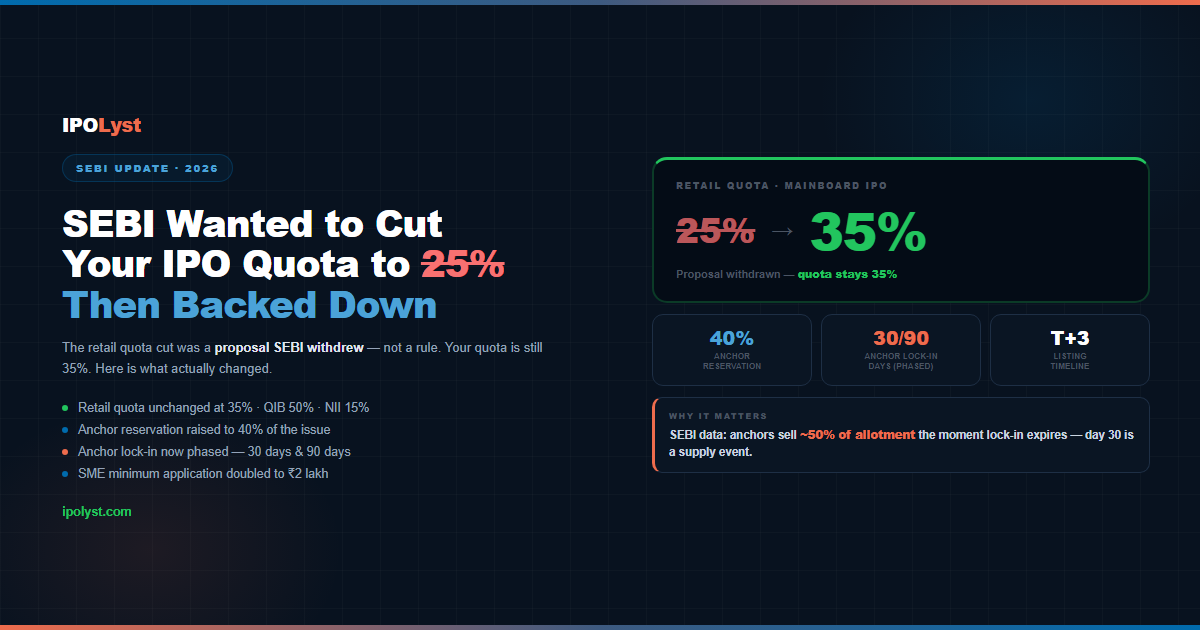
After reviewing stakeholder feedback, SEBI withdrew the proposal. The retail quota stays at 35%. If you are applying to an IPO today, the allocation split is exactly what it has been:
- Qualified Institutional Buyers (QIB): 50%
- Non-Institutional Investors (NII / HNI): 15%
- Retail Individual Investors (RII): 35%
If you are unclear on what those three buckets actually mean and how each is allotted, we break them down in our guide to QIB, NII and retail subscription.
If you have read otherwise recently, the source was almost certainly written while the proposal was live and never updated afterwards. It is worth checking the date on any article making this claim.
You can always verify the current position directly against the regulator's own circulars and press releases at sebi.gov.in. For any specific issue, the offer document filed with SEBI is the authoritative source on that IPO's allocation.
Why SEBI floated the idea in the first place
The reasoning behind the proposal is worth understanding, because it tells you how the regulator reads the retail investor — and that thinking has not gone away just because this particular proposal did.
SEBI's observation was that Indian IPO sizes have grown substantially, but direct retail participation has stayed roughly flat over the past three years. In very large issues specifically, retail subscription levels have been muted. From the regulator's point of view, reserving 35% of a ₹10,000 crore issue for a retail segment that does not consistently fill that portion creates a practical problem: the unsubscribed retail portion has to be reallocated, and the issue process becomes less predictable for everyone.
The counter-argument, which clearly carried weight in the feedback, is that reducing the retail quota in the largest and often highest-profile listings would push ordinary investors out of exactly the issues they most want access to — and that muted subscription in some large IPOs is a pricing and sentiment problem, not a reason to structurally shrink retail access.
SEBI sided with the second view. What it chose to do instead was address the size problem from the other end.
What SEBI did instead — easing the offer size, not the quota
Rather than reallocating a fixed pie, SEBI moved to make the pie a more manageable size at listing. The revised approach lets very large issuers come to market with a smaller initial offering and then reach the 25% minimum public shareholding requirement over a longer timeline, instead of being forced to dilute heavily in one go.
This matters for the mega-listings in the pipeline. A company targeting a valuation in the trillions does not have to dump an enormous block of stock on the market at once to satisfy public shareholding norms. For retail investors, the practical effect is that large IPOs become smaller and more frequent rather than fewer and overwhelming — and your 35% stays intact throughout.
What actually changed in 2026: the anchor investor overhaul
Here is the reform that went through while everyone was arguing about the retail quota. SEBI significantly restructured how anchor investors participate in IPOs, and this is the change that genuinely moves the numbers on your application.
The anchor portion got bigger
The overall reservation for anchor investors has increased from one-third to 40% of the issue. Within that anchor allocation, one-third is now ring-fenced for domestic mutual funds, with the remainder available to life insurance companies and pension funds. Where the insurer and pension portion goes unsubscribed, it is reallocated to mutual funds.
More anchors are allowed in
The permissible number of anchor investors has risen from 10 to 15 where the anchor portion exceeds ₹250 crore. For allocations up to ₹250 crore the range is a minimum of 5 and a maximum of 15, and for every additional ₹250 crore or part thereof, a further 15 investors are permitted.
The lock-in is now phased
Anchor investors previously faced a single lock-in period. That has been replaced with a phased structure: 50% of allotted anchor shares are locked in for 30 days, and the remaining 50% for 90 days from the date of allotment.
Why the anchor changes matter more than the headline
It is easy to read "anchor investor allocation rules" and assume it is institutional plumbing that has nothing to do with a retail application. It is not. The anchor book is the single strongest early signal you get about an IPO, and it now behaves differently.
A larger anchor portion with a guaranteed mutual fund share means the quality of the anchor book is more informative than it used to be. When domestic mutual funds take up their reserved portion enthusiastically, that is real institutional conviction being expressed with a lock-in attached. When the insurer and pension portion goes unsubscribed and gets pushed to mutual funds, that tells you something too.
The phased lock-in is the more consequential change for anyone holding past listing day. Under the old single lock-in, there was one date on which anchor supply could hit the market. Now there are two — day 30 and day 90 — and the first one releases half the anchor allocation.
This is where a piece of SEBI's own data becomes very relevant. The regulator has found that anchor investors offload roughly 50% of their IPO allotments immediately once the lock-in expires. That is not a rumour or a market anecdote; it is the pattern in the data across major domestic public offerings.
Put those two facts together and the practical implication is direct: if you are holding an IPO allotment beyond listing day, the 30-day mark is a date to have in your calendar. Half the anchor allocation becomes sellable, and history says a substantial chunk of it will actually be sold. That is a supply event you can anticipate.
What this means for your allotment odds
Your 35% retail reservation is unchanged, so the arithmetic of allotment has not shifted. In an oversubscribed IPO, retail allotment still runs on a lottery basis at one lot per successful applicant, and applying for more lots does not improve your odds of being selected — it only changes what you receive if you are selected.
The mechanics of this are unchanged by the 2026 amendments, and we have covered them in detail in our guide to IPO allotment and how to improve your chances. The single most effective lever remains applying through multiple distinct demat accounts held by different family members, each with its own PAN.
What has changed is the information available to you before you apply. With a larger and better-structured anchor book, the anchor allocation disclosed ahead of the issue opening is a more meaningful signal than it was two years ago. Read it.
SME investors: the change that did go through
While the mainboard retail quota survived intact, SME IPO investors did see a real increase in the cost of entry. SEBI raised the minimum application size for SME IPOs from ₹1 lakh to ₹2 lakh per application, following a board decision in September 2024.
The stated intent was to filter out speculative applications and ensure SME IPO participants are investors who can absorb the risk of a smaller, less liquid company. The effect is straightforward: SME IPOs are now a materially higher-commitment decision for retail applicants, and a single application ties up twice the capital it used to.
Alongside this, SME norms carry a set of investor-protection requirements including a cap on the offer for sale component, a prohibition on using IPO proceeds to repay promoter loans, and a mandatory monitoring agency for the use of funds. If you are applying to SME issues, these are worth checking in the offer document.
If you are weighing whether SME issues belong in your portfolio at all, start with our comparison of mainboard versus SME IPOs, which covers the liquidity and disclosure differences that matter most at this ticket size.
Listings now settle on T+3
One more change worth knowing, because it affects your cash flow rather than your odds: the IPO listing timeline now runs on T+3. Allotment, refunds for unsuccessful applicants, and the credit of shares to your demat account all happen faster than under the older cycle. If you did not get an allotment, your blocked funds are released sooner.
What our own listing data shows
Rules aside, the question most readers actually have is whether IPO applications are worth making at all right now. We track every IPO on IPOLyst through to its actual listing price, so we can answer that with our own numbers rather than sentiment.
Across 81 IPOs where we have recorded the actual listing price against the issue price:
- 59 of 81 listed at a premium — a 73% positive listing rate
- The average listing gain across all 81 was +19.1%
- Grey market premium correctly predicted the direction of the listing in 51 of 60 cases where a GMP reading existed — roughly 85% accuracy on direction
Two things are worth drawing out of that. First, GMP is a reasonable directional indicator and a poor magnitude indicator — it tells you whether a listing is likely to be positive far more reliably than it tells you by how much. Second, a 73% positive rate means roughly one in four listings still came in below issue price, and our worst outcomes in that set were around −20%. This is not a risk-free trade.
You can see the full GMP versus actual listing comparison for every IPO we track on our GMP performance tracker, which is updated as each IPO lists.
For the longer analysis of how reliable grey market premium has actually been as a predictor, see our study on IPO GMP accuracy versus listing price.
And if you are looking for what is open right now rather than what has already listed, our upcoming IPO calendar lists every mainboard and SME issue with live dates and GMP.
The short version
- Retail quota was NOT cut. It remains 35%. The 25% figure came from a proposal SEBI withdrew.
- QIB 50% / NII 15% / Retail 35% is still the mainboard split.
- Anchor reservation rose from one-third to 40%, with a third of that reserved for domestic mutual funds.
- Anchor lock-in is now phased — 50% at 30 days, 50% at 90 days. SEBI data shows anchors sell about half their allotment as soon as lock-in lifts.
- Permissible anchor investors rose from 10 to 15 above a ₹250 crore anchor portion.
- SME minimum application doubled from ₹1 lakh to ₹2 lakh.
- Listing settles on T+3, so refunds and demat credits arrive faster.
Frequently Asked Questions
Did SEBI reduce the retail quota in IPOs to 25%?
No. SEBI proposed reducing the retail quota from 35% to 25% for IPOs above ₹5,000 crore in a consultation paper dated 31 July 2025, but withdrew the proposal after stakeholder feedback. The retail individual investor quota remains 35% of the issue. Articles stating the quota was cut were written while the proposal was under consideration and were not updated after SEBI dropped it.
What is the current IPO allocation split in India?
For a mainboard book-built IPO, the split is 50% to Qualified Institutional Buyers, 15% to Non-Institutional Investors, and 35% to Retail Individual Investors. This is unchanged by the 2026 amendments.
What is the new anchor investor lock-in period?
Anchor investors now face a phased lock-in: 50% of allotted shares are locked in for 30 days from allotment, and the remaining 50% for 90 days. This replaced the earlier single lock-in period. SEBI data indicates anchor investors sell approximately half their allotment immediately upon lock-in expiry, making the 30-day mark a meaningful supply date for anyone still holding.
What is the minimum investment in an SME IPO now?
SEBI raised the minimum application size for SME IPOs from ₹1 lakh to ₹2 lakh per application, following its September 2024 board decision. Mainboard IPO lot sizes are unaffected and continue to be set per issue, typically in the ₹14,000 to ₹15,000 range for a single retail lot.
Does applying for more lots improve my chance of allotment?
No. In an oversubscribed retail portion, allotment is decided by lottery at one lot per successful applicant. Applying for additional lots does not increase your probability of being selected. Applying through separate demat accounts under different PANs — for example, different family members — increases the number of entries in the draw.
Disclaimer: This article is for informational and educational purposes only and does not constitute financial advice. IPOLyst is not a SEBI-registered investment advisor. Regulatory positions can change; readers should verify current requirements against official SEBI circulars and the offer document of any issue before applying. Past listing performance does not predict future results. Please conduct your own research before investing.