Sensex and Nifty closed at a six-week low on September 10, 2026, dragged down by a crude oil spike tied to renewed Iran-US tensions. That was the dominant story of the day, but five other developments — from a green-logistics deal to a major railway approval — moved individual stocks and sectors alongside it. Here's all six, with the numbers checked against source reporting rather than taken at face value.
1. Sensex, Nifty close at a six-week low as crude oil surges
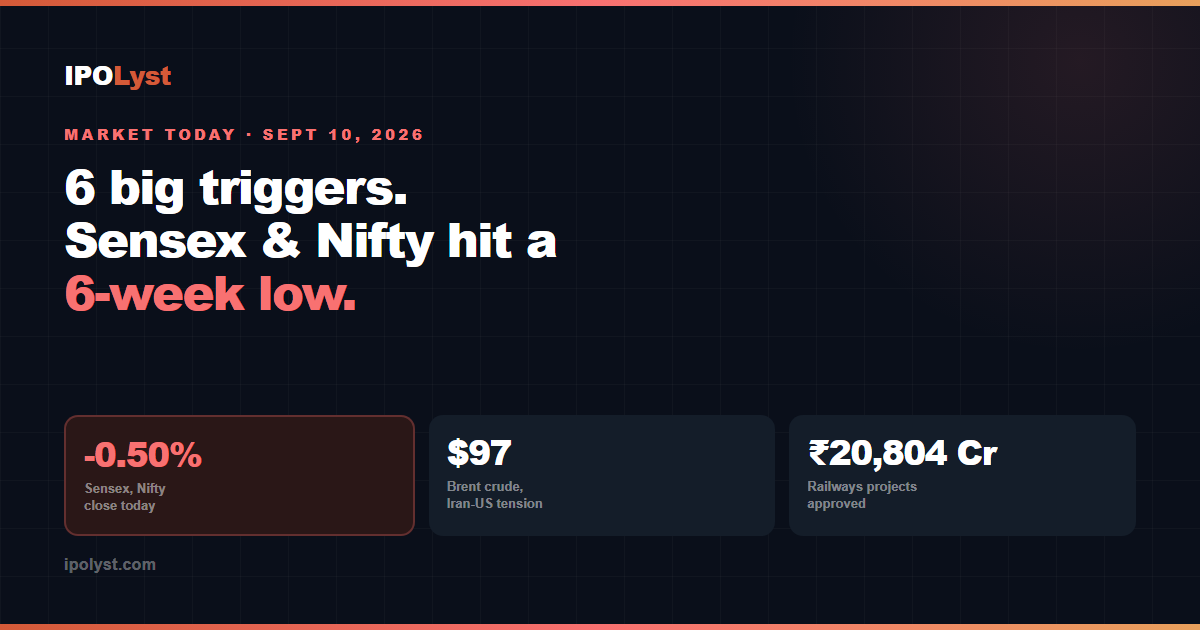
The BSE Sensex fell 382.62 points (-0.50%) to close at 76,132.81, while the NSE Nifty 50 declined 118.55 points (-0.50%) to settle at 23,779.15 — both benchmarks slipping to their lowest levels in about six weeks. Selling was broad-based: 37 of the 50 Nifty constituents ended in the red, with only 13 managing gains.
Two factors drove the decline. First, crude oil: Brent was trading around $97 a barrel after renewed US-Iran hostilities raised concerns over supplies and shipping through the Strait of Hormuz. That matters for India specifically — the country imports most of its oil, and a sustained rise feeds through to the import bill, the rupee, and eventually consumer inflation. Second, the Nifty IT index fell more than 2%, after stronger-than-expected US employment data raised the odds of a Fed rate hike at its September meeting.
Source: NewsDrum.
2. Railways: Cabinet clears ₹20,804 crore for 8 multitracking projects
The Cabinet Committee on Economic Affairs approved eight railway multitracking projects worth a combined ₹20,804 crore, spanning 31 districts across nine states, in two clusters:
- Northern cluster: 3 projects across West Bengal, Jharkhand, Odisha, Madhya Pradesh and Chhattisgarh, worth ₹10,783 crore and covering 656 km — including the Kharagpur-Jharsuguda fourth line and the Katni-Pendra Road fourth line.
- Southern cluster: 5 projects across Tamil Nadu, Andhra Pradesh, Karnataka and Telangana, worth ₹10,021 crore and covering 540 km.
Combined, the projects add roughly 1,196 km to the existing rail network, with completion targeted for 2029-30.
Source: HelloRail.
3. Hindustan Zinc signs 6-year deal for 30 electric trucks
Hindustan Zinc signed a six-year transportation contract with MFL India Limited to deploy 30 electric trucks for concentrate transportation — extendable by a further two years — as part of decarbonising its mine-to-smelter logistics network. The electric trucks will progressively replace conventional diesel vehicles moving zinc and lead concentrate from Rampura Agucha to the company's Rajasthan smelting operations, with MFL India also setting up dedicated EV charging infrastructure. Hindustan Zinc added 42 EVs to its logistics fleet in FY2026 alone, taking its green fleet to 232 vehicles (52 EV, 180 LNG).
Source: InvestyWise.
4. Wipro and CrowdStrike launch an AI-focused CISO Command Center
Wipro announced a new CISO Command Center built with CrowdStrike, aimed at enterprise security for AI-era risks — shifting organisations from managing separate security tools toward a model that ties cyber decisions more directly to business risk. The offering runs through Wipro's CyberTransform and CyberShield services, backed by the CrowdStrike Falcon platform, and Wipro is also part of CrowdStrike's Project QuiltWorks, a coalition focused on frontier AI risk.
Source: SecurityBrief.
5. ICICI Prudential AMC gets RBI approval for stakes in two banks
RBI approved ICICI Prudential Asset Management Company to acquire up to 9.95% of the paid-up share capital or voting rights in two banks: AU Small Finance Bank and DCB Bank, both cleared on September 8, 2026. Separately, there's broader reporting of ICICI Group receiving clearance to raise its collective shareholding to up to 9.95% across eight banks in total (including Bandhan Bank, City Union Bank, Equitas Small Finance Bank, Federal Bank, IDFC First Bank, HDFC Bank, Karur Vysya Bank and RBL Bank) — worth noting as context, though it's a separate, broader approval from the two banks confirmed for September 8 specifically. Either way, the acquisitions must be completed within a year of RBI's communication and remain subject to banking and securities regulations.
Source: InvestyWise.
6. GST collections: the +14.8% figure everyone's still citing
You'll see India's GST collections quoted as up 14.8% year-on-year to nearly ₹2 trillion — that number is real, but it's August 2026 data, released on September 1. September's own GST collection figures won't be published until early October, since the government reports collections on the 1st of the following month. It's useful context for the broader economy, not a fresh trigger from today.
The takeaway
Today was a case of one macro story (crude oil, via Iran-US tensions) outweighing several genuinely positive micro stories (a large railway approval, a green-logistics deal, a cybersecurity partnership, a regulatory clearance for a major AMC). That's a common pattern — a single supply-side shock in oil can offset a run of decent company- and sector-level news on the index level, even when the underlying news flow for individual businesses is constructive.
For a longer look at how much GMP and market sentiment can swing month to month, see our September 2026 GMP-vs-actual scorecard.
We track live IPO GMP, subscription data, and listing performance daily on ipolyst.com — including how markets like today's affect IPO demand and grey market sentiment.
Disclaimer: This article is for informational and educational purposes only and does not constitute financial or investment advice. IPOLyst is not a SEBI-registered investment advisor. Market data is subject to revision after close; please verify current figures independently before making any investment decisions.