Big IPO, big listing gain? History says not necessarily. Across India's five largest listings, the median listing day return was a loss of 1.33%, and three of the five opened below their issue price. Now NSE, at ₹22,562 Cr, is about to become the biggest financial sector IPO the market has seen. Here is how the earlier mega issues actually listed, and what that does and doesn't tell us about NSE.
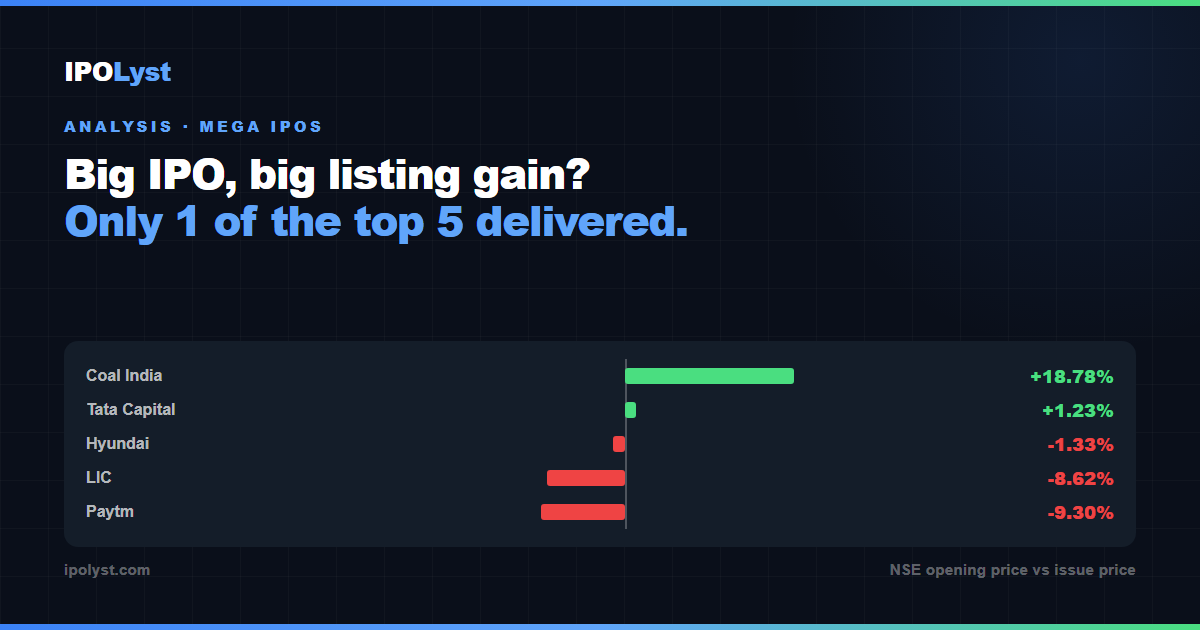
How the five biggest IPOs actually listed
All figures below compare the NSE opening price on listing day with the issue price, so the comparison is like for like.
- Coal India (November 2010): issue price ₹245, listed at ₹291. That is a gain of 18.78% on a ₹15,199 Cr issue, and the strongest of the group.
- Paytm (November 2021): issue price ₹2,150, listed at ₹1,950. That is a loss of 9.30% on a ₹18,300 Cr issue, and it fell to about 27% below the issue price by the close of the first day.
- LIC (May 2022): issue price ₹949, listed at ₹867.20. That is a loss of 8.62% on an issue of roughly ₹20,557 Cr.
- Hyundai Motor India (October 2024): issue price ₹1,960, listed at ₹1,934. That is a loss of 1.33% on a ₹27,870 Cr issue, the largest IPO India has ever had.
- Tata Capital (October 2025): issue price ₹326, listed at ₹330. That is a gain of 1.23% on a ₹15,512 Cr issue.
What the pattern really says
The popular version of this story is that mega IPOs never make money on listing day. The numbers are more mixed than that. Two of the five listed above the issue price: Coal India by a lot, Tata Capital by barely a percent. The other three opened lower. Averaged out, the five sit at roughly +0.15%, and the median is -1.33%.
So the honest reading is that size alone did not create a listing pop. Issues this large need enormous demand just to clear, and the price is usually set with that in mind, which leaves little room for a first day surprise. But five data points is a very small sample, so treat it as context, not a rule.
Where the NSE IPO stands right now
- Price band ₹1,700 to ₹1,785, with the anchor round of ₹6,746 Cr allotted at ₹1,785 to 189 investors
- Issue size ₹22,562 Cr, entirely an offer for sale, which is larger than LIC's issue and second overall only to Hyundai's
- Subscription at the last update: 1.15x overall, with QIB at 1.53x, NII at 1.64x and retail at 0.71x
- Bidding closes on September 21, and shares list on September 24
One structural difference from the earlier mega IPOs is worth knowing: NSE will not list on its own exchange. SEBI's rules bar an exchange from listing itself, so NSE's shares will debut on BSE.
What the grey market is implying
NSE's GMP is ₹148, or about 8%, on our tracker. Added to the ₹1,785 upper band, that points to a listing near ₹1,933, a gain of roughly 8.3%. If that held, NSE would land second in the table above, well behind Coal India but ahead of the other four.
It comes with a big caveat. The GMP was ₹218 just five days earlier and has fallen about 32% since, so the sentiment behind it has been weakening, not building. GMP is also an unofficial, unregulated indicator, and it has missed the actual listing price before, in both directions.
To see how far GMP has landed from the real listing price across recent issues, check our September GMP vs actual scorecard.
We checked the historical listing prices against sources like Chittorgarh's Coal India page, 5paisa's Hyundai listing report and Groww's Tata Capital debut coverage, and the NSE anchor round against Upstox's report on the anchor allotment. All matched.
For why NSE's grey market premium has been sliding, including how its options heavy revenue compares with BSE's, read our NSE GMP and SEBI F&O rules analysis.
You can follow the live premium for NSE and every other open issue on our IPO GMP tracker.
Frequently Asked Questions
Do big IPOs always give big listing gains?
No. Among India's five largest IPOs, Coal India listed 18.78% above its issue price and Tata Capital 1.23% above, while Paytm listed 9.30% below, LIC 8.62% below and Hyundai Motor India 1.33% below. The median listing return was -1.33%, so a large issue size did not reliably produce a listing day gain.
When and where will the NSE IPO list?
The NSE IPO is scheduled to list on September 24, 2026. Because SEBI's rules bar an exchange from listing on its own platform, NSE's shares will debut on BSE. Bidding runs from September 17 to September 21, 2026, in a price band of ₹1,700 to ₹1,785 per share.
What does NSE's IPO GMP suggest about its listing price?
NSE's GMP is ₹148, about 8%, which added to the ₹1,785 upper band would imply a listing near ₹1,933. It has fallen from ₹218 a few days earlier, and GMP is an unofficial indicator that can differ from the actual listing price, so it should not be read as a forecast.
Disclaimer: This article is for informational and educational purposes only and does not constitute financial or investment advice. IPOLyst is not a SEBI-registered investment advisor. Past listing performance is not a guarantee of future returns, and GMP is an unofficial, unregulated indicator that can change daily. Please conduct your own research or consult a registered advisor before investing.