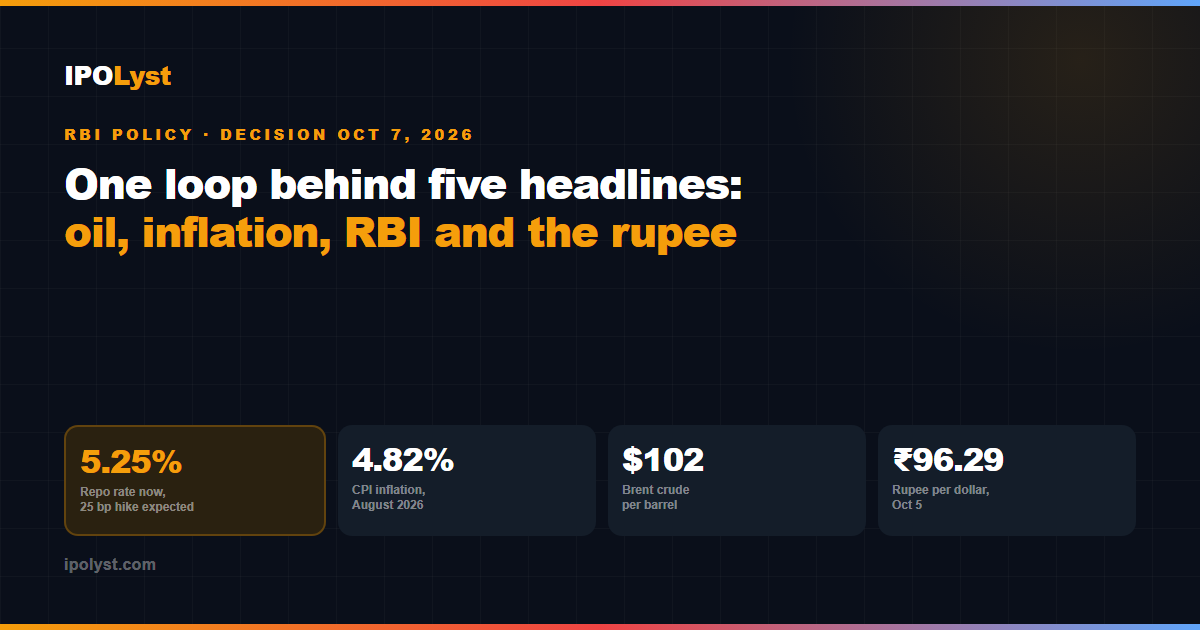
The RBI's Monetary Policy Committee is meeting from October 5 to 7, 2026, and the decision is due at 10 a.m. on Wednesday, October 7. The repo rate is 5.25%, and a Reuters poll of 61 economists taken from September 18 to 28 found 35 expecting a 25 basis point hike to 5.50%. This week's headlines look separate, but they describe one loop: expensive oil pushes up inflation, inflation pushes the RBI towards higher rates, and a weak rupee and foreign selling keep the pressure on. Here is how the pieces connect, what the market did on Monday, and what four IPO listings taught us.
The Loop: Oil, Inflation, RBI, Rupee, FIIs
- Oil: Brent crude is above $100 a barrel and was reported at $102.38 on October 5.
- Inflation: retail inflation (CPI) rose to 4.82% in August, the highest since December 2024, with rural inflation at 5.23% and urban at 4.31%. Wholesale inflation (WPI) was 9.92%, up from 9.78% in July. Reports link the rise to energy prices since the Middle East war and to rupee weakness.
- The RBI: CPI is still inside the RBI's 2% to 6% comfort band, but a hike would be its first since February 2023. The repo rate has been left unchanged at 5.25% for four straight meetings, after 125 basis points of cuts in 2025.
- The rupee: it was at about ₹96.29 to the dollar on October 5. Business Today reports that India's forex reserves fell $14.8 billion in the week ended September 18.
- Foreign investors: FIIs sold ₹9,484.22 Cr of Indian stocks on October 1, while domestic institutions bought ₹10,041.84 Cr.
The links between these are the standard economic channels, and the chain is our framing of the reports. Oil is a large import, so a higher price widens the import bill, weakens the rupee and lifts inflation. A weaker rupee and higher inflation make foreign investors more cautious about Indian assets, and the RBI is left choosing between raising rates and letting the rupee absorb the pressure.
Why a Hike Is a Dilemma, Not a Certainty
Business Today reports that the timing of a hike is "finely balanced" between October and December, with JM Financial expecting a shallow cycle most likely beginning in October. If the RBI holds, pressure shifts to the rupee and may need costly foreign exchange intervention after the reserves drop.
- Arihant Capital's Shruti Jain expects a 25 basis point hike because of persistent inflation pressure.
- Blue Aster Capital's Sidharth Sogani expects 25 basis points to 5.50% with a neutral stance, and calls it a shallow, pre-emptive cycle of 25 to 50 basis points in total.
- Some housing-sector voices quoted by Business Today expect a hold to give continuity.
A hike would be a near-term negative for rate-sensitive sectors such as banks, NBFCs, autos, real estate and consumption, according to Outlook Money and others, though the effect could be contained if the RBI signals that tightening will be calibrated. Loans linked to the repo rate would become costlier for floating-rate borrowers, and the 10-year government bond yield had already risen to 7.21% before the decision.
What the Market Did on Monday
The Sensex rose 472.77 points, or 0.66%, to 72,382.47, and the Nifty gained 133.80 points, or 0.60%, to 22,555.75, snapping a four-day losing run. Reports attribute the rebound partly to easing worries about a Federal Reserve rate hike after weak US jobs data, with September payrolls reported at 29,000.
- Bajaj Finance rose as much as 5% to ₹995.80 after its second-quarter business update: assets under management of ₹5.85 lakh crore, up 26.5%, new loans up 11% to 13.45 million, and 129.85 million customers. Business Standard also reported Punjab National Bank up 2.8% on 14.8% growth in international advances.
- ITC gained 4.49% to close at ₹268.55 after Citi upgraded the stock and set a target price of ₹300, about 17% above the previous close of ₹257. Citi said the earnings downgrade cycle is largely over.
It is tempting to say the market ignored the rate-hike risk because loan growth is strong. The reports we found do not say that, and the evidence for banks as a group is mixed: one report had the Bank Nifty up 0.48% and another had it down 0.33%, and we could not verify the M&M Financial move. So treat the divergence as a question to watch into October 7, not a conclusion. The stock-specific news above is the verified part.
Four IPO Listings, Four Outcomes
Four issues listed on October 5. Subscription alone did not explain the results. Prices are NSE first-trade prices.
- Orient Cables: listed at ₹450 against ₹272, up 65.44%, after a 97.25 times subscription on a ₹552 Cr issue.
- German Green Steel: listed at ₹142 against ₹139, up 2.16%, despite 30.50 times subscription on a ₹304 Cr issue.
- Runwal Enterprises: listed flat at ₹305 (₹306 on the BSE), after 2.65 times subscription on a ₹500 Cr issue.
- AceVector, the parent of Snapdeal: listed at ₹28.32 against ₹32, down 11.50%, after about 5 times subscription on a ₹420 Cr issue.
Comparing each with the last grey market premium stored on our tracker (our calculation, and the GMP may be from a few hours before listing):
- Orient Cables: GMP implied about +36.4%, the actual listing was +65.4%, about 29 points higher.
- German Green Steel: GMP implied about +9.4%, the actual listing was +2.2%, about 7 points lower.
- Runwal: GMP implied about -0.7%, the actual listing was flat.
- AceVector: GMP implied about +3.1%, the actual listing was -11.5%, about 15 points lower.
The grey market missed in both directions. It under-called the strongest issue and over-called two weaker ones, which fits our earlier look at how GMP compares with listing prices and last week's listing results for Moneyview, Adroit and Elevate. GMP is unofficial sentiment, not a forecast. Follow every issue on the IPO GMP tracker. SRIT India is expected to list on October 6, according to IPO aggregators, so confirm the date on the exchange.
What to Watch on October 7
- The decision itself: hold or a 25 basis point hike to 5.50%, announced at 10 a.m.
- The stance and the guidance: whether the RBI signals one hike or a series, which matters as much as the move.
- The rupee's reaction near ₹96, and whether Brent holds above $100.
- The next FII and DII figures, to see whether foreign selling slows.
What This Means for IPO Watchers
Higher rates raise the cost of money and tend to cool risk appetite, which can affect listing-day demand. For the wider market backdrop, see our report on the Nifty's eight-week losing streak and why the Indian stock market has been falling. None of this tells you whether to apply to or hold any specific issue.
Figures were checked against Business Today's report on the RBI rate-hike dilemma, Outlook Money's guide to the repo rate hike, Business Today's October 5 listings report, Upstox's Bajaj Finance update and Business Standard's ITC report.
Frequently Asked Questions
Will the RBI raise the repo rate on October 7, 2026?
It is not certain. A Reuters poll of 61 economists from September 18 to 28 found 35 expecting a 25 basis point hike to 5.50%, and several experts expect a shallow hiking cycle starting in October. Business Today describes the October-to-December timing as finely balanced. The decision is due at 10 a.m. on October 7.
What is the repo rate now, and when was the last hike?
The repo rate is 5.25%, unchanged for four straight meetings after 125 basis points of cuts in 2025. The last hike was in February 2023.
Why do high oil prices affect inflation and the rupee?
India imports most of its crude oil, so a higher price raises fuel and input costs, widens the import bill and puts pressure on the rupee. In August 2026, CPI inflation rose to 4.82% and wholesale inflation to 9.92%, with reports linking the rise to energy prices.
How would a repo rate hike affect my loan EMI?
Loans linked to the repo rate, which are typically floating-rate loans, would become costlier, so borrowers could see a higher EMI or a longer tenure, depending on how their lender passes it on. Check your loan terms or ask your lender.
Why did AceVector list at a discount after 5 times subscription?
AceVector, the parent of Snapdeal, listed at ₹28.32, down 11.50% from its ₹32 issue price, even though the issue was subscribed about 5 times. High subscription has not guaranteed a listing gain: German Green Steel was subscribed 30.50 times and listed only 2.16% higher.
Disclaimer: This article is for informational and educational purposes only and does not constitute financial or investment advice. IPOLyst is not a SEBI-registered investment advisor. Past performance is not a guarantee of future returns. Investments in securities markets are subject to market risk. Policy expectations, market data and grey market premiums are unofficial or can change quickly, so please verify figures with official sources and consult a registered advisor before making investment decisions.