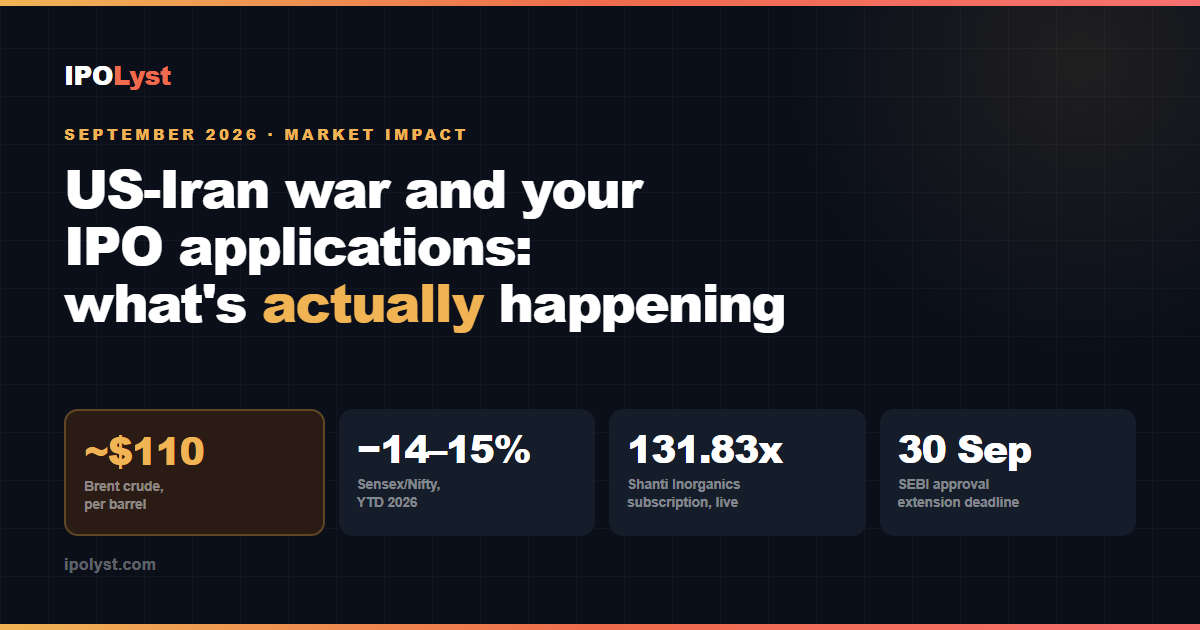
If you have been watching your portfolio, or your pending IPO applications, turn red over the last few weeks, you are not imagining it. The US-Israel-Iran conflict that broke out in March 2026 has been one of the biggest drags on Indian equity markets this year — the Sensex fell nearly 700 points and the Nifty slipped below the 24,000 mark on 2 September alone, and both indices are down roughly 14-15% year-to-date. The direct cause is oil. India imports close to 85% of its crude requirement, and Brent has been trading near $110 a barrel since the conflict began — a level that pushes up inflation, weakens the rupee and squeezes margins right across the market. Here is what that actually means if you are applying to IPOs right now, and what it does not mean.
Why a war in West Asia moves an Indian IPO
The mechanism is more direct than it looks. It runs through three channels, each of which touches an IPO differently to how it touches an already-listed stock.
- Oil prices: India's import bill rises with crude, which widens the current account deficit and pressures the rupee. That shows up as higher costs for any company that consumes fuel, plastics, or freight — which is most of them.
- FII outflows: foreign institutional investors reduce risk in emerging markets during geopolitical shocks. QIBs are 50% of a mainboard IPO's allocation, so a pullback there is felt immediately in subscription numbers.
- Secondary market sentiment: a new listing's opening trade is priced off where similar stocks are trading that morning. A falling market on listing day compresses the pop even for a fundamentally sound company.
None of these three channels change a company's revenue, margins or growth story. They change the price at which the market is willing to buy that story on a given week. That distinction matters for how you read the current pipeline.
What SEBI has already done about it
The regulator moved early. In April 2026, SEBI issued a one-time extension for companies whose IPO approvals were due to expire between 1 April and 30 September 2026, letting those approvals stay valid through the end of September rather than forcing a fresh filing during a volatile window. Of the 161 companies holding valid approvals at the time, 35 had approvals set to expire on 30 September — the extension exists specifically so those issuers are not forced to launch, or refile, into weak conditions.
That is a meaningful signal. SEBI does not extend deadlines for companies that are rushing to list — it extends them for companies that would rather wait. Several large names, including NHPC and Oil India in earlier cycles facing similar conditions, have historically used exactly this kind of window to push their timeline rather than list into a falling market.
What is actually happening in the pipeline right now
This is where the picture gets more interesting than "the market is down, so IPOs are bad." As of 2 September, seven IPOs are open for subscription on our tracker, and their subscription numbers are nowhere close to uniformly weak.
- Shanti Inorganics (SME) — subscribed 131.83x, GMP +43%.
- Ashutosh Fibre (SME) — subscribed 123.7x, GMP +11%.
- Phychem Technologies (SME) — subscribed 18.93x, GMP +2%.
- Deepa Jewellers (Mainboard) — subscribed 3.6x, GMP +20%.
- Rays of Belief (Mainboard) — subscribed 3.61x, GMP +15%.
- Purple Style Labs (Mainboard) — subscribed 1.29x, GMP +1%.
- Farm Peace (SME) — subscribed 0.06x, GMP flat.
Two SME issues are drawing triple-digit subscription in the same week the Nifty dropped below 24,000. That tells you something specific: retail and HNI appetite for individual, well-priced issues has not collapsed. What has softened is the mainboard side, where QIB participation is more sensitive to the kind of FII caution that geopolitical risk produces — Purple Style Labs at 1.29x and Farm Peace at a bare 0.06x are the weak end of the current book, not the whole market.
The full live picture, updated through the day, is on our IPO GMP tracker.
How this differs from a normal soft patch
We have covered IPO market volatility before, and the honest answer is that some volatility is structural — issuers timing large deals, sector rotation, rate expectations. This is different in one respect: it is event-driven and has a visible off-ramp. Oil prices and FII flows both move quickly when the underlying geopolitical situation changes, in either direction. Search coverage from the past few weeks already notes early signs of this — easing tensions and a softer crude price have been credited with improving sentiment on separate days even within this same conflict window. A structural slowdown takes quarters to reverse. An event-driven one can reverse in days.
For the broader context on why India's IPO pipeline has stayed large even through a volatile year, see our earlier piece on what 2026's market volatility really means.
What this means if you are applying to an IPO this month
1. GMP is more compressed than usual — treat it as more provisional than usual
Grey market premium reflects current sentiment, and current sentiment is unusually reactive to headlines right now. A GMP reading taken a week before listing carries more uncertainty than in a calm month. Check it closer to the closing date, not the opening date.
2. Watch subscription numbers over GMP for mainboard issues specifically
QIB participation is the channel most directly exposed to FII caution. A mainboard issue subscribing weakly in the institutional book during this window is a market-condition signal, not necessarily a company-quality signal — but it does raise the odds of a soft listing day regardless of the underlying business.
3. SME demand tells you less about the war and more about the specific issue
The 131x and 123x subscriptions this week show retail demand for a good SME story has not gone anywhere. If an SME issue is drawing weak demand right now, that is more likely about the issue itself than about Iran.
4. If your allotted IPO lists into a down market, the listing-day pop compresses — the underlying story usually does not change
If you already have an allotment and are deciding whether to sell on listing day or hold, our listing day strategy guide covers exactly this decision, and it applies with more force than usual this month — a company can list flat or slightly down purely on market timing and still be a reasonable business to hold.
Frequently Asked Questions
Is the US-Iran war affecting Indian IPOs in September 2026?
Yes, indirectly. The conflict has pushed Brent crude to around $110 a barrel and driven FII caution in Indian equities, with the Sensex and Nifty down roughly 14-15% year-to-date in 2026. This affects IPOs mainly through weaker QIB (institutional) subscription on mainboard issues and more compressed grey market premiums. It has not stopped the IPO pipeline — SEBI extended approval deadlines through 30 September 2026 specifically to give companies flexibility, and multiple issues are still subscribing well, including two SME IPOs that crossed 100x subscription in the first week of September.
Has SEBI delayed or postponed any IPOs due to the conflict?
SEBI has not blanket-postponed IPOs. It issued a one-time extension in April 2026 allowing IPO approvals due to expire between 1 April and 30 September 2026 to remain valid through the end of September, giving issuers the option to wait for calmer conditions rather than forcing them to launch or refile during volatility. Of 161 companies with valid approvals at the time, 35 had approvals expiring on 30 September 2026.
Should I apply for IPOs while the market is down due to the war?
This is a decision that depends on your own risk tolerance and time horizon, and IPOLyst does not give personalised investment advice. What the current data shows is that demand is not uniformly weak — SME subscription in early September 2026 has in some cases been very strong, while mainboard QIB books have been softer. A soft market can mean weaker grey market premiums and a smaller listing-day pop even for fundamentally sound companies, so applying with an expectation of a large day-one gain carries more uncertainty than usual this month.
Why does oil price affect Indian stock markets so much?
India imports approximately 85% of the crude oil it consumes. A sustained rise in oil prices increases the country's import bill, widens the current account deficit, puts pressure on the rupee, and raises input costs for fuel-, plastics- and freight-dependent businesses across the economy. This is why an oil price shock from a conflict in a major producing region typically shows up quickly in Indian equity indices, even for companies with no direct exposure to the region.
Disclaimer: This article is for informational and educational purposes only and does not constitute financial advice. IPOLyst is not a SEBI-registered investment advisor. Market conditions, GMP, and subscription figures change rapidly and the situation described here reflects data available as of 2 September 2026. Please verify current conditions before applying to any IPO, and consult a registered advisor for investment decisions specific to your situation.