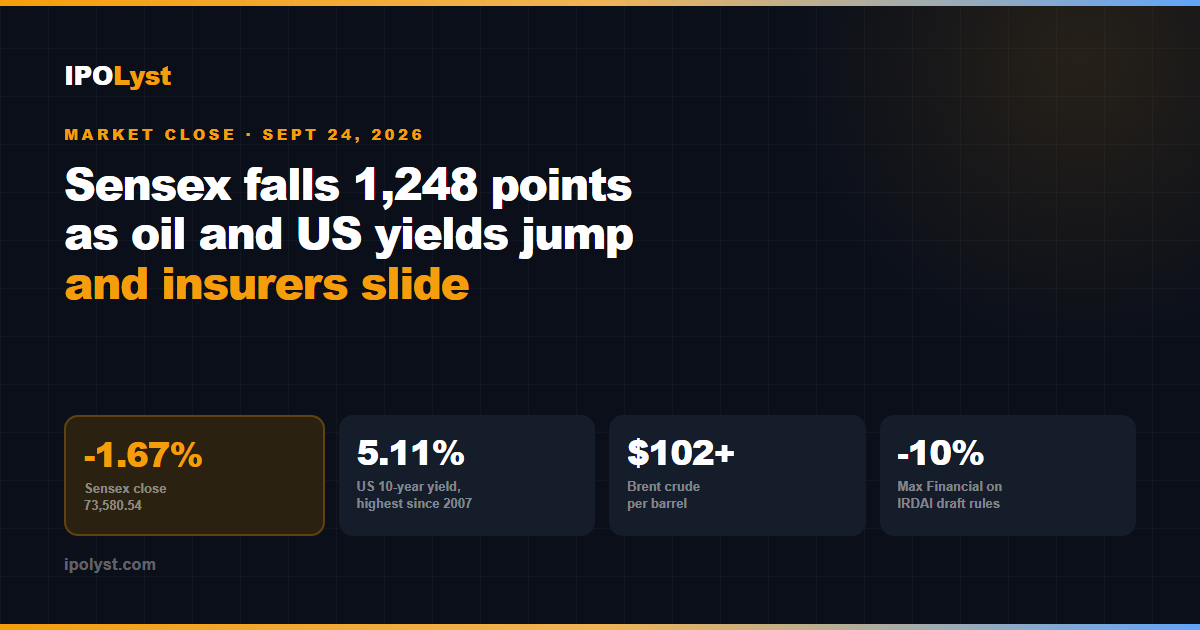
The Sensex fell 1,247.71 points, or 1.67%, to close at 73,580.54 on September 24, 2026, and the Nifty 50 lost 383.70 points to end at 23,063.10. Four things hit the market together: US bond yields at their highest since 2007, Brent crude above $102 a barrel, a draft rule from the insurance regulator that hammered insurers and financial stocks, and a slide in Reliance Industries. Here is what each one did, based on the reports we could verify.
What Happened at the Close
- Sensex: down 1,247.71 points (1.67%) to 73,580.54, after gaining 299 points a day earlier.
- Nifty 50: down 383.70 points (1.64%) to 23,063.10.
- The Sensex closed below the 74,003.82 level of September 15, the day of our earlier report on its fifth straight weekly fall.
- Breadth was weak in the morning: 745 stocks advancing against 1,872 declining on the NSE.
- The rupee weakened by 14 paise to 95.87 against the US dollar during the session.
Reason 1: US Bond Yields Jumped
The US 10-year Treasury yield rose to 5.106%, its highest since 2007, according to LatestLY's market report. The 2-year yield crossed 4.9%, the highest since May 2024. Overnight, the Nasdaq fell 1.1% to 26,936, which set a weak tone before India opened.
Traders in Fed funds futures were assigning a 66% probability of another rate hike in October. That follows the 25 basis point hike on September 16 that took the Fed's target range to 3.75% to 4.00%, when 16 of 18 policymakers projected at least one more hike.
The usual channel is simple. Higher US yields make US bonds more attractive compared with Indian assets, which can pull foreign money away from emerging markets and weigh on the rupee. Our earlier report on the Fed rate hike and the India market reaction explains why the hike itself was already priced in and why the next signals matter more.
Reason 2: Crude Oil Above $102
Brent crude traded above $102 a barrel. Fortune had it at $102.03 at 10 a.m. ET on September 23, up $2.76 from the day before, and India TV reported it still above $102 when Indian markets opened on September 24. LatestLY attributed the rise to continued differences between Iran and the US. Fortune's page did not state a specific cause for the move, so we are not adding one.
India imports most of the crude oil it uses, so a higher oil price tends to widen the import bill and put pressure on the rupee and on inflation. That is why oil and the rupee often move against Indian stocks on the same day.
Brent had been near $108 in mid-September, a four-month high, as we described in why the Sensex kept falling for a fifth week. Today's level is lower than that peak but still high.
Reason 3: The Insurance Regulator's Draft Rules
This was the domestic trigger that pure global-cue explanations miss. India's insurance regulator, IRDAI, put out a consultation paper proposing deep cuts to how much insurers can spend and pay distributors. It is a draft, not a final rule, and the paper's comment deadline was not stated in the report we reviewed.
- Life insurers would have to bring their expenses of management down to 15% of gross direct premium in two years and 12.5% in five years, from about 30% now.
- General insurers would have to reach 20% in five years.
- Commissions on health renewals and porting would drop to 5% for distribution entities and 10% for agents.
- Single premium credit life commissions would be capped at 2%.
- Mandatory bundling of insurance with loan products would be prohibited.
BusinessToday reported the falls: Max Financial Services down 10%, ICICI Prudential Life down 7.62%, HDFC Life down 6.75%, Star Health down 2.33% and SBI Life down 1.86%, while LIC was flat. Business Standard's headline said insurance-related stocks slid by up to 20%, with PB Fintech among the hardest hit. We did not use a single figure for PB Fintech because reports differed.
Brokerages split the impact unevenly. Emkay Global said the drastic cut in distribution commission could make insurance distribution unviable, and that HDFC Bank, Max Financial and ICICI Prudential would need to restructure how they distribute. Bernstein said SBI Life and LIC were relatively better placed because of lower costs and a higher mix of agency and ULIP business. Financial stocks led the losses on the day, and Bajaj Finance was among the biggest Sensex losers, down 3.08% in early trade. We have not seen a report that directly ties Bajaj Finance's fall to the IRDAI draft, so we treat that as a separate data point.
Reason 4: Reliance Industries Slipped
Business Standard reported that Reliance Industries fell about 2% to a 17-month low of ₹1,226.10 on the BSE, citing comments from credit rating agencies about its risk profile. The same report said the stock is down 22% in 2026, compared with a 13% fall in the Sensex. Reliance is the most valuable company in India by market cap, so its moves weigh heavily on the index.
Foreign Investors Were Not the Story on September 23
Some reports on the fall mention persistent foreign selling. The verified exchange data we found for the day before showed the opposite: foreign institutional investors bought ₹1,617.45 Cr of Indian stocks on September 23, and domestic institutions bought ₹2,341.46 Cr. That data is from the previous session, not September 24, so it does not tell us what foreign investors did during today's fall. Choice Broking's Hitesh Tailor said before the open that the near-term tone was likely to turn defensive.
What This Means for IPO Watchers
The IPO market opened this week with the Sensex already weak. NSE's own shares debuted on BSE on September 24 and settled at ₹1,817, according to Upstox, about 1.8% above the ₹1,785 issue price by our calculation, even as the index fell 1.67%. Elevate Campuses, Moneyview and Runwal Enterprises are all in their bidding windows.
A weak market matters for IPOs because listing-day demand and grey market premiums tend to follow overall market mood. We tracked that in IPO GMP is crashing across the board, and you can follow every open issue and its live premium on the IPO GMP tracker. None of this tells you whether a specific IPO is worth applying to.
For the dates, price bands and lot sizes of the issues open now, see our roundup of the seven mainboard IPOs opening September 22 to 24, and for how India's biggest IPOs have listed in the past, see do mega IPOs give big listing gains.
What to Watch Next
- Whether the US 10-year yield holds above 5.1% or falls back.
- Brent crude, and whether the Iran and US differences ease or widen.
- The rupee against the ₹96 mark, after closing near ₹95.87 during the session.
- Feedback on IRDAI's consultation paper and whether the proposals change before they become final.
Market figures were checked against India TV's September 24 market report, LatestLY's explainer on why the market fell, BusinessToday's report on the IRDAI proposal, Fortune's oil price page and Business Standard's market close report.
Frequently Asked Questions
Why did the Sensex fall on September 24, 2026?
The Sensex fell 1,247.71 points, or 1.67%, to 73,580.54. Reports point to several causes at once: the US 10-year yield rising to 5.106%, Brent crude above $102 a barrel, IRDAI's draft insurance commission and expense caps hitting insurers and financials, and a fall in Reliance Industries to a 17-month low.
Did the IRDAI insurance proposal cause the market fall?
It was one of the causes, not the only one. The draft hit insurance stocks hard, with Max Financial down 10% and ICICI Prudential Life down 7.62%, and financials led the market's losses. US yields and oil also weighed on the whole market that day. The IRDAI paper is a consultation draft, not a final rule.
What is the US 10-year yield and why does it affect Indian stocks?
It is the interest rate the US government pays to borrow for ten years. When it rises, US bonds become more attractive compared with Indian assets, which can pull foreign money out of emerging markets and weaken the rupee. On September 24, 2026, it rose to 5.106%, the highest since 2007.
Disclaimer: This article is for informational and educational purposes only and does not constitute financial or investment advice. IPOLyst is not a SEBI-registered investment advisor. Market data, regulatory proposals and price levels can change quickly. Please verify figures with official sources and consult a registered advisor before making investment decisions.